


Finding the right shoe size across countries can feel surprisingly confusing. A number that looks familiar in Mexico may not mean exactly the same thing in the United States, and that little difference can turn a comfortable pair into a shoe you never want to wear again. Understanding women’s shoe size conversion makes online shopping and international purchases much easier.
If you are trying to convert a Mexico shoe size into a US shoe size, the first thing to know is that there is not always one universal Mexican sizing formula. Different brands can use different measurements, lasts, and manufacturing standards. So, while a conversion chart is a useful starting point, measuring the actual foot is often the smarter move.
Understanding Mexico Shoe Size to US Conversion

The phrase Mexican shoe size to US usually refers to comparing the number printed on shoes sold in Mexico with the corresponding size in the American market. The challenge is that Mexico does not simply use an identical version of the US shoe sizing system.
In many Mexican sizing systems, the number is closely related to foot length, while US women’s sizes follow a different numerical scale. This means that a Mexican size cannot always be converted by simply adding or subtracting one number. Weird little sizing mysteries, unfortunately, are part of buying shoes internationally.
A Mexico women’s shoe size chart can help provide an approximate comparison, but always check the specific retailer or brand before purchasing.
Here are some useful terms to understand:
- Mexico shoe size refers to the sizing designation commonly used by footwear sellers in Mexico.
- US shoe size refers to the numerical sizing system used for women’s footwear in the United States.
- Mexican shoe size can vary slightly depending on the brand and manufacturing standards.
- Shoe size conversion means comparing one country’s sizing system with another.
- International shoe sizes are not perfectly standardized.
- A size conversion chart provides an approximate shoe size equivalent, rather than a guarantee of fit.
Women’s Mexican Shoe Size Conversion
When looking at women’s Mexican shoe size conversion, foot length is usually more useful than the printed number alone. If you know the measurement of your foot in centimeters, you have a much better starting point for finding an equivalent US women’s size.
For example, suppose a retailer lists a Mexican women’s size alongside a centimeter measurement. Instead of relying only on the number, compare that measurement with a US women’s shoe size chart from the same manufacturer.
A simple conversion process looks like this:
- Find the Mexican women’s shoe size listed by the seller.
- Check whether the seller provides centimeters or millimeters.
- Measure your actual foot length from heel to the longest toe.
- Compare the measurement with the brand’s women’s shoe size chart.
- Check the recommended US women’s shoe size.
- Review the brand’s width information before ordering.
This approach is more dependable because two shoes carrying supposedly equivalent sizes may have slightly different internal dimensions.
Why Foot Length Matters
Your foot doesn’t care what number is printed on the box. It cares whether there is enough room for your toes, whether the heel stays secure, and whether the shoe accommodates your natural foot shape.
A proper heel-to-toe length measurement can therefore be more useful than memorizing international size equivalents. Measure both feet because one foot is often slightly longer than the other, and use the larger measurement when choosing your size.
Mexico Shoe Size Chart Women: What to Check
A Mexico shoe size chart women shoppers use should ideally include more than just country-to-country numbers. A useful chart may show foot length, inches, centimeters, and corresponding US, EU, and UK sizes.
When reviewing a chart, look for:
- Mexican size
- US women’s shoe size
- EU women’s shoe size
- UK women’s shoe size
- Heel-to-toe length in inches
- Heel-to-toe length in centimeters
- Recommended shoe width
- Brand-specific fitting notes
Charts can look wonderfully precise, but shoe sizing isn’t quite that tidy in real life. A manufacturer may use a different shoe last mold, different materials, or slightly different manufacturing tolerances.
How to Measure Your Foot for an Accurate US Size

If you want a more reliable shoe size measurement, measuring your feet at home is one of the easiest things you can do.
Place a sheet of paper on a hard floor and stand naturally on it while wearing the type of socks you normally use with the shoes. Keep your weight distributed normally, rather than sitting down.
Trace around the foot or mark the heel and the longest toe. Measure the distance between those two points.
For better results:
- Measure both feet.
- Measure at the end of the day.
- Keep your heel positioned naturally.
- Record the measurement in centimeters and inches.
- Use the longer foot when comparing sizes.
- Measure your shoe width if the manufacturer provides width options.
Your foot length is not exactly the same thing as the internal shoe length. Shoes need some extra space for movement, and the amount of space depends on the shoe style and construction.
The Role of the Brannock Device
Professional shoe stores may use a Brannock device to estimate shoe size. This instrument measures several aspects of the foot, including length and width, making it more informative than simply placing your foot against a ruler.
A Brannock device measurement can be especially useful when you are unsure whether you need a standard, narrow, or wide shoe.
Still, even professional measurements do not remove every sizing difference. Your preferred fit, the shoe design, and the manufacturer’s construction all matter.
Why the Same Size Can Fit Differently
One of the strangest things about buying footwear is that the same numerical size can feel completely different between two pairs.
This happens because a shoe manufacturer may use different shoe lasts during production. A shoe last is essentially the mold around which a shoe is constructed. Different lasts create different shapes around the toes, heel, instep, and sides.
Other factors include:
- Foot shape
- Shoe width
- Toe box dimensions
- Instep height
- Heel construction
- Upper design
- Materials used
- Manufacturing tolerances
- Intended shoe style
A leather loafer, running shoe, ballet flat, and high heel can all technically have the same size while fitting your foot in very different ways.
Shoe Width Is Just as Important as Length
Length gets most of the attention, but shoe width can completely change how comfortable a shoe feels.
Someone with narrow feet may feel their foot sliding inside a standard-width shoe. Someone with wide feet may feel pressure around the sides or toes even when the length is technically correct.
If you have narrow feet, look for brands offering narrow-width options. If you have wide feet, consider wider constructions or shoes with a more generous toe box.
People with a high instep may also need more volume through the upper portion of the shoe. A size increase isn’t always the best solution because making the shoe longer can create excessive space at the heel.
Toe Box and Foot Shape Matter
The shape of your toes is another overlooked part of shoe fit. Some shoes have a rounded toe box, while others are pointed, square, or anatomically shaped.
A shoe can have sufficient heel-to-toe length but still feel too tight because the toe box doesn’t match your foot.
Pay attention to:
- Toe box width
- Toe box height
- Forefoot shape
- Instep height
- Heel width
- Arch position
Your ideal shoe size by foot length is only one piece of the fitting puzzle.
Mexican Shoe Size to American Size: Why Charts Differ
Searching for Mexican shoe size to American size conversion often produces several charts that don’t completely agree. This doesn’t necessarily mean one chart is automatically wrong.
Different charts may be based on different assumptions, brands, or measurement standards. Some may convert using nominal size numbers, while others use actual foot length.
The safest method is to treat a Mexican size conversion chart as a guide, then verify the centimeter measurement with the seller.
This is particularly important when purchasing expensive footwear online. Returning an incorrectly sized pair can be a lot more annoying than spending two extra minutes measuring your feet.
US, EU, and UK Women’s Shoe Sizes
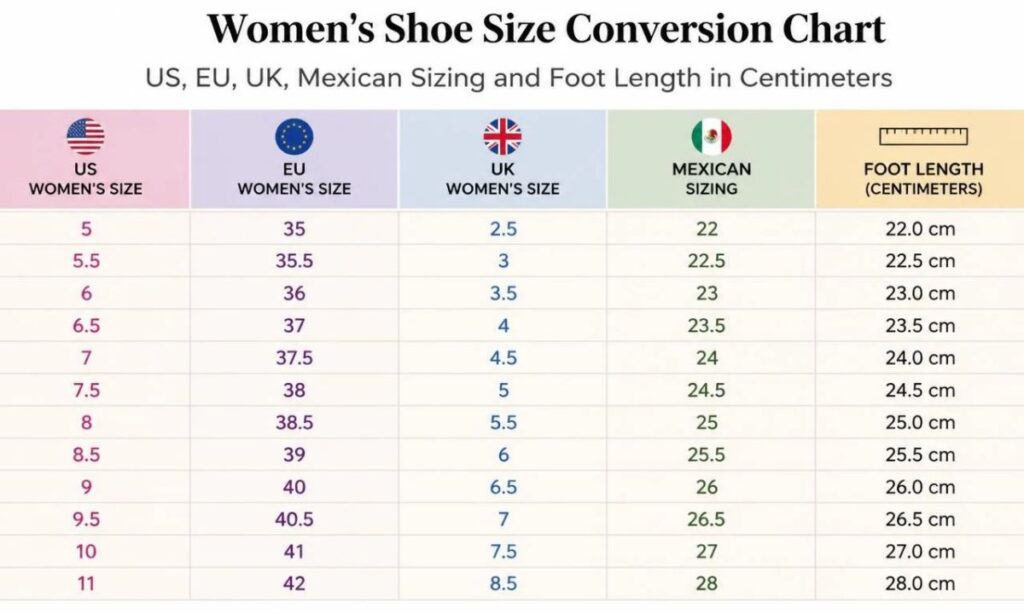
International shopping becomes even more complicated when a retailer provides multiple sizing systems.
A product might list:
- US women’s shoe size
- EU women’s shoe size
- UK women’s shoe size
- Mexican sizing
- Foot length in centimeters
These systems are related, but they are not interchangeable number-for-number.
For example, an EU shoe size does not follow the same numerical scale as a US size, and a UK shoe size uses another scale again. That is why a proper women’s shoe size conversion chart is useful.
When possible, compare the actual foot measurement instead of jumping between three different numerical systems.
What Is a Barleycorn in Shoe Sizing?
You may occasionally encounter the term barleycorn when reading about traditional shoe sizing.
A barleycorn is a historical unit associated with shoe-size scales. Traditional British sizing systems have been described in terms of barleycorn increments, with three barleycorns traditionally corresponding to one inch.
You don’t need to calculate barleycorns when ordering modern shoes, thankfully. Today’s shoppers can rely on published size charts and centimeter measurements without doing historical footwear mathematics.
Shoe Materials Can Change the Fit
The materials used to construct a shoe influence how it feels after wearing it.
A leather upper may soften and conform to the foot over time. Mesh material tends to offer more flexibility and airflow, while stretch material can accommodate certain foot shapes more easily.
Consider these differences:
- Leather may become more flexible with wear.
- Mesh can provide a more forgiving upper.
- Stretch fabrics can adapt around the forefoot.
- Structured synthetic materials may retain their original shape.
- Thick shoe lining can change the amount of interior space.
However, don’t assume a tight shoe will magically become the perfect size after breaking in. Material flexibility cannot compensate for a fundamentally incorrect size.
Shoe Style Can Change the Recommended Size
Your shoe style can influence how a particular size feels.
Running shoes often provide extra toe space because feet can swell during activity. High heels may position the foot differently inside the shoe. Boots can have thicker linings or additional room for socks.
Even sandals can behave differently because straps determine how securely the foot is held.
So, when comparing a Mexican size with a US size, consider what kind of shoe you’re buying rather than treating every style as identical.
Shoe Sizing Differences Between Brands
A shoe brand may use its own lasts and fitting philosophy. That’s why people sometimes wear one size in sneakers and another size in dress shoes.
A few factors behind shoe size differences by brand include:
- Different lasts
- Different toe shapes
- Different manufacturing tolerances
- Different upper materials
- Different lining thickness
- Different width standards
- Different quality-control processes
The manufacturing process also matters. Even within the same model, tiny production differences can occur because materials and construction are not perfectly identical every single time.
How to Compare a Mexican Size With a US Size
If you’re looking at a pair of shoes sold in Mexico and want the American equivalent, use this simple process.
First, identify the Mexican size shown by the seller. Then locate the manufacturer’s conversion chart, if available. Look for a corresponding measurement in centimeters.
Next, compare that measurement with your own heel-to-toe measurement.
Finally, check width and fitting notes before making your purchase.
This method is much safer than assuming that every Mexican size has one fixed American equivalent.
Men’s and Women’s Shoe Sizing Are Different

Don’t accidentally use a men’s shoe size chart when you’re shopping for women’s footwear. Men’s and women’s scales are different, and the width conventions can differ too.
For reference, retailers may separately provide:
- US men’s shoe size
- EU men’s shoe size
- UK men’s shoe size
- US women’s shoe size
- EU women’s shoe size
- UK women’s shoe size
A women’s size chart should be your primary reference when converting women’s shoe size Mexico to USA.
If a retailer only gives men’s sizing, don’t guess the conversion without checking that retailer’s own chart.
A Simple Shoe Size Comparison Checklist
Before ordering internationally, keep this little checklist nearby:
- Confirm the country sizing system.
- Identify whether the chart is for men’s or women’s shoes.
- Measure both feet.
- Record foot length in centimeters.
- Check shoe width.
- Look for the manufacturer’s own conversion information.
- Compare the shoe size equivalent using measurements.
- Read customer reviews for fitting information.
- Check the return policy.
That last point is boring but important. International returns can sometimes cost more than the shoes themselves, so knowing the retailer’s policy before clicking purchase is smart.
Why There Is No Perfect International Shoe Size Conversion
The idea of one universal shoe sizing system sounds convenient, but footwear is influenced by much more than numerical scales.
Different countries developed different sizing traditions. Different manufacturers developed different lasts. Different materials behave differently. Human feet also vary enormously.
That means US and EU sizing differences, US and UK sizing differences, and Mexican-to-US comparisons should be treated as practical estimates rather than scientific constants.
The most reliable information is usually the combination of a brand’s size chart and your actual foot measurements.
Tips for Buying Mexican Shoes Online
Shopping for Mexican women’s shoe sizes online becomes easier when you slow down before ordering.
Look for product pages that provide measurements rather than only size numbers. If the seller gives a centimeter measurement, compare it with your measured foot.
Also check whether the shoe is intended to have a snug, standard, or roomy fit.
Some useful questions to ask the seller include:
- Is the listed size Mexican or US?
- What is the internal length?
- Is the shoe standard, narrow, or wide?
- Does the material stretch?
- Does the model run small or large?
- Is the measurement based on the foot or the shoe?
That last question matters because shoe measurement and foot measurement aren’t necessarily identical.
Explore More Blog : Foot Girth
Frequently Asked Questions
How to Convert Women’s Shoe Size Mexico to US
Learn how Mexican women’s shoe sizes compare with US sizes using a simple conversion chart and foot-length measurements.
Mexico Women’s Shoe Size Chart
Use a Mexico women’s shoe size chart to compare Mexican, US, EU, and UK sizes for a more accurate fit.
How to Measure Your Foot for US Shoe Size
Measure your heel-to-toe length in inches or centimeters and compare it with the manufacturer’s women’s shoe size chart.
Tips for Choosing the Right US Women’s Shoe Size
Consider foot width, toe box, shoe brand, and materials because sizing can vary between manufacturers and shoe styles.
Conclusion
Converting a women’s shoe size Mexico to US is easier when you stop thinking of the size number as the whole story. A number is only a label; your actual foot length, width, shape, and the construction of the shoe determine whether it feels right.
Use a Mexico women’s shoe size chart or shoe size conversion chart as your starting point, but whenever possible, verify the size using heel-to-toe measurements in centimeters or inches.
Remember that a shoe’s shoe last, toe box, materials, width, and construction can all influence the final fit. The same nominal size may feel surprisingly different between manufacturers, and that’s perfectly normal.
For international purchases, the winning strategy is simple: measure your feet, check the manufacturer’s chart, compare measurements, and consider the shoe’s shape and width before ordering. It takes a little extra effort, but your feet will probably appreciate the tiny bit of detective work.
