


Have you ever put on a pair of shoes that seems perfect in length, yet the sides feel strangely tight? Maybe your toes feel cramped, your little toe gets squeezed, or the shoe leaves marks around the widest part of your foot. If that sounds familiar, you may have wondered, “Do I have wide feet?” It’s a very common question, and the answer is not always as obvious as looking at your feet.
Your foot width can affect comfort just as much as your shoe size. Two people can wear the same US shoe size but need completely different widths. One person may feel comfortable in a standard shoe, while another needs wide shoes or even an extra-wide option.
The good news is that you don’t need complicated equipment to investigate your shoe width. With a piece of paper, a pencil, and a ruler or measuring tape, you can take a useful foot measurement at home. A shoe width chart can then help you understand where your measurement falls.
Do I Have Wide Feet? Signs to Look For
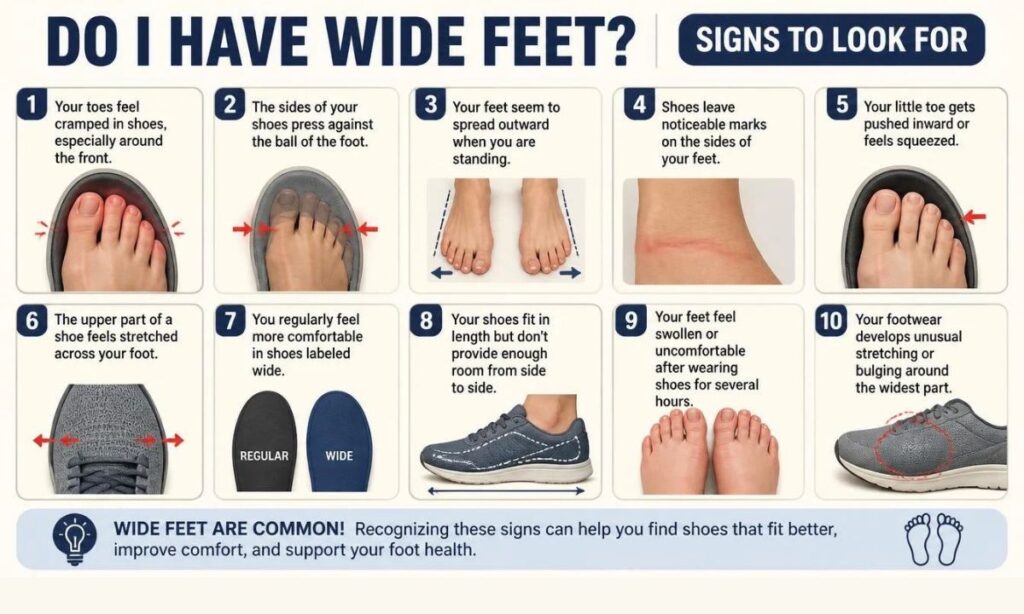
The first clue is often your experience inside your shoes. If your shoes are long enough but consistently feel tight around the sides, your feet may need more width rather than more length. This little distinction is important, because buying a longer shoe doesn’t necessarily solve a width problem.
Here are some common signs that can make you wonder, do I have wide feet?
- Your toes feel cramped in shoes, especially around the front.
- The sides of your shoes press against the ball of the foot.
- Your feet seem to spread outward when you are standing.
- Shoes leave noticeable marks on the sides of your feet.
- Your little toe gets pushed inward or feels squeezed.
- The upper part of a shoe feels stretched across your foot.
- You regularly feel more comfortable in shoes labeled wide.
- Your shoes fit in length but don’t provide enough room from side to side.
- Your feet feel swollen or uncomfortable after wearing shoes for several hours.
- Your footwear develops unusual stretching or bulging around the widest part.
These signs don’t automatically prove that you have wide feet. Shoe shape, materials, toe-box design, and even the particular manufacturer shoe width can make a big difference. A shoe with a narrow toe box can feel tight even when your feet aren’t technically wide.
How to Tell If You Have Wide Feet at Home
One of the easiest ways to learn how to know if your feet are wide is to measure them while standing. Your foot spreads slightly under body weight, so a standing measurement is generally more useful than measuring while sitting.
You can follow these basic foot measurement instructions:
- Place a sheet of paper on a hard, flat floor.
- Put your foot flat on the paper while standing normally.
- Trace around the foot carefully with a pencil held upright.
- Repeat the process for the other foot.
- Use a ruler to measure the widest part of each tracing.
- Record the foot width in inches or centimeters.
- Measure both the left foot and right foot.
- Use the larger foot measurement when selecting footwear.
The widest section is usually around the ball of the foot, rather than across the toes. Don’t pull your toes together or squeeze your foot during the process. Your goal is to capture your natural foot shape, not make the foot look narrower.
For an even more direct measurement, you can stand normally while someone measures across the widest part of your foot with a measuring tape. This can be easier than tracing, though a tracing can be helpful when you want to compare length and width.
Foot Width Measurement: What Does It Actually Tell You?
A shoe width measurement tells you how much horizontal space your foot needs. It works together with your shoe size, because width requirements change as shoe size changes.
For example, a particular width measurement might be considered standard at one shoe size but not another. That’s why simply saying, “My foot is 4 inches wide,” isn’t always enough to determine your correct shoe width.
This is where a foot width chart or shoe width chart by size becomes useful. These charts generally compare foot measurements with different width categories, although exact measurements vary among manufacturers.
Your US shoe size, gender sizing system, and footwear brand can all influence the recommendation. In other words, there isn’t one universal measurement that magically identifies every wide foot.
Understanding a Shoe Width Chart
A shoe width chart typically uses letters to describe how narrow or wide a shoe is. The exact meaning can vary between brands, which is one reason checking the manufacturer’s chart is worth doing.
Common width designations include:
- AAAA / 4A – very narrow width
- AAA / 3A – exceptionally narrow width
- AA / 2A – narrow width in many women’s sizing systems
- A width – narrow or slim width depending on the brand
- B width – commonly a standard women’s width
- C width – sometimes used for slightly wider or intermediate widths
- D width – commonly a standard men’s width
- E width – wide in many sizing systems
- EE / 2E – often a wider men’s option
- EEE / 3E – extra-wide in some brands
- EEEE / 4E – commonly used for extra-wide men’s footwear
- 5E, 6E, 8E, 10E, 12E, and 14E – increasingly wider options offered by some manufacturers
These labels can look a little like alphabet soup at first, honestly. But they become much easier once you understand that the letter generally indicates width rather than length.
What Does Wide Width Mean in Shoes?
So, what does wide width mean in shoes? Simply put, a wide shoe provides more space across the foot than the corresponding standard-width shoe.
A wide width doesn’t necessarily mean the shoe is dramatically bigger everywhere. Ideally, it gives additional room in the areas where your foot needs it, particularly around the forefoot and ball of the foot.
This distinction matters because some people mistakenly buy a longer shoe when they really need a wider one. A shoe that is too long may cause the heel to slip while still squeezing the sides. That’s not exactly a recipe for a happy walk.
Medium vs Wide Shoes
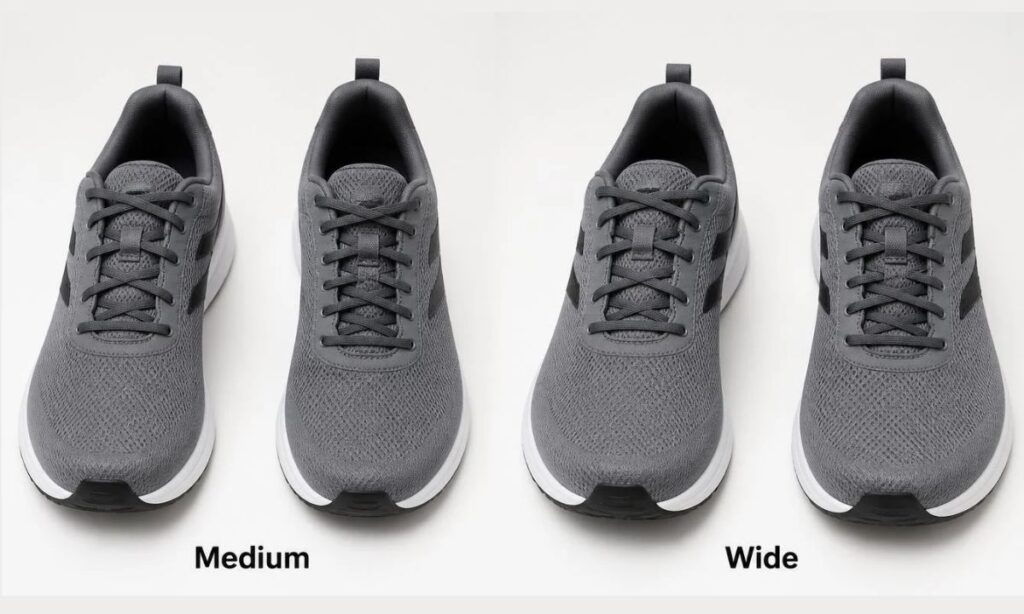
The difference between medium shoe width and wide footwear can be surprisingly noticeable. A medium shoe is designed around a standard width for its particular size and sizing system. A wide shoe provides additional lateral space.
If your foot fits comfortably from heel to toe but feels squeezed from side to side, moving to a wider width may be more appropriate than increasing your shoe size.
A proper shoe fit should allow your foot to sit naturally without excessive pressure. Your toes should have enough room to move, and the shoe shouldn’t pinch the sides of your foot when you’re standing or walking.
Narrow vs Wide Feet
Understanding narrow vs wide feet is useful because width isn’t simply a matter of whether your feet “look big.” Someone with a relatively long foot can still have a narrow width, while someone with a shorter foot may require wide footwear.
Possible signs of a narrow fit problem can include excessive side-to-side movement, a shoe that feels loose across the forefoot, or the need to tighten laces unusually much to keep the foot secure.
By contrast, wide feet symptoms often involve pressure at the sides, cramped toes, stretched uppers, and discomfort around the forefoot.
Still, don’t diagnose your foot width based on symptoms alone. Measuring and comparing your results with the relevant women’s width chart or men’s width chart gives you a more useful starting point.
Women’s Shoe Width and Men’s Shoe Width
Women’s shoe width and men’s shoe width use different conventions in many US sizing systems. This can make width letters confusing when you’re comparing footwear.
For example, B width shoes are commonly associated with standard women’s width, while D width shoes are commonly associated with standard men’s width. But these conventions are not universal across every manufacturer.
Women’s sizing may commonly include categories such as:
- Women’s narrow
- Women’s standard or medium
- Women’s wide
- Women’s extra wide
Men’s footwear may commonly include:
- Men’s narrow
- Men’s standard or medium
- Men’s wide
- Men’s extra wide
Always check the individual brand’s US sizing information before assuming a letter means exactly the same thing everywhere.
Shoe Width Letters Explained
If you’ve ever wondered about shoe width letter meaning, you’re definitely not alone. Width letters are essentially a shorthand for how much space the shoe provides across the foot.
The basic idea looks something like this:
Narrow → Medium/Standard → Wide → Extra Wide
However, the exact letter assigned to each category can change depending on whether you’re looking at men’s or women’s footwear and which manufacturer produced the shoe.
For example, D width shoes are commonly standard for men’s shoes, while D width can indicate a wider women’s option in some sizing systems. Similarly, E width, EE width, and 4E shoe width generally indicate progressively wider options in many men’s shoe ranges.
That is why width should always be interpreted alongside the shoe’s sizing chart rather than treated as a universal code.
Wide vs Extra Wide Shoes
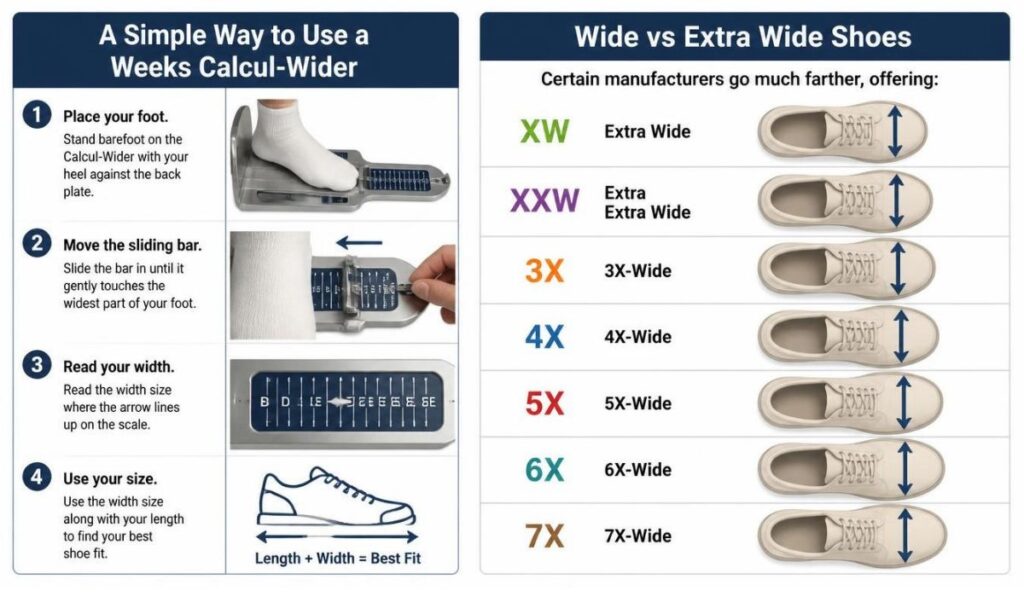
If standard wide footwear still feels restrictive, you may need to investigate wide vs extra wide shoes more closely.
A wide shoe gives additional room compared with a standard shoe, while an Extra Wide (XW) or similar designation gives even more space. Some brands use terms such as 2E, 3E, 4E, or other E-width combinations instead.
Certain manufacturers go much farther, offering:
- Extra Wide (XW)
- Extra Extra Wide (XXW)
- 3X-Wide
- 4X-Wide
- 5X-Wide
- 6X-Wide
- 7X-Wide
Not every brand offers these sizes, of course. Width naming can get wonderfully complicated for something that is supposed to make walking comfortable.
How to Measure Foot Width for Wide Shoes
If you’re specifically trying to learn how to measure feet for wide shoes, repeat the measurement process carefully and consistently.
Measure both feet while standing, ideally later in the day. Feet can expand somewhat during normal daily activity, so a later-in-the-day measurement may give a more practical representation of the space your shoes need.
Wear the type of shoe socks you normally wear when taking your measurement if you’re measuring inside a shoe or evaluating a particular footwear setup.
Pay attention to:
- The widest part of the foot
- The ball of foot
- The overall foot length
- The left-to-right differences between feet
- Any areas affected by swelling
- Your normal standing posture
Don’t pull the measuring tape too tightly. You want the measurement of your foot, not a compressed version of it.
When Foot Swelling Changes Your Shoe Width
Your feet aren’t necessarily the exact same size throughout the day. Foot swelling can make footwear feel tighter, especially after standing, walking, exercising, or spending long hours on your feet.
Conditions such as edema can also increase foot volume. In these circumstances, a shoe that feels perfect early in the morning may become uncomfortable later.
Some people also have foot-shape changes associated with bunions or hammertoes, which can make the forefoot require additional room. People with diabetes-related foot concerns should be especially careful about pressure and footwear fit and should follow advice from their healthcare professional.
If swelling or foot changes are significant or persistent, measuring your feet alone isn’t a substitute for professional guidance.
Shoe Width Calculator: Can It Help?
A shoe width calculator can provide a convenient starting point for estimating your width. Usually, you’ll enter information such as your shoe size and measured foot width, and the tool compares those values with a sizing database or chart.
A calculator can be handy, but don’t treat the result as an absolute rule. Shoe construction differs between manufacturers, and even two models from the same company can fit differently.
Think of a shoe width calculator as a helpful assistant rather than the final judge. Your actual foot fit and comfort still matter.
Shoe Width by Size Is Not Universal
One tricky part of shoe width by size is that width isn’t independent of length. A width measurement should generally be interpreted alongside the corresponding shoe size.
This means there isn’t a single universal standard shoe width measurement that applies to every person and every shoe. Manufacturers use their own lasts, materials, construction methods, and sizing standards.
Two shoes marked the same US size and width can therefore feel somewhat different. Strange, yes, but shoes have their own personalities sometimes.
What Shoe Width Do I Need?
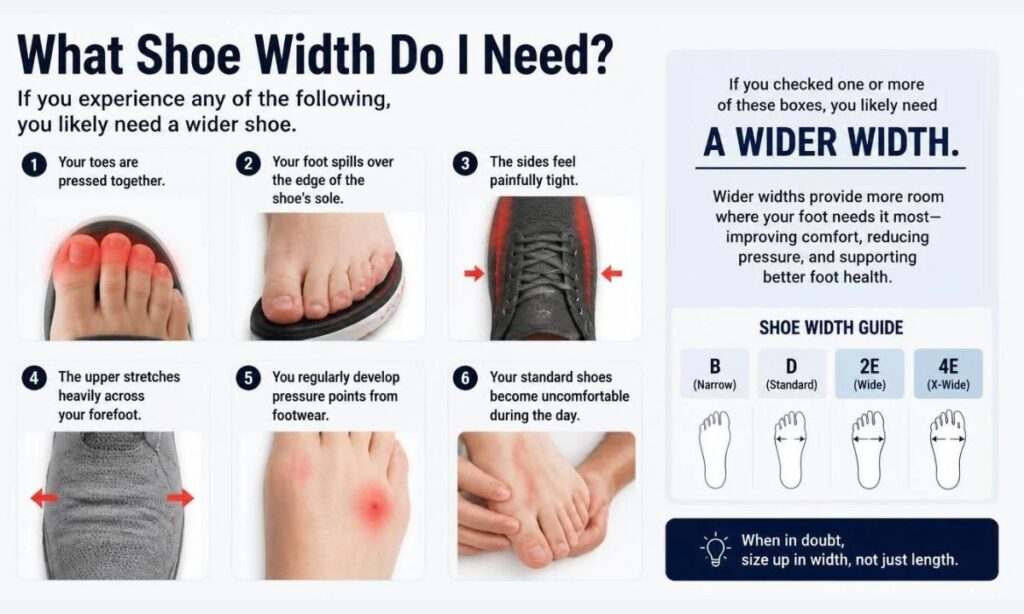
If you’re asking what shoe width do I need, start with three things: your shoe size, your measured foot width, and the manufacturer’s sizing chart.
Then consider how the shoe actually feels when you’re standing and walking.
You may need a wider option if:
- Your toes are pressed together.
- Your foot spills over the edge of the shoe’s sole.
- The sides feel painfully tight.
- The upper stretches heavily across your forefoot.
- You regularly develop pressure points from footwear.
- Your standard shoes become uncomfortable during the day.
On the other hand, don’t automatically choose a wide shoe simply because your feet feel uncomfortable. The problem could be the shoe’s shape, inadequate depth, poor length, or an unsuitable toe box.
Foot Shape and Toe Box Matter Too
A person’s foot shape can be just as important as width. Some feet are broad primarily around the ball, while others have a wider overall forefoot or a distinctive toe arrangement.
A wider toe box can sometimes improve comfort without requiring the entire shoe to be dramatically wider. Likewise, extra depth shoes may help when the issue is vertical space rather than horizontal width.
For people using orthotics, an AFO brace, compression socks, or a custom orthotic, the required shoe space can change further. In some cases, shoes with removable depth layers provide useful extra room.
Choosing the Right Shoe Width
Choosing the right width isn’t only about finding the widest shoe possible. The goal is a comfortable fit that supports your foot without squeezing it or allowing excessive movement.
When trying footwear, check that:
- Your heel stays reasonably secure.
- Your toes have comfortable space.
- The sides don’t pinch.
- Your foot doesn’t spill over the sole.
- The upper isn’t painfully stretched.
- You can walk naturally.
- The shoe doesn’t create pressure points.
A proper shoe fitting for wide feet should consider both length and width. A shoe can technically have enough width and still fit poorly if the shape doesn’t match your foot.
What If Wide Shoes Still Feel Tight?
Sometimes the answer isn’t simply “go wider.” A person may need additional extra depth, a different toe-box shape, or a completely different shoe model.
For example, someone with a bunion might benefit from a shoe designed to accommodate that particular area rather than simply moving into an extremely wide size.
Likewise, someone using orthotics may need a shoe with removable insoles and additional internal volume. This is where understanding your individual foot shape becomes especially helpful.
A Simple Wide Foot Measurement Checklist
Before buying your next pair, keep this little wide foot measurement checklist nearby:
- Measure both feet.
- Measure while standing.
- Measure the widest part of each foot.
- Record your foot width in inches or centimeters.
- Note your regular US shoe size.
- Compare your result with the brand’s shoe width chart.
- Check whether the brand uses B, D, E, EE, 2E, 4E, or another width system.
- Consider your foot shape and toe-box needs.
- Try shoes later in the day if your feet tend to swell.
- Choose comfort and proper fit rather than relying only on the printed size.
It takes only a few minutes, but it can save you from another pair of shoes that looked lovely online and felt like tiny traps once you actually wore them.
Explore More Blog : Men Size 7
Frequently Asked Questions
How Do I Know If I Have Wide Feet?
Measure the widest part of both feet while standing and compare the results with a shoe width chart.
What Are the Signs of Wide Feet?
Tight sides, cramped toes, stretched shoe uppers, and frequent pressure around the forefoot can indicate wide feet.
How Do I Measure My Foot Width?
Trace your foot on paper, then use a ruler to measure across the widest part, usually around the ball of the foot.
What Shoe Width Is Best for Wide Feet?
Wide or extra-wide shoes may provide better comfort, but always check the brand’s width chart for the most accurate fit.
Conclusion
So, do I have wide feet? You can get much closer to the answer by measuring both feet while standing and comparing the results with the appropriate shoe width chart. Look at your shoe size and width together rather than treating them as separate numbers.
Remember that foot width, shoe construction, brand sizing, foot shape, swelling, and toe-box design can all affect how footwear feels. A width label is useful, but your actual comfort is an important part of finding a proper shoe fit.
If standard shoes repeatedly squeeze the sides of your feet, if your toes feel cramped, or if you consistently need more room around the forefoot, exploring wide shoes or extra wide shoes may be worthwhile. But the best choice depends on your measurements and the specific shoe.
Your feet carry you through ordinary mornings, long days, unexpected adventures, and all those little walks nobody remembers. They deserve shoes that give them enough room to do their job comfortably.
