


Finding the right pair of shoes can feel surprisingly difficult. You may know your usual shoe size, yet the shoes still pinch your toes, squeeze the sides of your feet, or leave you wondering why one brand feels perfect while another feels unbearably tight. Often, the missing piece isn’t length at all. It is foot width.
If you have ever thought, “How do I know if I have wide feet?” you are certainly not alone. Feet come in many shapes, and two people who wear the same shoe size can need completely different widths. Your foot shape, the ball of the foot, toe box, and even how much your feet swell during the day can change the way shoes fit.
The good news is that you don’t have to guess forever. With a simple foot measurement, a piece of paper, and a ruler, you can get a much clearer idea of whether you need a standard, wide, or extra-wide shoe.
How to Tell If You Have Wide Feet
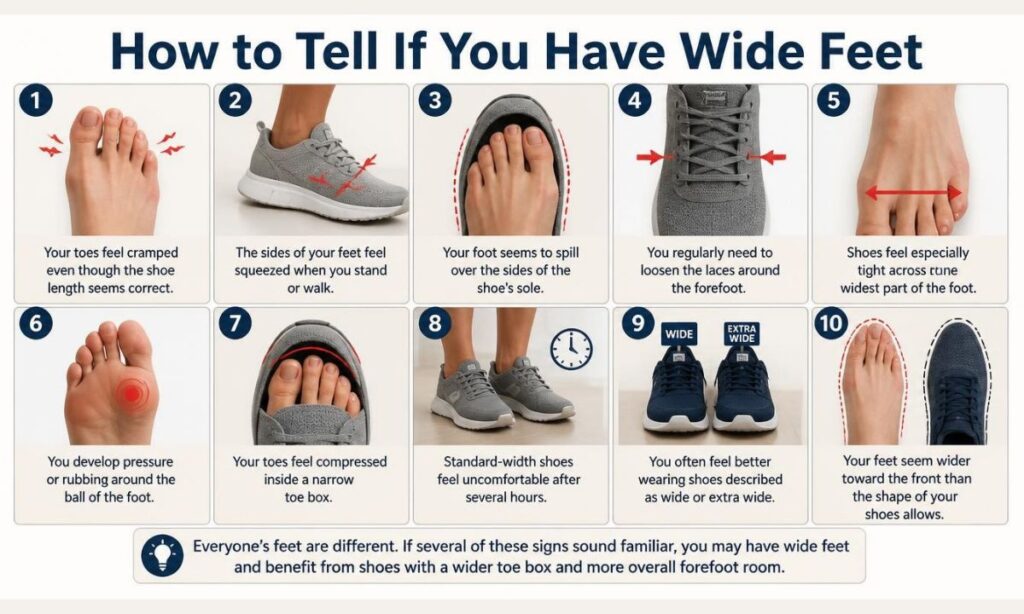
The easiest way to learn how to know if you have wide feet is to look at both your shoe fit and your actual measurements. A shoe that feels tight does not automatically mean you have wide feet; sometimes the shoe is simply too short, poorly shaped, or made with a narrow shoe last.
There are several common clues that can point toward wide feet:
- Your toes feel cramped even though the shoe length seems correct.
- The sides of your feet feel squeezed when you stand or walk.
- Your foot seems to spill over the sides of the shoe’s sole.
- You regularly need to loosen the laces around the forefoot.
- Shoes feel especially tight across the widest part of the foot.
- You develop pressure or rubbing around the ball of the foot.
- Your toes feel compressed inside a narrow toe box.
- Standard-width shoes feel uncomfortable after several hours.
- You often feel better wearing shoes described as wide or extra wide.
- Your feet seem wider toward the front than the shape of your shoes allows.
None of these signs alone proves that your feet are wide. Still, when several happen together, they are a pretty useful signal that your current shoe width may not be giving your feet enough space.
How to Measure Foot Width at Home
Learning how to measure wide feet is much more reliable than judging them only by appearance. You can perform a basic shoe width measurement at home using ordinary household items.
For a useful measurement, you need:
- A sheet of paper
- A pencil
- A ruler
- A measuring tape, if available
- The socks you normally wear with your shoes
- A flat floor
Place the paper on a hard, level surface. Put your foot flat on the paper while standing normally. Have someone trace around your foot if possible, because bending down can slightly change your position.
Your standing measurement matters because body weight spreads the foot differently than when you are sitting.
Trace the outline carefully, then measure across the widest area of the foot. This is generally around the ball of the foot, rather than near the toes or heel. Record the measurement in inches or centimeters.
Repeat the process with the other foot. Don’t assume both feet are exactly the same size; it is very common for one foot to be slightly longer or wider. For shoe sizing, use the larger foot measurement when choosing footwear.
Use the Foot Tracing Method for Better Accuracy
A foot tracing or paper tracing is one of the simplest ways to understand your foot shape. It is not a perfect replacement for professional fitting, but it gives you useful information when you’re measuring foot width at home.
Stand naturally on the paper with your full weight distributed over the foot. Keep your toes relaxed rather than curling them, because curled toes can make the tracing smaller than your actual foot.
Mark the widest points on both sides of the forefoot. Measure the straight-line distance between those points with a ruler. You can also use a measuring tape, although a ruler often makes the straight width easier to read.
Try to measure feet later in the day if your feet tend to swell. Feet can become slightly larger after walking, standing, exercising, or spending many hours upright. If your shoes become uncomfortable by evening, this detail is especially important.
The goal isn’t to produce a magical number that works for every shoe brand. Instead, you’re building an accurate picture of your foot so you can compare it with a shoe width chart or the manufacturer’s sizing information.
What Is Considered a Wide Foot?

So, what is considered a wide foot? There isn’t one universal measurement that says every foot above a certain number is wide.
This is where shoe sizing gets a little messy. Width depends on both foot length and width. A width that is considered broad for a smaller shoe size might be relatively ordinary for a larger size.
Different shoe manufacturers also use different lasts and width standards. A “wide” shoe from one brand may not feel identical to a wide shoe from another brand. There is no completely universal shoe width standard that makes every manufacturer’s sizing interchangeable.
A useful approach is to compare your measured width with the specific brand’s brand-specific width guide. Look at your US shoe size and then compare your measured width with the manufacturer’s recommendations.
This is why searching only for “wide feet measurement” can sometimes be confusing. The same number can mean something different depending on the shoe size and sizing system being used.
Understanding Shoe Width Letters
Once you know your approximate foot width, the next challenge is understanding shoe width letters.
Width labels commonly include categories such as:
- N – Narrow
- B – commonly a standard women’s width
- M – Medium or standard in many men’s shoes
- D – commonly a standard men’s width
- W – Wide
- E – Wide in some sizing systems
- EE or 2E – Extra wide
- 3E or EEE – Extra wide
- 4E – Very wide or extra wide
- XW – Extra Wide
But don’t assume the letters mean exactly the same thing for every brand. For example, women’s B width is often considered medium, while men’s D width is commonly considered medium. In another manufacturer’s system, the terminology or available options may differ.
You may also encounter extremely broad categories such as 5E, 6E, 8E, 10E, 12E, or 14E in specialty footwear. Some brands offer even more width choices, while others provide only standard and wide.
The important lesson is simple: check the manufacturer’s width definitions before buying.
Women’s Shoe Width: What Does Wide Mean?
Women’s shoe width often uses a different lettering convention from men’s footwear. A typical women’s width system may include:
- 4A or AAAA – Extremely narrow
- 2A or AA – Narrow
- B – Medium or standard
- D – Wide
- 2E or EE – Extra wide
- 4E – Very wide
Some manufacturers may use S, N, M, W, or XW rather than letters such as B and D.
This can make online shopping a bit confusing. A woman who normally wears a B-width shoe might need a D-width shoe in another brand, while another manufacturer could label a similar fit as W.
Don’t rely only on the letter. Compare your foot width measurement, shoe size, and the brand’s chart together.
Men’s Shoe Width: Understanding D, E, and EE

The men’s shoe width system is generally different from women’s sizing.
In many men’s shoes:
- B may indicate a narrow width.
- D commonly represents medium or standard width.
- E is generally wide.
- EE or 2E is extra wide.
- 3E or 4E may indicate progressively wider options.
- Some specialty brands go as far as 6E, 8E, 10E, 12E, or 14E.
This is why searches such as shoe width D vs EE are common. The difference isn’t simply about making the entire shoe longer. Width changes the amount of room around the forefoot and other parts of the shoe.
If your foot is comfortable in length but squeezed across the sides, moving to a wider width may be more appropriate than buying a longer shoe.
Signs You Need Wide Shoes
Sometimes your feet tell you what the measurement chart hasn’t quite explained yet.
There are several signs you need wide shoes that are worth paying attention to:
- Your shoes feel tight across the forefoot.
- Your toes cannot spread naturally.
- You notice pressure around existing bunions.
- Your little toe rubs against the side of the shoe.
- You frequently remove your shoes because your feet hurt.
- Your foot hangs over the edge of the outsole.
- You get red pressure marks after wearing shoes.
- Laces seem unusually tight even when the heel fits.
- A larger shoe size fixes the width problem but leaves too much room in front.
That last sign is particularly useful. If going up a full shoe size gives your toes more side-to-side room but leaves excessive space in front, the real problem may be width rather than length.
Wide Feet vs. Normal Feet vs. Narrow Feet
A standard foot width isn’t necessarily better than a wide or narrow foot. Width is simply one part of your individual foot anatomy.
A narrow foot may move around inside a wide shoe, while a wide foot can feel restricted inside a narrow shoe. Neither situation creates a proper shoe fit.
Think about the entire fit:
Length: Your toes should have appropriate space without your foot sliding excessively.
Width: The sides of your foot shouldn’t feel squeezed or forced outward.
Toe box: Your toes should have enough room to sit naturally.
Heel: The shoe should hold the heel securely without painful pressure.
Depth: Some feet need additional vertical room, not just extra width.
This last point is easy to overlook. Someone with bunions, hammertoes, swelling, or certain foot conditions may need extra depth as well as a wider shoe.
Wide Feet and Foot Conditions
Some people need wider footwear because of the natural shape of their feet, while others experience changes related to specific conditions.
For example, bunions can make the front of the foot wider. Hammertoes may require more space in the toe box. Edema can cause temporary or persistent swelling, changing the amount of room needed inside a shoe.
People using orthotics, an AFO brace, or a custom orthotic may also need shoes with additional depth and removable insoles.
In some cases, extra depth shoes or shoes with removable depth layers provide a better solution than simply choosing a wider size. If you have diabetes-related foot concerns or another significant foot condition, professional footwear advice can be particularly valuable.
Comfort is not something you should have to “break in” through serious pain.
How Shoe Manufacturers Affect Width
One frustrating fact about footwear is that your foot doesn’t change dramatically every time you buy a different brand, but the shoe can feel completely different.
That’s because every shoe manufacturer may use a different shoe last, materials, construction method, and width standard.
A size 9 wide from one company might feel narrower than a size 9 wide from another. Even two shoes from the same company can fit differently because athletic shoes, dress shoes, boots, and casual footwear may use different shapes.
So when shopping, look for the brand-specific width guide instead of assuming that your usual width will always transfer perfectly.
Your previous shoes are a useful reference, but they aren’t a universal measuring instrument.
How to Find Your Shoe Width
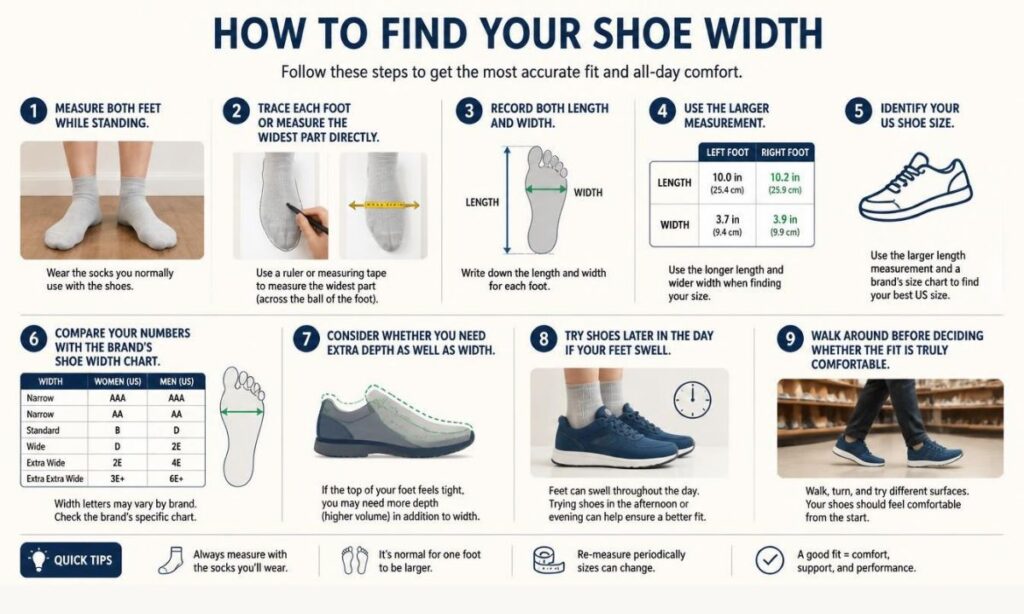
If you’re wondering how to find your shoe width, use this simple process:
- Measure both feet while standing.
- Wear the socks you normally use with the shoes.
- Trace each foot or measure the widest part directly.
- Record both length and width.
- Use the larger measurement.
- Identify your US shoe size.
- Compare your numbers with the brand’s shoe width chart.
- Consider whether you need extra depth as well as width.
- Try shoes later in the day if your feet swell.
- Walk around before deciding whether the fit is truly comfortable.
A shoe width calculator can also be helpful when it is based on the correct shoe size and a reliable measurement. But calculators should be treated as guides, not absolute rules.
Choosing the Right Wide Shoe
Once you’ve determined that you probably need a wide fit, don’t simply buy the widest shoe available.
Start with the smallest width that gives your foot enough comfortable space. A shoe that is excessively wide can allow your foot to slide around, which may create rubbing and instability.
Look for a wide shoe with a naturally shaped toe box, appropriate depth, supportive construction, and enough room around the ball of the foot.
If you’re between two widths, some manufacturers recommend selecting the wider option. However, the right decision depends on the actual shoe, your foot shape, and how securely the heel fits.
A comfortable fit should feel supportive rather than restrictive.
When to Use a Shoe Width Chart
A shoe width chart or foot width chart is especially useful when shopping online.
Charts generally connect shoe length, shoe size, and width measurements. You might see separate information for:
- Women’s shoe width
- Men’s shoe width
- Narrow widths
- Medium widths
- Wide widths
- Extra-wide widths
- US sizing
- Inches
- Centimeters
Remember that charts are estimates. The manufacturer’s recommendations should take priority because width variation exists across brands.
If your measured width falls between categories, don’t panic. That doesn’t mean your feet are strange. It simply means your particular foot may need a shoe with a different shape or construction.
How to Improve Shoe Fit for Wide Feet
If your feet are wide, there are several practical ways to improve shoe fit.
Choose shoes with adjustable laces or straps when possible. These allow you to create more room around the forefoot without making the entire shoe loose.
Look for a rounded or naturally shaped toe box instead of a sharply tapered design. Flexible uppers can also accommodate some foot shapes better than rigid materials.
If you use compression socks, remember that they can change how much space you need inside the shoe. Swelling can also change throughout the day, so footwear that feels perfect in the morning might become uncomfortable later.
For persistent problems, a qualified professional can help evaluate your foot measurement, gait, and footwear needs.
Frequently Asked Questions
How Can I Tell If I Have Wide Feet?
If your shoes feel tight around the sides or your toes feel cramped, you may have wide feet. Measuring your foot width can confirm it more accurately.
How Do I Measure My Foot Width?
Trace your foot on paper while standing and measure the widest part, usually around the ball of your foot. Compare the measurement with a shoe width chart.
What Are the Signs of Wide Feet?
Common signs include pressure on the sides of your feet, toes rubbing against the shoe, and needing to loosen your laces for extra room.
What Shoe Width Is Best for Wide Feet?
Wide or extra-wide shoes may provide a more comfortable fit. Always check the brand’s width guide because sizing can vary between manufacturers.
Conclusion
Learning how to know if you have wide feet doesn’t require complicated equipment. Start by paying attention to how your shoes feel, then confirm what you’re experiencing with an accurate foot width measurement.
Measure both feet while standing, focus on the widest part of the forefoot, and compare the result with the appropriate shoe width chart for your shoe size and brand. Remember that width labels such as B, D, E, EE, and 4E can mean different things depending on whether you’re looking at men’s or women’s footwear and which manufacturer made the shoe.
Most importantly, don’t force your feet into shoes simply because the length is correct. A proper shoe should give your toes and forefoot enough room to function naturally while still holding your heel securely.
Your feet carry you through thousands of steps, errands, workdays, walks, and all those ordinary little adventures nobody writes down. Giving them the right amount of space is a small decision, but honestly, your feet may thank you for it every single day.
