

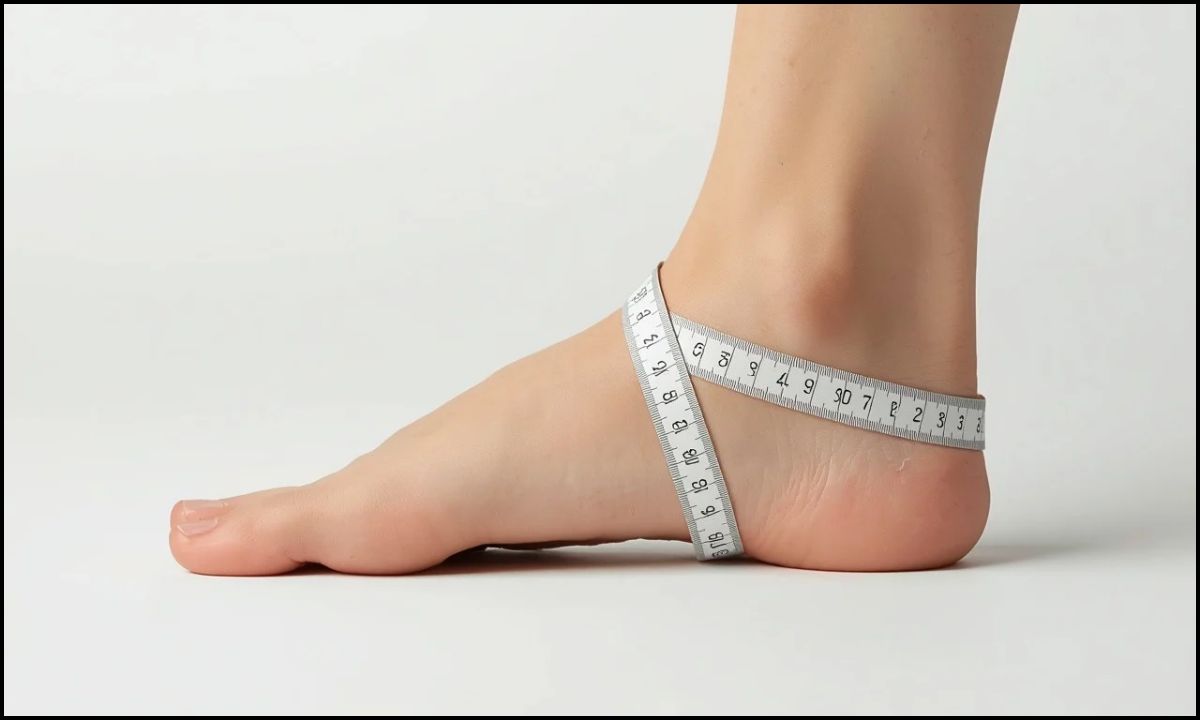
Buying shoes by length alone can feel a little like guessing the size of a suitcase from its color. A shoe may match your heel-to-toe measurement perfectly, yet still feel tight across the middle of your foot. That is where foot girth becomes important.
Foot girth describes the circumference around the foot at a specific area, commonly around the instep or the ball of the foot. It can provide useful information about how much volume a shoe needs, especially when ordinary shoe size and shoe width measurements do not fully explain why a pair feels uncomfortable.
When you understand foot measurement, foot length, foot width, and girth together, choosing footwear becomes much less mysterious. A comfortable shoe should not merely be long enough; it should provide enough room around your foot without allowing excessive movement either.
This guide explains what foot girth means, how to measure it at home, how it relates to shoe sizing, and when you may need footwear with additional depth or volume.
What Is Foot Girth?

In simple terms, foot girth is a measurement around part of the foot, rather than across or along it. Think of wrapping a measuring tape around your foot at a particular location and recording the circumference. That measurement is different from the foot length or foot width.
The exact location used for girth can vary depending on the purpose of the measurement. In footwear fitting, the instep girth is particularly useful because it indicates the amount of volume around the upper and middle portion of the foot.
A person’s feet can have similar length and width but noticeably different girth. One foot might have a relatively low instep while another has a higher instep. Both people could technically wear the same numerical shoe size, but they may need very different shoe shapes.
This is why shoe sizing is not always as simple as reading one number from a chart. The shape and volume of your foot matter too.
Why Foot Girth Matters for Shoe Fit
Imagine putting on a shoe that has enough room from your heel to your longest toe, but the upper presses firmly against the top of your foot. The shoe isn’t necessarily too short. It may simply lack enough volume.
That is one reason foot girth for shoes can be useful.
Girth can help explain several common fitting experiences:
- The shoe feels tight over the top of the foot.
- Laces seem unusually difficult to close comfortably.
- The upper leaves pressure marks around the instep.
- Your toes have enough space, but the middle of the foot feels cramped.
- A wider shoe does not solve the problem because the issue is vertical volume rather than horizontal width.
- You need footwear with additional depth to accommodate your foot shape.
A good shoe fit involves more than one measurement. Foot length, width measurement, and girth can work together to give a more complete picture.
Foot Girth vs. Foot Width
These two measurements are easy to confuse, but they describe different things.
Foot width is generally measured across the widest part of foot, often around the ball area. Girth is a circumference measurement that goes around the foot.
You can picture it this way:
- Length measurement: heel to longest toe.
- Width measurement: side to side across the broadest portion.
- Girth measurement: around the foot at a specified location.
So, a person can have a relatively narrow width of foot but a high instep and therefore require more volume in the shoe.
Likewise, someone can have a broad foot but relatively low instep volume.
This distinction becomes especially important when deciding between different shoe width options. A wider shoe may provide more horizontal room, while an extra depth shoe can provide additional vertical and overall volume.
How to Measure Foot Girth at Home
Learning how to measure foot girth does not require a fancy machine. A flexible measuring tape, a piece of paper, a pen, and a little patience are usually enough.
It is generally best to measure while standing because your foot can expand slightly when it carries your body weight. If possible, wear the type of socks you normally use with the shoes you are planning to buy.
Follow these general steps for an at-home measurement:
- Stand naturally with your weight distributed evenly.
- Place your foot flat on the floor.
- Identify the area where the girth measurement is required.
- Wrap the flexible measuring tape around the foot.
- Keep the tape comfortably against the skin without squeezing.
- Record the measurement in inches or centimeters.
- Repeat the measurement on the other foot.
- Use the larger relevant measurement when comparing footwear dimensions.
Don’t pull the tape so tightly that it presses into the skin. That tiny bit of extra tension can make the measurement smaller than your actual foot circumference.
If you don’t have a flexible tape, you can use a strip of paper or string, mark where the ends meet, and then measure that strip with a ruler. It is a little old-school, but it works.
How to Measure Instep Girth
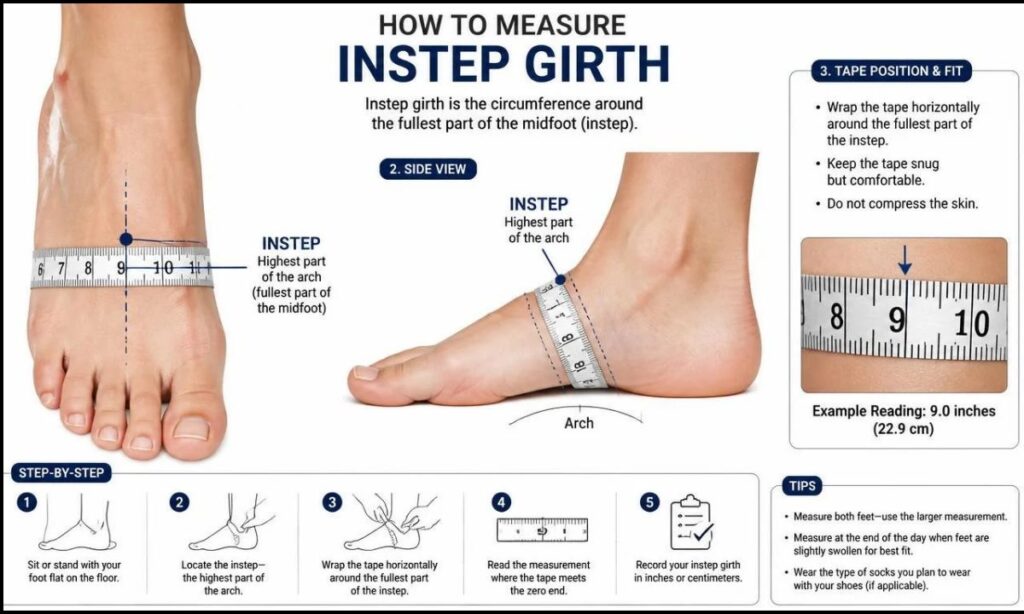
If your goal is how to measure instep girth, the process focuses on the higher portion of the foot.
The instep is the upper middle area of the foot between the ankle region and the toes. The exact measurement point can depend on the shoe-fitting system or chart being used, so follow the instructions associated with your particular foot girth chart whenever one is provided.
For a general instep measurement, stand naturally and wrap the measuring tape around the foot at the specified instep location. The tape should form a complete circle around the foot and remain level rather than twisting.
Record the instep circumference without compressing the foot.
If you’re comparing your measurement with a manufacturer’s specifications, use the same measurement method they describe. Two charts can use slightly different landmarks, which means their numbers should not automatically be treated as interchangeable.
Foot Tracing and Other Foot Measurements
Girth is only one piece of the puzzle. A reliable foot measurement chart may also require length and width.
One useful approach is the foot tracing method.
Place a sheet of paper on a hard, flat surface and stand on it. Keep your weight distributed naturally. Use a pen to trace around the outline of your foot, keeping the pen as upright as practical.
From the resulting foot outline, you can measure:
- Heel-to-toe measurement
- Width of foot
- Widest part of the foot
- Overall foot shape
For the length, measure from the back of the heel to the longest toe. Do not assume the second toe is always the longest; feet differ, and the longest toe should determine the measurement.
For width, measure across the broadest part of the tracing.
This gives you a useful combination of foot length and width, while a separate girth measurement adds information about the foot’s volume.
Understanding a Foot Girth Chart
A foot girth chart can help you compare your measurement with the specifications used by a footwear manufacturer or fitting system.
However, there isn’t one universal girth number that guarantees a particular shoe size. Shoe construction, material, brand, last shape, and style can all influence how the footwear fits.
A traditional shoe may have a different internal shape from an athletic shoe even when both are labeled with the same numerical size.
That is why a chart should be treated as a guide rather than an absolute rule.
When reviewing a chart, pay attention to:
- The measurement location.
- Whether measurements are for men’s shoes or women’s shoes.
- Whether the values refer to the foot or the shoe.
- The unit of measurement.
- The manufacturer’s sizing system.
- Available width increments.
- Available depth or volume options.
Foot Girth and Shoe Size
People often search for foot girth shoe size information because they want to determine a shoe size directly from circumference.
Unfortunately, girth by itself usually cannot determine the complete appropriate size.
A typical sizing process considers multiple measurements. Your shoe size is commonly associated with length, while your shoe width describes side-to-side dimensions. Girth can provide additional information about volume and fit.
For example, two people could both have a foot length that corresponds to the same numerical shoe size. One may have a lower instep, while the other has a significantly higher instep. The second person may need a different shoe construction even though the numerical size remains similar.
This is why shoe size by foot measurements should be approached as a combination rather than a single-number equation.
Using a Shoe Size Calculator
A shoe size calculator can make conversion easier, particularly when you have measurements in inches or centimeters.
Some calculators use:
- Foot length
- Foot width
- US shoe sizing
- UK sizing
- European sizing
- Gender-specific sizing information
A shoe size and width calculator can provide a suggested starting point, but it cannot always account for the shape of an individual shoe.
Think of the calculator as a starting map, not a GPS that knows every pothole.
Your suggested shoe size and suggested shoe width should still be checked against the manufacturer’s sizing information whenever possible.
Shoe Depth and Foot Girth

Sometimes a person thinks they need a wider shoe when the real issue is depth.
Shoe depth measurement relates to the amount of vertical space and internal volume available for the foot. This can be particularly important for people with a prominent instep or additional foot volume.
An extra depth shoe is constructed with additional internal space compared with many traditional shoes.
Some footwear is described as double depth shoe or double-depth footwear. These designs can offer substantially more room for certain foot shapes, orthotic devices, or braces.
If the problem is pressure over the top of the foot, simply increasing width may not solve it. A shoe with additional depth may be more relevant.
Extra-Depth and Double-Depth Footwear
Extra depth shoes are often designed to accommodate feet that need additional vertical space.
They may be useful in situations involving:
- Higher instep volume
- Orthotic devices
- Foot braces
- AFOs
- Swelling
- Certain foot shapes requiring additional room
- Additional in-shoe accommodations
Double-depth footwear provides another option when standard shoe volume is insufficient.
The important point is that more space is not automatically better. Shoes that are excessively roomy can allow the foot to slide, which may create friction and instability.
The goal remains proper shoe fit, not simply maximum shoe volume.
AFO Braces and Accommodating Footwear
People who wear an AFO or AFO brace may need to consider more than ordinary shoe length and width.
An AFO can occupy additional space inside the shoe, changing the volume requirements significantly. In these cases, standard footwear may feel too restrictive even when the underlying foot measurements appear normal.
AFO-friendly shoes, shoes for foot braces, and other accommodating footwear may be designed with additional depth, removable insoles, wider openings, or other features that make them easier to use with an orthotic brace.
The correct choice depends on the specific brace and the person’s foot. When an orthotic device is involved, professional fitting advice can be particularly valuable.
Measuring Both Feet Is Important
Most people don’t have perfectly identical feet. One may be slightly longer, wider, or fuller than the other.
For that reason, perform your accurate foot measurement on both feet.
You can record:
| Measurement | Left Foot | Right Foot |
|---|---|---|
| Foot length | ___ | ___ |
| Foot width | ___ | ___ |
| Foot girth | ___ | ___ |
| Instep girth | ___ | ___ |
When selecting footwear, the larger relevant measurement often deserves attention because a shoe that accommodates only the smaller foot can feel restrictive on the other one.
This is especially noticeable in structured footwear that has little flexibility.
Men’s and Women’s Shoe Sizing

Men’s shoes and women’s shoes may use different sizing conventions and width labels, so don’t automatically transfer a measurement from one system to another.
Likewise, a width label does not necessarily represent exactly the same physical width across every brand.
A person’s women’s shoe sizing may therefore produce a different numerical label than their men’s equivalent, even though the underlying foot measurements haven’t changed.
Always check the specific shoe brand and its sizing guide where possible.
Shoe Width Differences and Width Increments
Shoe width is often expressed with letters, although the meaning of a letter can vary by sizing system and gender.
The important concept is that width increments represent changes in the shoe’s overall width or volume.
If a shoe is too narrow across the ball of the foot, moving to an appropriate wider width may help. But if the main problem is pressure over the instep, changing width alone may not address the issue.
Similarly, size increments usually change length and can also alter the overall proportions of a shoe, but sizing up is not always the correct solution for a volume problem.
A proper fitting approach considers length, width, girth, depth, and the specific shoe style.
Common Mistakes When Measuring Foot Girth
Even a simple measurement can go wrong in surprisingly creative ways.
One common mistake is measuring while sitting down. Since the foot can change shape under body weight, a standing measurement may better represent how the foot occupies a shoe.
Another mistake is pulling the measuring tape too tightly. Girth is a circumference measurement, so compressing the foot can artificially reduce the result.
Other mistakes include:
- Measuring only one foot.
- Using a rigid ruler around a curved foot.
- Measuring at the wrong anatomical location.
- Comparing measurements from different methods.
- Ignoring the manufacturer’s instructions.
- Assuming every shoe brand has identical sizing.
- Treating a shoe size calculator as an exact answer.
Good measurements are useful, but good interpretation matters just as much.
How Foot Girth Affects Shoe Fit by Brand and Style
A person’s experience can change considerably from one shoe to another.
A soft athletic shoe may accommodate changes in foot volume more easily than a rigid traditional shoe. A leather dress shoe can have a very different internal shape from a running shoe.
Even within one brand, different models can fit differently.
That’s why shoe fit by brand and shoe fit by style matter when comparing footwear.
Materials also play a role. Flexible uppers may accommodate the foot differently from stiff materials. Lacing systems, toe-box construction, heel counters, and internal padding can all affect perceived comfort.
So, when your measurements suggest one thing but the shoe feels completely different, the shoe’s construction may be part of the explanation.
How to Measure Your Foot for Shoe Size
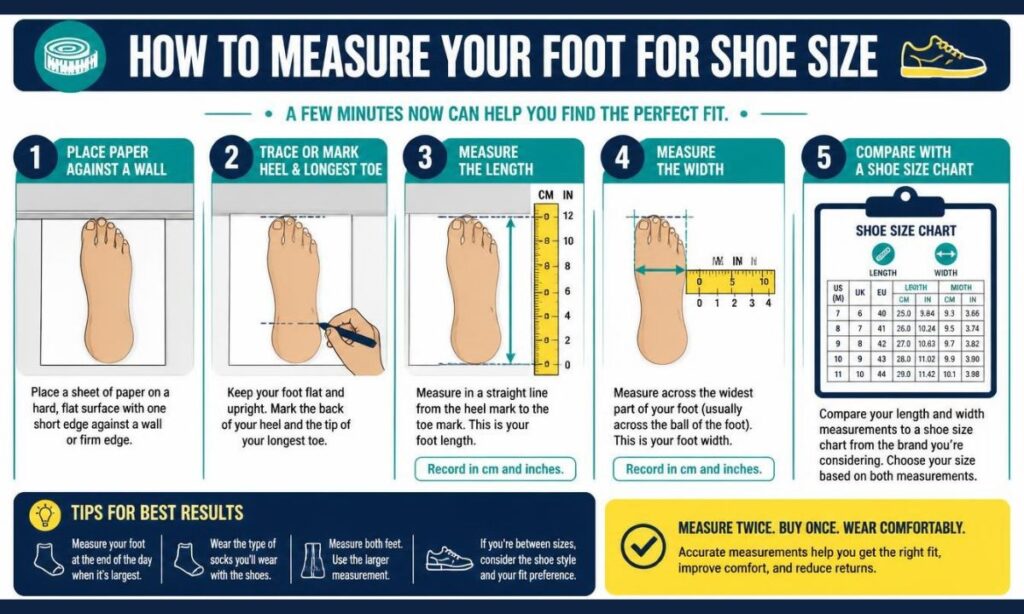
If you want to measure foot for shoe size, a practical home process combines several measurements rather than relying on girth alone.
Start with foot tracing to determine length and width. Measure from the heel to the longest toe for length. Then measure the widest section for width.
Next, take the required girth measurement using a flexible tape.
Record everything in the same unit, preferably inches or centimeters, and compare your results with the manufacturer’s shoe measurement guide.
For the most useful result, measure at the end of the day or after you’ve been standing and walking normally for some time. Feet can change slightly in volume throughout the day.
A Simple Home Measurement Checklist
Before beginning your measuring foot at home session, gather:
- Paper
- Pen
- Measuring tape
- Straight edge or ruler
- The socks you normally wear
- A flat floor
Then complete your foot sizing guide measurements:
- Trace each foot.
- Measure foot length.
- Measure foot width.
- Measure the required girth.
- Record both feet.
- Compare measurements with the shoe manufacturer’s chart.
- Consider shoe depth and construction.
- Check the final fit while standing and walking.
You don’t need to make the process complicated. Accurate measurements are mostly about consistency.
What Does a Proper Shoe Fit Feel Like?
A proper shoe fit should feel secure without creating painful pressure.
Your heel should remain reasonably stable. Your toes should have enough space to move naturally. The widest part of the foot should correspond comfortably with the shoe’s widest area.
The upper should not press aggressively against the instep.
You also want to avoid choosing a shoe that is so loose that your foot slides forward and backward with every step.
A comfortable shoe should feel supportive rather than restrictive. If you notice persistent pain, numbness, unusual pressure, or significant rubbing, the footwear may not be appropriate for your foot shape.
When to Seek Professional Shoe-Fitting Help
Home measurements are useful for shopping and comparison, but some situations deserve professional attention.
Consider getting expert assistance if you have difficulty accommodating an AFO brace, orthotic brace, significant differences between your feet, persistent footwear-related discomfort, or other special footwear requirements.
A professional can assess the relationship between foot shape, shoe construction, and any device worn inside the footwear.
The goal isn’t merely to find a number on a chart. It is to find footwear that works with the actual shape and needs of your feet.
Explore More Blog : Men Size 7
Frequently Asked Questions
What Is a Men’s Size 7?
Men’s size 7 is a common shoe size that can vary slightly in fit depending on the brand, style, and sizing system.
What Is Men’s Size 7 in UK and EU?
A US men’s size 7 generally converts to around UK 6 and EU 40, though exact conversions can vary by manufacturer.
How Long Is a Men’s Size 7 Shoe?
A men’s size 7 typically corresponds to a shoe length of about 9.6 inches, but measurements may differ between brands.
How Should Men’s Size 7 Shoes Fit?
Men’s size 7 shoes should provide enough room for the toes while keeping the heel secure without uncomfortable pressure around the foot.
Conclusion
Understanding foot girth adds an important dimension to ordinary shoe sizing. Your foot is a three-dimensional structure, while a simple shoe-size number tells only part of the story.
By combining foot length, foot width, instep girth, and other relevant foot measurements, you can make more informed footwear choices.
Remember that charts and calculators are starting points. Manufacturers use different lasts, materials, sizing systems, and construction methods, so the same labeled size can feel different from one shoe to another.
If you’re measuring at home, take your time. Trace both feet, record your dimensions carefully, and compare them with the specific brand’s information. And when a standard shoe simply doesn’t provide enough room, look beyond width alone and consider shoe depth, extra depth footwear, or other accommodating designs.
Your feet spend a surprisingly large portion of life carrying you around. Giving them a little measuring-tape attention before buying shoes is a small task, but it can make everyday footwear feel considerably more comfortable.
