

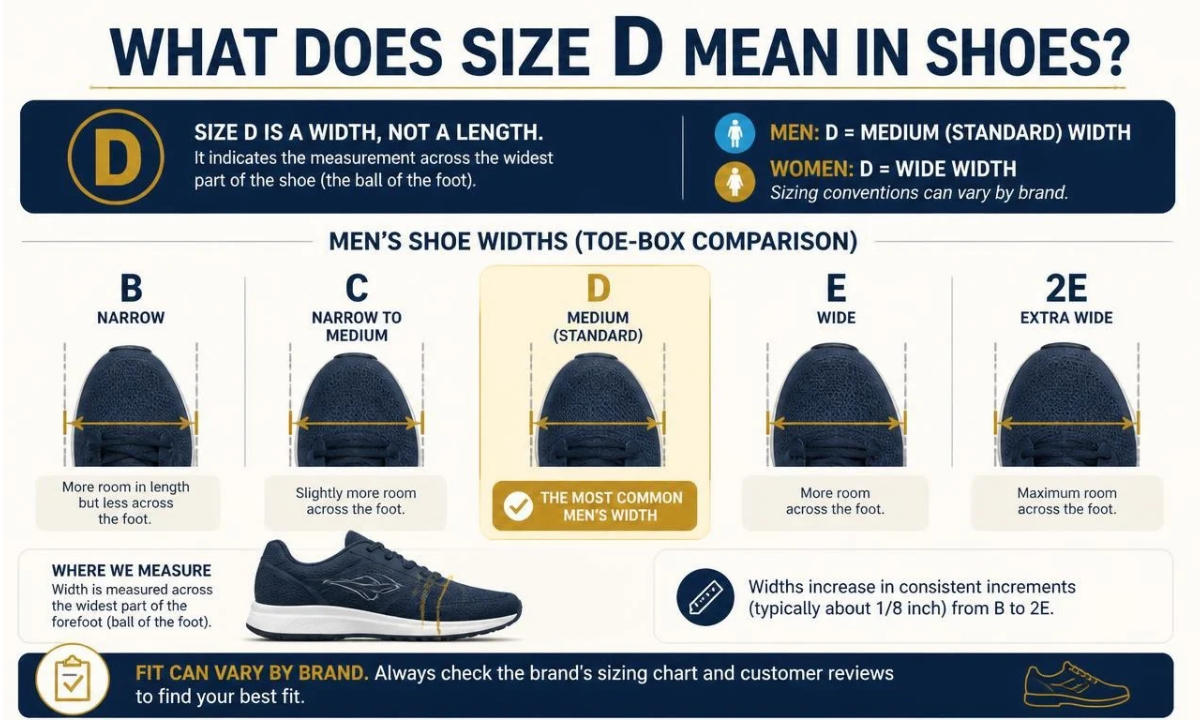
When buying shoes, the number tells you the shoe size, but the letter can be just as important. A letter such as D describes the shoe’s width, and that little detail can make the difference between a shoe that feels comfortably secure and one that feels annoyingly tight.
So, what does size D mean in shoes? In most US sizing systems, D generally means medium or standard width for men. For women, however, D commonly indicates a wide width. This difference between men’s sizing and women’s sizing is one reason shoe-width labels can be confusing at first.
A person may have the correct length but still feel pressure around the toes, ball of the foot, or sides of the foot. That’s where understanding D shoe width becomes useful. Your feet, after all, did not agree to follow a universal shoe-making rulebook, and brands can vary a bit too.
What Does Size D Mean in Shoes?
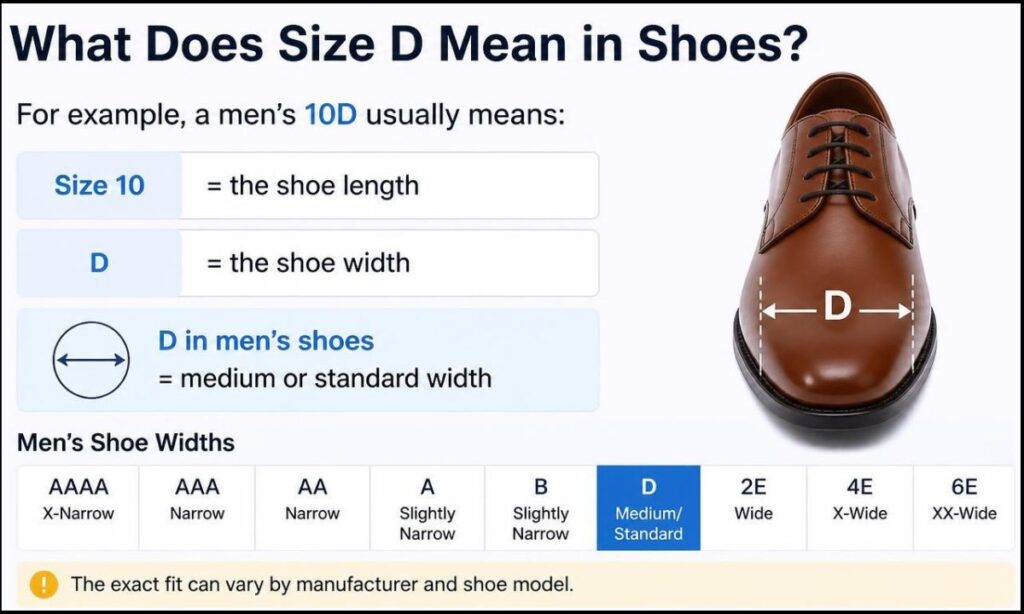
The simple answer is that D is a shoe width designation rather than a length measurement. In US men’s sizing, D width shoes are typically considered medium or standard width. In US women’s sizing, D generally represents a wide width.
This is why the same letter can mean something different depending on whether you’re looking at men’s sizing or women’s sizing. Shoe manufacturers use a shoe width lettering system to describe how much space a shoe provides across the foot.
For example, a men’s 10D usually means:
- Size 10 = the shoe length
- D = the shoe width
- D in men’s shoes = medium or standard width
- The exact fit can vary by manufacturer and shoe model
A women’s 8D, meanwhile, will commonly be interpreted as a wide-width shoe. That may surprise someone who has only looked at men’s sizing before.
The letter doesn’t mean that D is automatically the perfect width for every person. It is simply a standardized starting point, and real-world shoe fit can change depending on the shoe last, materials, construction, and brand.
What Does D Width Mean in Shoes for Men?
For men, D is generally the medium shoe width and is often considered the standard shoe width. If a men’s shoe is marked 10D, the 10 refers to the length while D describes the width.
This is the most common interpretation of men’s D width, although individual brands may have their own sizing conventions. A shoe labeled D is generally designed for an average-width men’s foot rather than an especially narrow or wide foot.
Men’s width letters commonly progress something like this:
- B — narrow
- C — slightly narrow or depending on manufacturer
- D — medium or standard
- E — wide
- EE or 2E — extra wide
- EEE or 3E — extra wide
- 4E and beyond — increasingly wider options
Because shoe sizing variation exists between manufacturers, don’t assume that every D shoe will feel identical. A D sneaker from one brand can feel noticeably different from a D work boot from another.
That little letter is useful, but it isn’t magic.
What Does D Width Mean in Shoes for Women?
For women, D generally means wide width, rather than medium. This is one of the most important things to understand when looking at women’s shoe width.
A typical women’s width system may look approximately like this:
- AAA or 3A — very narrow
- AA or 2A — narrow
- A — narrow
- B — medium or standard
- C — wide
- D — wide
- E or EE — extra wide, depending on the brand
So, if you’re asking is D a wide shoe, the answer depends on the sizing category. In women’s shoes, D is commonly wide. In men’s shoes, D is generally medium.
This is why searching only for a letter without checking the men’s or women’s category can lead to a rather confusing shopping experience. Women’s sizing and men’s sizing don’t use width letters in exactly the same way.
D Shoe Width vs. B Width
Understanding shoe width D vs B is helpful because B is commonly used for standard women’s width, while D is commonly used for standard men’s width.
For women:
- B is generally medium or standard
- D is generally wide
For men:
- B is generally narrow
- D is generally medium or standard
So a B and D are not automatically “two sizes apart” in the same way that shoe-length sizes are. Width letters describe horizontal space, while the numerical shoe size primarily describes length.
Someone wearing a women’s 8B may need an 8D if the shoe feels too restrictive around the forefoot. But simply switching widths isn’t always enough. If the shoe is also too short, a wider size won’t magically create extra length.
The best choice comes from actual foot measurement and how the shoe fits when worn.
D Shoe Width vs. E and EE
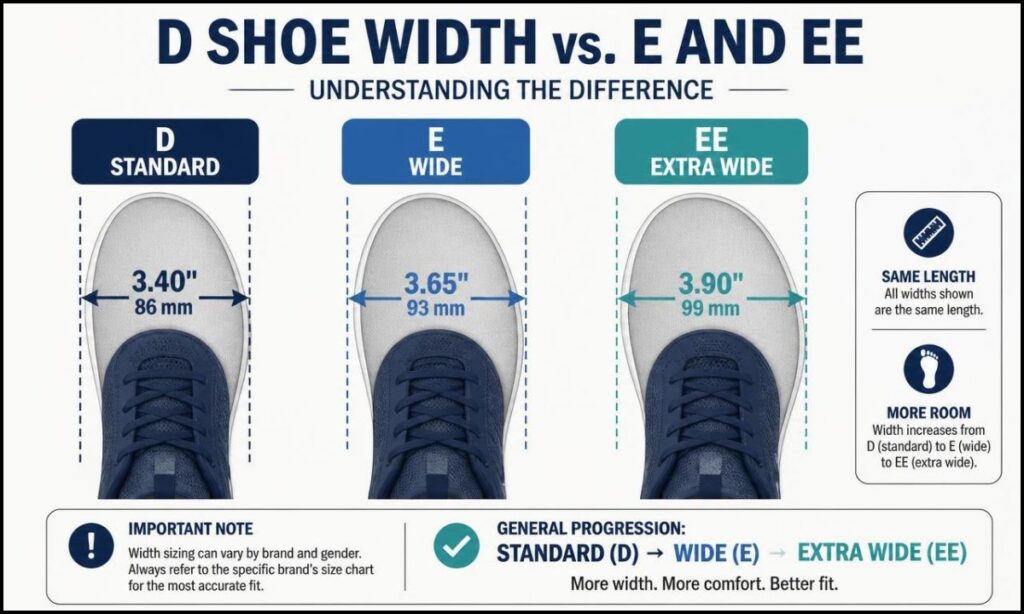
The difference between D, E, and EE is mainly the amount of width offered.
For men’s shoes, the general progression is:
D → E → EE/2E → EEE/3E → 4E
D is normally medium, E is wide, and EE or 2E is commonly extra wide.
This makes shoe width D vs E a useful comparison for anyone whose regular shoes feel tight across the forefoot. If a D shoe creates pressure around the ball of the foot, moving to an E width may provide additional room.
For even broader feet, EE width, 2E shoe width, 4E shoe width, or larger widths may be available.
Still, wider doesn’t automatically mean better. A shoe that is too wide can allow excessive foot movement, rubbing, and poor stability. The goal is a comfortable fit, not simply the maximum amount of space possible.
Shoe Width Letters Explained
The shoe width lettering system can look like alphabet soup when you first encounter it. There isn’t one universal sequence that every manufacturer follows perfectly, but common US conventions include:
| Width | Common interpretation |
|---|---|
| AAA / 3A | Very narrow |
| AA / 2A | Narrow |
| A | Narrow |
| B | Women’s medium; men’s narrow |
| C | Women’s wide |
| D | Women’s wide; men’s medium |
| E | Men’s wide |
| EE / 2E | Men’s wide or extra wide |
| EEE / 3E | Extra wide |
| 4E / EEEE | Extra wide |
| 5E–6E | Very wide / XXW |
| 7E–8E | Extremely wide |
The exact labeling can vary, especially in specialized footwear. Some manufacturers offer widths such as 5E, 6E, 10E, or even wider options.
That’s why a brand-specific width guide is worth checking before ordering. The alphabet tells you the category, but the manufacturer’s measurements tell you what that category actually means in that particular shoe.
How to Measure Your Shoe Width
If you’re wondering whether D is your correct shoe width, measuring your foot can give you a much better starting point than guessing.
You can perform a basic shoe width measurement at home with paper, a pencil, and a ruler or measuring tape. It’s surprisingly simple, though getting someone to help can make the measurement more accurate.
Place your foot flat on a sheet of paper while standing normally. Wearing the type of socks you expect to use with the shoes is useful too, because thick socks can slightly change the space your foot needs.
Mark the widest points of your foot, usually around the forefoot. Then measure the distance between those points.
For useful foot width measurement, remember:
- Measure while standing rather than sitting.
- Keep your weight naturally distributed.
- Measure the widest part of the forefoot.
- Measure both feet because they may differ slightly.
- Use the larger measurement when comparing with a sizing chart.
- Compare the result with the manufacturer’s chart.
A foot width measurement chart can then help you determine whether your foot is narrow, medium, wide, or extra wide for your particular shoe size.
Using a Shoe Width Chart or Calculator
A shoe width chart can make width sizing much easier, particularly when you’re shopping online. Many brands publish measurements based on shoe size and width.
A shoe width calculator may also estimate the appropriate width after you enter your shoe size and foot measurement. These tools are helpful, but they shouldn’t be treated as an absolute rule.
The same foot can feel different in two shoes that technically have the same width. Why? The shoe last, upper material, toe-box shape, sole construction, and overall design all affect the available space.
A sneaker with a flexible upper might feel comfortable in a D width, while a stiff leather shoe could feel restrictive at the same nominal width.
For this reason, use a calculator or shoe width chart by size as a starting point, then check the manufacturer’s information when possible.
Is D a Medium Shoe Width?
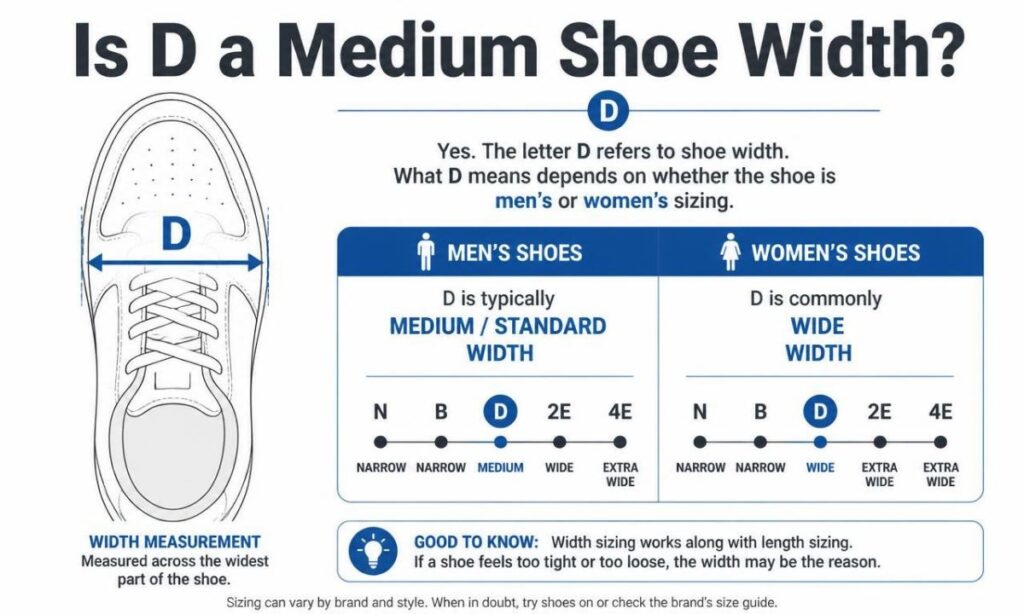
For men’s shoes, yes, D is generally a medium width and is often called the standard width.
For women’s shoes, D is generally considered wide.
That’s the short answer, but there’s a little more to it. Width isn’t determined by the letter alone because the numerical shoe size also matters. A D-width size 7 and a D-width size 12 aren’t identical in physical dimensions.
The proportions increase as shoe length increases, so width sizing is interpreted alongside the shoe’s numerical size.
This is why a person should not simply say, “I always wear D,” without considering the specific brand, shoe style, and sizing system.
Signs You May Need a Different Width
Your feet can give you plenty of clues when your shoes aren’t wide enough. Sometimes they complain quietly, other times they make the problem very obvious.
Common signs include:
- Pressure along the sides of the foot
- Toes feeling cramped together
- Red marks after removing the shoes
- Pain around the ball of the foot
- A feeling that the foot is spilling over the sole
- Bunions rubbing against the shoe
- Numbness or tingling caused by tightness
- Difficulty getting the shoe comfortably fastened
On the other hand, a shoe can also be too wide. If your heel slips significantly or your foot moves from side to side, the shoe may provide more width than you actually need.
A proper shoe fit guide should consider both length and width. One without the other is like measuring a door but ignoring its frame.
D Width and Different Foot Conditions
Width becomes especially important for people dealing with certain foot conditions. Someone with bunions, hammertoes, swelling, or other changes in foot shape may need more room in the forefoot.
Bunions, for example, can create a wider area around the base of the big toe. A conventional narrow toe box may place pressure directly over that area.
People experiencing edema or foot swelling may also find that their normal shoes become uncomfortable during parts of the day. In these situations, adjustable footwear or appropriate wider shoes may be more practical.
For people with diabetes-related foot concerns, shoe fit deserves particular attention, and professional medical or podiatric guidance may be appropriate. A shoe should not create avoidable pressure points.
Some individuals may also benefit from orthotics, a custom orthotic, an AFO brace, or extra-depth shoes. These needs can change how much interior volume a shoe requires.
Shoe Width and Shoe Depth Are Different
Width isn’t the only measurement that affects comfort. Shoe depth refers to the vertical space available inside the shoe.
A person may have enough width but still feel pressure across the top of the toes or forefoot. In that situation, simply choosing a wider D-to-E option might not solve the problem.
Extra-depth shoes provide additional vertical room and may be useful for certain foot shapes or medical devices. Some designs also have removable depth layers, allowing the wearer to create more internal space for orthotics or other inserts.
This distinction matters because a shoe can be wide enough from side to side while still being too shallow from top to bottom.
Choosing D Width Shoes for Everyday Comfort
When shopping for D width shoes, start with the size you normally wear, then consider how your foot actually behaves inside that shoe.
If you are shopping for men’s footwear, D will usually be the standard starting width. For women, a D width may provide additional room if standard B-width shoes feel restrictive.
Try shoes later in the day when feet can naturally become slightly larger. Wear the socks you normally use and walk around rather than judging the shoe while sitting down.
There should be enough room for the toes to move naturally, while the heel remains reasonably secure. The shoe should not squeeze the sides of the foot, but it shouldn’t allow the foot to slide around either.
That balance is what creates a genuinely comfortable shoe fit.
Why Shoe Manufacturers Can Differ
One of the frustrating parts of footwear shopping is that a D width isn’t perfectly identical across every company.
A shoe manufacturer may use its own last, materials, design standards, and fitting philosophy. Even two shoes from the same brand can feel different because their shapes aren’t identical.
This is why shoe width manufacturer differences are worth remembering. Your usual D-width shoe may fit beautifully in one model but feel narrower in another.
Before ordering online, check the brand-specific width guide and, when available, read information about the shoe’s toe box and intended fit.
Customer reviews can sometimes reveal whether a particular model runs narrow or wide too, though individual experiences naturally vary.
Women’s and Men’s Width Sizing Compared
The biggest source of confusion is the difference between women’s and men’s width conventions.
| Width letter | Common men’s meaning | Common women’s meaning |
|---|---|---|
| B | Narrow | Medium/standard |
| C | Slightly narrow or varies | Wide |
| D | Medium/standard | Wide |
| E | Wide | Extra wide in some systems |
| EE / 2E | Extra wide | Very wide in some systems |
| 4E | Extra wide | Specialized very-wide option |
These are general conventions rather than universal laws. A women’s shoe width chart and men’s shoe width chart from a specific brand should take priority over a generic chart when available.
This is also why converting width between men’s and women’s footwear isn’t as straightforward as converting the numerical US shoe size.
How to Find Your Correct Shoe Width
If you aren’t sure whether you need D, B, E, or another width, use a few pieces of information together.
Start with your normal shoe size, then perform a foot width measurement. Compare that result with the manufacturer’s shoe width measurement chart for your size.
Next, think about your current shoes. Are they tight around the sides? Do your toes feel crowded? Does your heel slide? Are there pressure marks?
If your feet are between widths, some brands recommend choosing the wider option for a more comfortable fit. However, this isn’t universal, so the manufacturer’s guidance is still important.
People using compression socks, orthotics, braces, or other inserts should also consider how those additions change the amount of space required inside the shoe.
Read more : Shoe Width B vs D
Frequently Asked Questions
What Does Size D Mean in Shoes for Men?
In men’s shoes, D usually means a medium or standard width, designed for average-width feet.
What Does Size D Mean in Shoes for Women?
In women’s shoes, D commonly indicates a wide width, offering more room across the forefoot than a standard B width.
Is D a Medium or Wide Shoe Width?
D is generally medium for men and wide for women, so its meaning depends on the sizing category.
How Do You Know If D Width Is Right for You?
Measure your foot width and compare it with the brand’s width chart to find a comfortable and properly fitting shoe.
Conclusion
So, what does size D mean in shoes? In the most common US sizing conventions, D means medium or standard width for men and generally wide width for women.
The numerical size tells you about length, while the letter provides information about width. Together, they give you a much clearer idea of how a shoe is intended to fit.
If you’re shopping for D width shoes, don’t stop at the letter. Measure your feet, compare both length and width, check the manufacturer’s sizing information, and pay attention to how the shoe feels around the toes and forefoot.
A good shoe shouldn’t require your feet to negotiate a peace treaty with the footwear every morning. The right width should simply let you walk, stand, and move without unnecessary pressure.
And remember, shoe width sizing explained on a generic chart is only a starting point. Your actual foot shape, the shoe design, and the brand’s measurements all matter when finding the right fit.
