

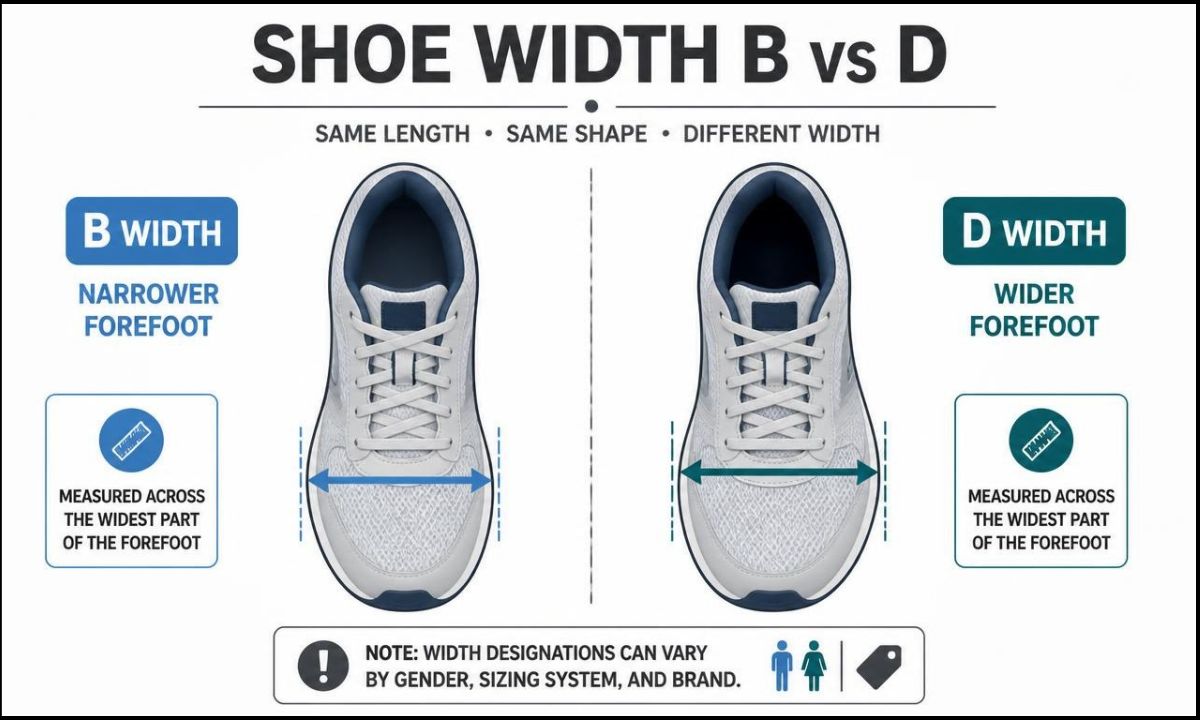
Choosing the right shoe width can be just as important as choosing the correct shoe size. A pair can have the perfect length and still feel uncomfortable if the width is wrong. This is especially true when comparing Shoe width B vs D, because the meaning of each letter changes depending on whether you are looking at men’s or women’s footwear.
The B width and D width sit in different places on the width spectrum, and the difference can affect how your toes, the ball of the foot, and the sides of your feet feel inside the shoe. A shoe that looks fine on a shelf may feel completely different after several hours of walking, which is why width deserves a little more attention than it usually gets.
In simple terms, B width is commonly a medium or standard width for women and a narrow width for men. D width is commonly medium or standard for men and wide for women. But, yep, shoe sizing has a habit of making simple things slightly confusing because manufacturers can use different labeling systems.
What Does Shoe Width B vs D Mean?
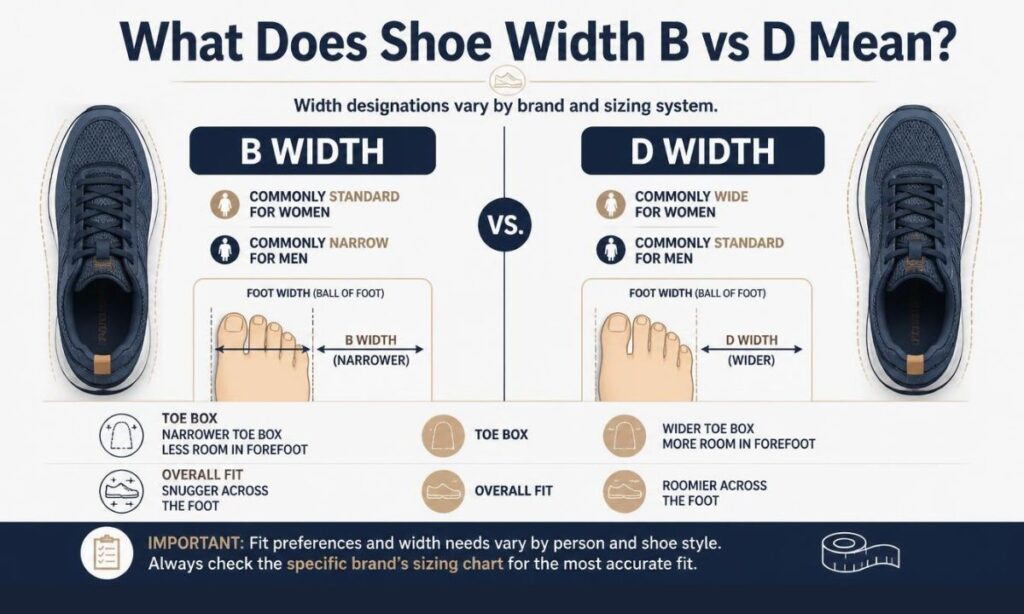
The main difference between B width vs D width is the amount of space provided across the foot. Width letters are part of the shoe width lettering system, which manufacturers use alongside numerical shoe sizes to describe how roomy a shoe is.
For women, B is generally considered a Medium (M) or standard width, while D is generally a Wide (W) width. For men, the situation changes: B is often a Narrow (N) width, while D is typically the standard or medium width.
- B width — commonly medium for women and narrow for men.
- D width — commonly wide for women and medium for men.
- A D-width shoe generally provides more room than a B-width shoe when the same gender and US shoe size are being compared.
- Width is measured separately from shoe length, so a size 9 B and size 9 D can have the same length but different amounts of space across the foot.
- The actual difference may vary by brand, shoe style, and shoe last.
So, if you’re wondering, “is B narrower than D?” the answer is generally yes when comparing the same sizing system. But don’t treat the letters like a universal ruler; they are not perfectly identical across every manufacturer.
Shoe Width B vs D for Women
When discussing women’s footwear, B width is usually the familiar medium or standard option. It is designed for a foot that does not need unusually narrow or wide construction.
A women’s D width, on the other hand, is generally considered wide. This extra room can be helpful for people whose feet spread more across the forefoot, especially around the ball of the foot.
- Women’s B width shoes are commonly medium or standard width.
- Women’s D width shoes are commonly wide width.
- B may suit an average foot width when the shoe’s length is also correct.
- D can provide additional room across the forefoot.
- People with bunions may sometimes prefer a wider construction, although width alone does not solve every fitting issue.
- Feet that experience daily foot swelling may feel more comfortable in shoes with additional room.
- Brand-specific sizing should always be checked before buying.
For example, imagine two women both wearing a US size 8. One may feel comfortable in an 8B, while another may need an 8D because her forefoot is broader. Neither person necessarily needs a different length; their feet simply have different shapes.
Shoe Width B vs D for Men
For men, the common interpretation changes quite a bit. Men’s B width shoes are generally considered narrow, while men’s D width shoes are usually medium or standard.
That makes D one of the most familiar choices for men shopping for everyday footwear. A man who normally wears a medium-width shoe may find a B-width shoe too restrictive across the forefoot.
- Men’s B width shoes are commonly narrow.
- Men’s D width shoes are commonly medium or standard.
- D is often called the standard shoe width for men.
- B can be useful when a standard shoe feels too loose around the sides.
- A wider foot may require 2E, 3E, 4E, or another wider designation.
- The same numerical shoe size can be offered in several widths.
- Always check the manufacturer’s width labels rather than assuming every brand follows exactly the same measurements.
This is one reason searching for “standard shoe width B” without specifying gender can create confusion. B is not automatically “medium” everywhere. Context matters, quite a lot actually.
B Width vs D Width: Quick Comparison
Here is a simple comparison to make the difference easier to understand:
| Width | Women’s Shoes | Men’s Shoes |
|---|---|---|
| B | Medium / Standard | Narrow |
| D | Wide | Medium / Standard |
| 2E / EE | Extra Wide in many systems | Wide in many systems |
| 3E / EEE | Very Wide | Extra Wide |
| 4E / EEEE | Extra Wide | Extra Wide |
These labels are general conventions rather than a guarantee. A shoe manufacturer may use its own brand-specific sizing, and the shape of the shoe can change how a particular width feels.
Is D Wider Than B?

Yes, in the same sizing system, D is generally wider than B. The tricky part is that the practical meaning depends on gender.
For men, moving from B to D usually means moving from a narrow shoe to a medium or standard shoe. For women, moving from B to D generally means moving from medium to wide.
Think of the letters as positions on a width scale rather than universal definitions. Narrow options can include N, 2A, AA, or even 4A/AAAA, while wider choices can include D, 2E/EE, 3E/EEE, 4E/EEEE, and beyond.
Some specialty manufacturers go much wider, with options such as 5E, 6E, 8E, 10E, 12E, and 14E. These are more specialized widths and aren’t available in every shoe style.
How to Measure Foot Width
A reliable foot measurement can help you choose between B, D, or another width. You don’t need a complicated laboratory setup either; a piece of paper, a pencil, and a ruler can usually get you started.
Try measuring your feet at the end of the day, when they may be slightly larger from normal activity.
- Place a sheet of paper on a flat floor.
- Stand naturally with your full weight on the foot.
- Trace around the foot carefully.
- Measure the widest part of the tracing, usually around the forefoot.
- Record the width measurement in inches.
- Repeat the process for the other foot.
- Compare your measurements with the brand’s shoe width measurement chart.
Do not measure while sitting if you can avoid it. Your foot can spread differently when standing, and that small difference may matter when you’re already between widths.
A measuring tape can also help, particularly if you’re measuring around the circumference of the foot, although that is not the same thing as measuring its flat width.
Using a Shoe Width Chart or Calculator
A shoe width chart can turn your measurements into a more useful starting point. Many charts show width ranges according to shoe size, gender, and width designation.
A shoe width calculator can also be helpful when available, especially if it asks for your shoe size and measured foot width. Still, calculators should be treated as guides rather than absolute answers.
Why? Because shoes are not just numbers.
The shoe last, materials, toe shape, upper construction, and design can all change how a shoe fits. A stiff leather shoe may feel much tighter than a flexible sneaker even when both are labeled the same size and width.
A good shoe width size guide should therefore be used together with the individual manufacturer’s chart whenever possible.
Why Shoe Width Can Vary Between Brands
One of the most overlooked parts of shoe shopping is width sizing variation. Two shoes marked D may not feel identical.
Manufacturers use different lasts and construction methods, and their idea of a medium or wide shoe can vary. Even within one brand, a running shoe, dress shoe, boot, and casual sneaker may have noticeably different shapes.
This is why brand shoe width differences are real and worth checking before ordering online.
A few things can affect the final fit:
- The shape of the toe box
- The width of the shoe last
- Upper material and flexibility
- Heel construction
- Insole thickness
- Arch design
- Intended activity
- Manufacturer sizing practices
So if your favorite brand’s D width fits beautifully, another brand’s D isn’t automatically going to feel exactly the same. Sadly, shoe letters don’t come with a universal measuring tape attached.
B Width, D Width, and Other Shoe Width Letters
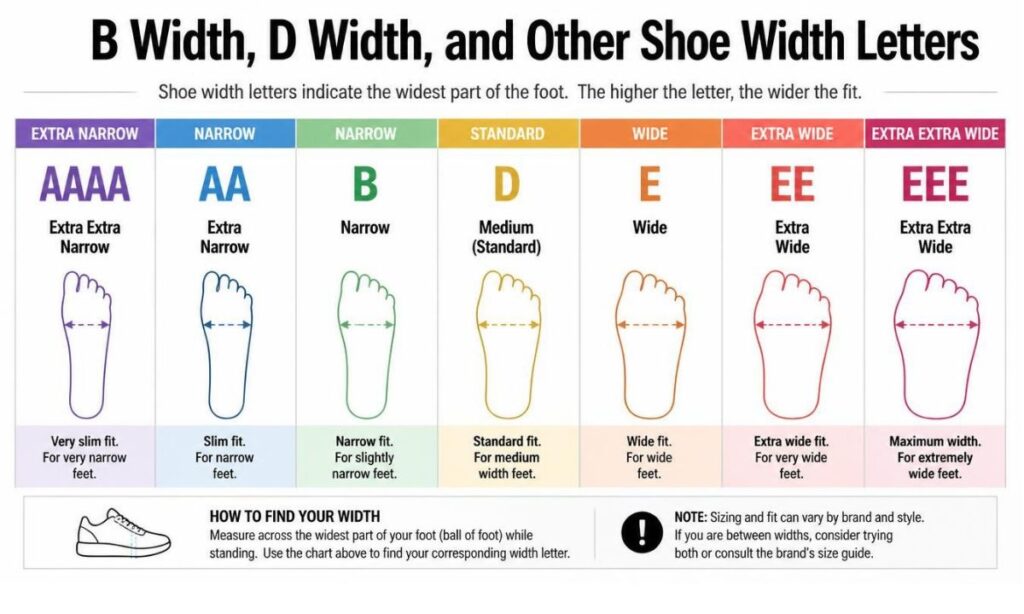
B and D are only two points in a much larger width system. Depending on the manufacturer, shoppers may encounter several designations.
Narrow widths can include 2A / AA and 4A / AAAA, while standard and wider options often include B, D, 2E / EE, 3E / EEE, and 4E / EEEE.
A simplified progression may look something like this:
4A → 2A → A → B → D → 2E → 3E → 4E → 5E and wider
However, this sequence should not be treated as an exact measurement chart for every brand. Width increments and naming conventions differ.
Some manufacturers also use Medium (M), Wide (W), Narrow (N), and Extra Wide (XW) instead of relying entirely on letters such as B and D.
Choosing the Correct Shoe Width
The correct width should allow your foot to sit naturally without excessive pressure or unwanted movement. Proper shoe fit is not about making the foot squeeze into the shoe; it’s about giving the foot enough room while keeping the shoe secure.
A few useful signs can help you evaluate the fit:
- Your toes should not be pressed tightly against one another.
- The widest part of your foot should align with the widest part of the shoe.
- Your heel should remain reasonably secure.
- The sides should not create painful pressure points.
- You should have enough toe room for normal movement.
- The shoe should not feel excessively loose just because it is wide.
Your individual foot shape matters too. Someone with a narrow heel and broad forefoot may experience a different fit from someone whose foot is uniformly wide.
Shoe Width for Bunions, Hammertoes, and Swelling
Width becomes even more important when the feet have specific fitting concerns. Bunions, hammertoes, and foot swelling can make a conventional shoe feel uncomfortable even when the numerical size appears correct.
For some people, a wider toe box can reduce pressure around sensitive areas. People dealing with edema may also experience changes in foot volume throughout the day.
Those with diabetes-related foot concerns should be particularly careful about footwear fit and should follow guidance from an appropriate healthcare professional when needed.
Specialized options may include orthopedic shoes, extra-depth shoes, and footwear designed to accommodate orthotics or an AFO brace. These shoes often provide additional volume rather than simply increasing the width.
Even something as simple as compression socks can change how snug a shoe feels, especially if the sock material is thicker than your usual pair.
Does a Wider Shoe Mean a Longer Shoe?

No. Width and length are separate parts of shoe sizing.
A D-width shoe in size 9 is not simply a longer version of a B-width size 9. Both are intended to correspond to the same general length, while the width construction differs.
This is important because some people respond to a tight shoe by buying a larger numerical size. That can create a new problem: the shoe becomes longer when what the foot actually needed was additional width.
If your toes have plenty of front-to-back space but the sides feel squeezed, changing width may be more appropriate than automatically increasing length.
Shoe Width Measurement and Comfortable Shoe Fit
The goal of shoe fitting is not to find a letter that sounds right on paper. The goal is a comfortable shoe fit that works with your actual foot.
Start with your regular shoe size, measure your feet, compare the results with a reliable chart, and then check the manufacturer’s recommendations. If one foot is slightly larger than the other, fit the shoes to the larger foot rather than forcing both feet into a size based only on the smaller one.
Your feet can also change over time. Age, activity, pregnancy, swelling, weight changes, and other factors may alter foot dimensions. So an old size label isn’t necessarily a permanent identity card for your feet.
Read more : Shoe Width D vs EE
Frequently Asked Questions
Is B width narrow or medium?
It depends on the footwear category. B width is commonly medium or standard in women’s shoes but narrow in men’s shoes.
Is D width wide or medium?
Again, gender matters. D width is commonly medium or standard in men’s footwear and wide in women’s footwear.
Is D wider than B?
Generally, yes. Within the same sizing system, D provides more width than B.
Can I use my shoe size to determine width?
Your numerical size alone doesn’t tell you everything. A proper shoe width measurement, brand chart, and actual fitting experience provide better information.
Are B and D widths the same across brands?
Not necessarily. Manufacturer shoe sizing can vary, so always check the specific brand’s chart when available.
Conclusion
Understanding Shoe width B vs D makes shopping for footwear a lot less mysterious. The key thing to remember is that the same letter can mean something different in men’s and women’s shoes. B is commonly medium for women and narrow for men, while D is commonly wide for women and medium for men.
Before buying, consider your foot width, numerical shoe size, foot shape, and the manufacturer’s sizing information. A shoe width chart or shoe width calculator can be useful, but neither replaces trying the shoe on when that’s possible.
Most importantly, don’t assume that a familiar letter automatically means the perfect fit. Feet are wonderfully inconsistent little things, and two people wearing the same size can need completely different widths. Measure carefully, pay attention to pressure points, and choose footwear that lets your feet feel comfortable rather than merely fitting a number on a box.
