

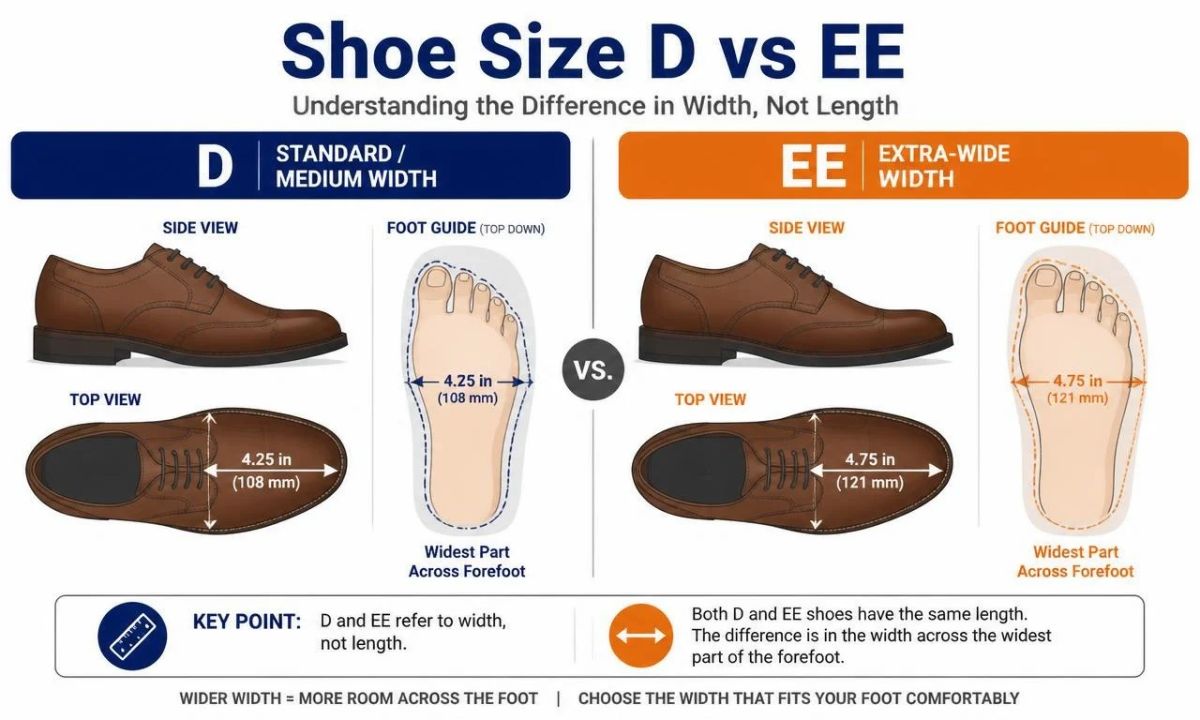
Choosing the right shoes can feel surprisingly complicated. You find your Shoe Size, check the length, and then suddenly there are letters like D, E, EE, or even 4E staring back at you. What are they supposed to mean? And why can two shoes with the same number fit completely differently?
The answer is Shoe Width. The number in a shoe size generally describes length, while the letter helps describe how wide the shoe is. Understanding shoe width D vs EE can make shopping for comfortable footwear much less of a guessing game.
For many men’s shoes, Shoe Width D is considered a standard or medium width, while Shoe Width EE is wider. But width labeling can vary between manufacturers, shoe styles, and even men’s and women’s footwear, so the letter alone doesn’t tell the whole story.
If you’re wondering about the difference between D and EE, how each width feels, or whether you should choose a wider shoe, this guide breaks it down in plain language.
What Does Shoe Width D Mean?

The D Width is commonly used as the Medium Width or standard width for men’s footwear in the United States. In other words, when someone buys a typical men’s shoe without selecting a special width, D is often the default.
A D shoe width meaning is therefore fairly simple: it represents a moderate amount of room across the foot. It isn’t especially narrow, but it isn’t designed for particularly broad feet either. The actual measurement can still change depending on the shoe’s size and design, so don’t treat D as one fixed measurement.
For example, D width shoes for men may work comfortably for someone whose feet have an average Foot Width. But if your toes feel squeezed or the sides of your feet bulge over the sole, the issue may be width rather than length.
Some common points about D width include:
- D Width is commonly a standard men’s width.
- D medium width is often used for average-width men’s feet.
- A D shoe may feel snug on a naturally wide foot.
- D does not automatically mean the shoe will fit every average-width foot.
- The shoe’s construction and Shoe Last can affect the final fit.
- Different brands may interpret width measurements somewhat differently.
- Men’s D width is not necessarily equivalent to D width in women’s footwear.
That final point is important because the same letter doesn’t always carry the exact same practical meaning across sizing systems.
What Does Shoe Width EE Mean?
Shoe Width EE generally indicates a wider fit than D in men’s footwear. If D feels too restrictive around the sides of your feet, an EE shoe may provide additional room across the forefoot.
The EE shoe width meaning is commonly associated with a wide men’s shoe. You’ll also see EE represented as 2E in many US Shoe Width Sizes systems. So when shopping, don’t be confused if one brand says EE and another says 2E; they can refer to the same general width category.
An EE shoe may be useful for people with naturally broader feet or those who simply need more room around the Ball of the Foot.
Common characteristics include:
- EE Width provides more room than D in many men’s sizing systems.
- EE wide width is commonly used for wide feet.
- 2E shoe width is another common way to label EE.
- EE can be helpful when standard-width shoes feel tight.
- It may provide more lateral room without increasing shoe length.
- EE width shoes for men are widely available in many footwear categories.
- The actual fit still depends on the Shoe Manufacturer and shoe model.
So, if you’re asking is EE wider than D, the answer is generally yes for men’s U.S. shoe sizing. That’s the basic distinction, though real-world measurements can vary.
Shoe Width D vs EE: What Is the Main Difference?
The simplest way to understand D vs EE shoe width is to think about room across the foot rather than front-to-back length.
D is generally a standard men’s width, while EE is generally wider. A person wearing the same numerical shoe size could therefore experience a noticeably different fit between the two widths.
| Feature | D Width | EE Width |
|---|---|---|
| General category for men | Medium/standard | Wide |
| Relative width | Standard | Wider |
| Common alternative label | D | 2E |
| Best suited to | Average-width feet | Wider feet |
| Forefoot room | Moderate | More generous |
| Side-to-side space | Standard | Increased |
The important thing is that moving from D to EE generally changes width, not length. A size 10 D and a size 10 EE are both size 10 in length, but the EE version is constructed to offer more room across the foot.
That can make a huge difference when your feet are wide but your length is already correct. Going up a whole shoe size just to gain width can create a different problem: the shoe may become too long.
D Width vs 2E: Are They the Same?
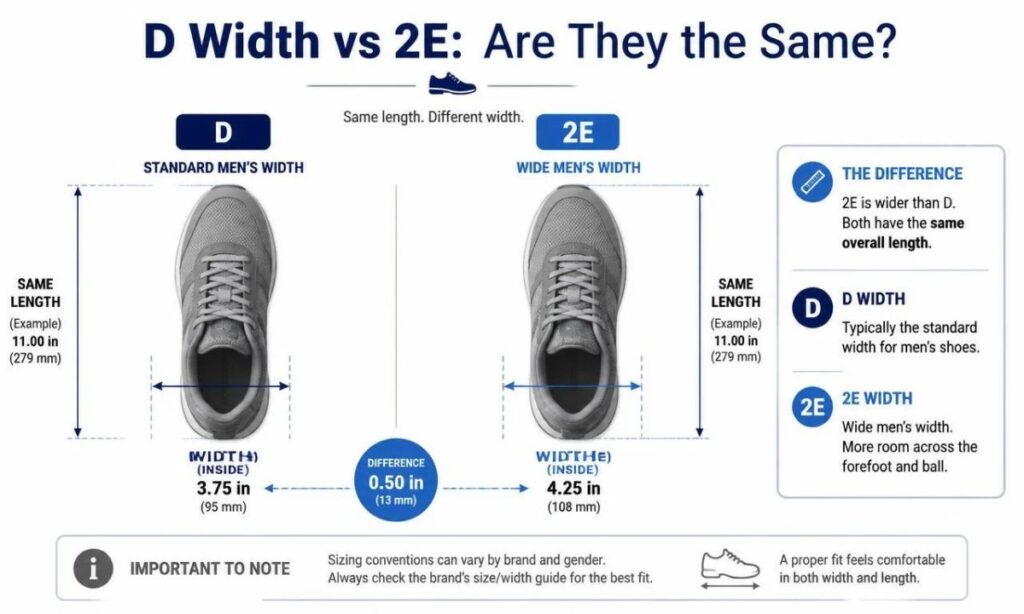
In many men’s footwear sizing systems, D Width vs 2E is essentially a comparison between standard and wide width.
D is commonly the medium width, while 2E is commonly equivalent to EE and represents a wider option. The exact dimensions aren’t universal, however, because manufacturer shoe width differences are very real.
One brand’s 2E may feel slightly different from another brand’s 2E. That’s why a shoe width size chart should be treated as a helpful guide rather than an absolute law carved into a shoe-shaped stone.
When shopping online, look for the manufacturer’s specific measurements whenever they’re available. This is especially useful if you’ve previously found that your usual width feels different from brand to brand.
How Shoe Width Letters Work
The shoe width lettering system can seem backwards at first because more letters don’t always mean more width in a simple alphabetic way.
Common width labels can include:
- A Width – commonly associated with narrow women’s widths.
- B Width – commonly a standard women’s width.
- C Width – can fall between standard and wider categories depending on the system.
- D Width – commonly standard men’s width.
- E Width – wider than D.
- EE / 2E – commonly wider than E or used as a wide category depending on the manufacturer.
- 3E – extra-wide category in many systems.
- 4E – very wide or extra-wide.
- 5E and 6E – used by some manufacturers for increasingly wider fits.
- EEE – another designation used for extra-wide footwear.
- EEEE – another way some brands identify an especially wide option.
- XXW – commonly means extra-extra-wide.
Because the shoe width sizing system isn’t completely standardized across every brand, always check the manufacturer’s guide before assuming one letter has precisely the same measurement everywhere.
Men’s Shoe Width vs Women’s Shoe Width
The relationship between width letters becomes a little more confusing when comparing Men’s Shoe Width and Women’s Shoe Width.
In many U.S. sizing systems, B is commonly considered a standard women’s width, while D is commonly considered a standard men’s width. That doesn’t mean a men’s D and women’s D will necessarily measure identically.
For example, women’s D width is often used for a wide women’s shoe, whereas men’s D width is typically a standard or medium width.
That’s why you should never choose a width simply because you remember the letter from another pair of shoes. Your Foot Measurement, the brand, and the intended shoe all matter.
How to Measure Foot Width at Home
If you’re unsure whether D or EE is right for you, start with an accurate foot width measurement in inches.
You don’t need an elaborate laboratory setup. A piece of paper, pencil, ruler, and your usual socks can do the job pretty well.
Step-by-Step Foot Measurement
Place your foot flat on a piece of paper while standing naturally. Ask someone to trace around the foot if possible, because bending down can change how much weight you place on your foot.
Then:
- Mark the widest points across your foot.
- Measure between those two points.
- Repeat for the other foot.
- Record both measurements.
- Compare the result with the brand’s Shoe Width Chart.
- Use the larger foot when choosing footwear.
The widest section is usually around the forefoot, near the Ball of the Foot. Don’t measure around the entire foot like you’re measuring your waist; you’re trying to establish the width from one side to the other.
This process is often called foot tracing measurement, and it’s a useful starting point when ordering shoes online.
Why Shoe Size Alone Isn’t Enough
People often say, “I’m a size 10,” as if that tells the complete story. It doesn’t quite.
Your Shoe Size usually communicates length, while width provides another important part of the fitting picture. Two people can both wear a US size 10 but need different widths.
A person with narrow feet might find D too roomy in some footwear, while someone with broad feet may feel squeezed into the same size.
This is why a proper shoe fitting guide considers both length and width.
A comfortable shoe should generally allow your toes enough space to move naturally without your heel constantly slipping or your foot being compressed from the sides. Basically, your feet shouldn’t have to negotiate a peace treaty with your shoes every morning.
When Should You Choose EE Instead of D?
If D shoes feel consistently tight around the sides while the length is correct, EE may be worth trying.
Typical signs that you may need a wider shoe include:
- Pressure along the sides of your forefoot.
- Toes feeling crowded together.
- Your foot extending beyond the edge of the insole.
- Red marks appearing along the sides after wearing shoes.
- Difficulty finding a comfortable fit even when the length is correct.
- A feeling that the shoe is squeezing the widest part of your foot.
- Socks becoming unusually tight around the forefoot.
These signs don’t automatically prove that EE is the right answer, but they suggest that width deserves attention.
You might also need a wider fit if your feet have changed over time. Foot shape can change with age, activity, swelling, or other circumstances, so the width that worked several years ago isn’t guaranteed to remain comfortable forever.
D vs EE Shoe Width for Wide Feet
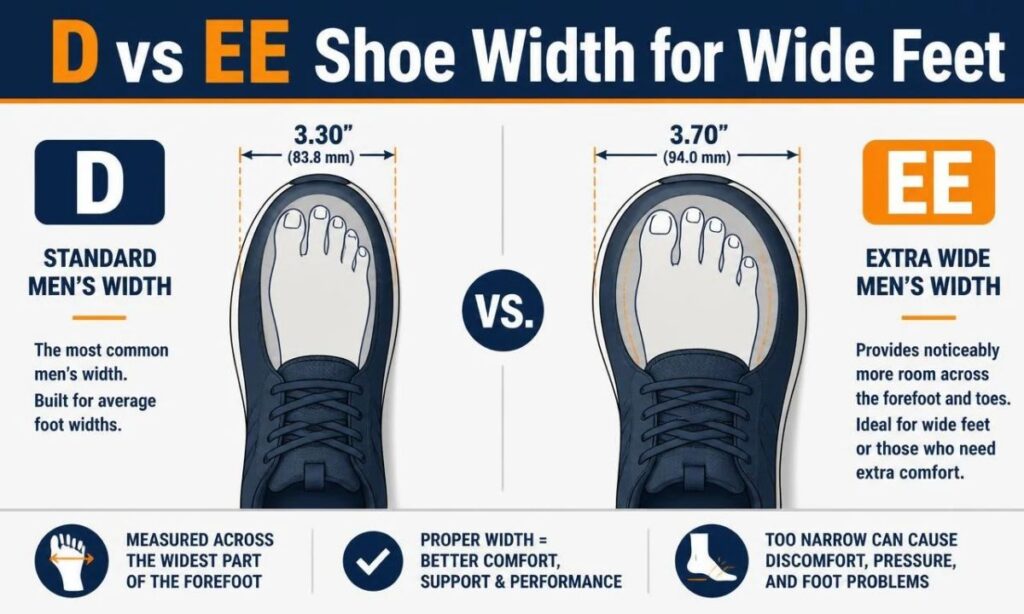
For people with wide feet shoe size concerns, the main goal isn’t simply buying the widest shoe available. It’s finding enough room without creating unnecessary movement.
If D squeezes your foot and EE provides comfortable space without excessive sliding, EE may be more suitable.
However, someone with extra wide feet may need more than EE. Depending on the manufacturer, options such as 3E, 4E, 5E, 6E, EEE, or EEEE may be available.
This is where a wide width shoes or extra-wide width shoes collection can be useful. Some manufacturers specifically design footwear for broader feet instead of merely stretching a standard shoe.
EE vs 4E: When Is EE Not Wide Enough?
The difference between EE vs 4E can matter if you have particularly broad feet.
EE or 2E is commonly considered wide, while 4E is generally wider. A person who needs extra-wide footwear may find EE still restrictive around the forefoot.
Some athletic, work, medical, and comfort shoe manufacturers offer 4E options because ordinary wide shoes don’t provide enough room for every foot shape.
Again, though, there isn’t one universal measurement that applies to every brand. Compare actual width measurements whenever you can.
E vs EE Shoe Width
The comparison of E vs EE shoe width is another area where labels can cause confusion.
In many men’s sizing systems, E is wider than D, while EE/2E is wider again. But manufacturers don’t all organize their widths in precisely the same way.
A simplified progression may look something like:
D → E → EE/2E → 3E → 4E
But you should check the specific Shoe Width Chart before relying on that progression for a particular brand.
How Shoe Construction Changes the Fit
Width isn’t determined only by the letter printed inside the shoe.
The Shoe Last—the form around which the shoe is constructed—has a major influence on how footwear feels. Two shoes marked D can have noticeably different shapes because their lasts are different.
One might have a rounded toe box, while another could taper sharply toward the toes. One might offer more volume over the instep, while another hugs the top of the foot.
That’s why a numerical chart can never completely replace trying shoes on.
A comfortable shoe fit depends on the entire design, including the upper material, sole, toe box, heel shape, and internal volume.
Shoe Width Calculator and Width Charts
A Shoe Width Calculator can help estimate the width you may need based on your measurements. Likewise, a Shoe Width Chart can provide a quick comparison between foot measurements and available widths.
These tools are especially handy when shopping online, but they shouldn’t be treated as perfectly universal.
The most useful approach is:
- Measure both feet.
- Record your length and width.
- Identify your approximate width category.
- Check the brand’s sizing information.
- Compare the actual shoe measurements when provided.
- Consider the shoe’s intended use and construction.
- Check return policies before ordering online.
This takes a few extra minutes, but it’s usually less annoying than ordering shoes three times and becoming personally offended by the cardboard box.
Shoe Width and Foot Shape
Not every wide foot is shaped in exactly the same way.
Some people have a wide forefoot but relatively narrow heels. Others have more overall volume across the foot. Some have a broad toe area because of their natural Foot Shape, while others need extra space because of specific pressure points.
This is why simply saying “I need wide shoes” doesn’t always tell the entire story.
A shoe with a roomy toe box may work better for one person, while another may need greater width throughout the entire shoe.
The goal is not merely width. It’s appropriate space in the places where your foot actually needs it.
When Extra-Depth Shoes May Help
Width isn’t the only measurement that can affect comfort.
Some people need Extra-Depth Shoes because they require more vertical room inside the footwear. This can be particularly useful when a person’s foot has greater volume or when they use devices inside the shoe.
Some extra-depth designs include Removable Depth Layers, allowing the wearer to remove an insole layer and create additional internal space.
These shoes can sometimes be useful for people using Orthotics, a Custom Orthotic, or an AFO Brace, although the appropriate footwear depends on the specific device and individual needs.
Shoe Width for Orthotics and Special Footwear
If you use orthotic inserts, don’t assume that simply moving from D to EE will solve every fitting issue.
An orthotic occupies space inside the shoe. You may need additional width, depth, or both. Some shoes are specifically designed to accommodate orthotics, with removable insoles and more generous internal volume.
People looking at Orthopedic Shoes should pay attention to width, depth, opening, heel security, and compatibility with their devices rather than focusing on one letter alone.
If you have ongoing foot problems or Diabetes-Related Foot Concerns, professional fitting advice can be especially useful. Conditions involving swelling, pressure points, or reduced sensation can make ordinary trial-and-error footwear selection less appropriate.
Shoe Width and Swollen Feet
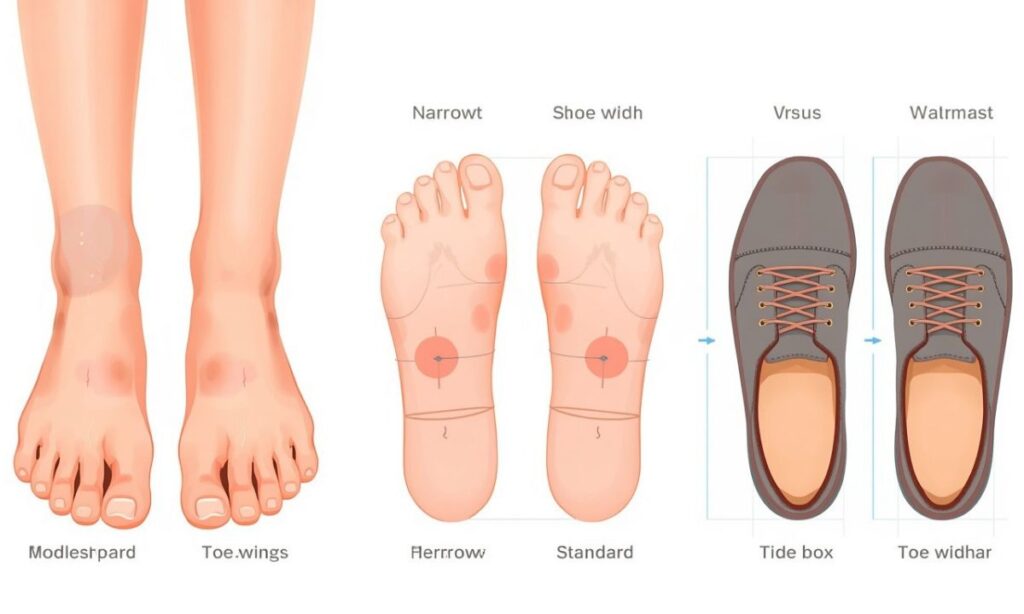
Feet can become wider during the day because of normal changes in fluid distribution. Some people also experience more significant swelling, known as Edema.
If your shoes feel comfortable in the morning but painfully tight later, width and volume may both be contributing factors.
People with Bunions or Hammertoes may likewise benefit from footwear that provides sufficient room around the affected areas. A wider shoe isn’t automatically the answer, but compressing a sensitive area generally isn’t a great fitting strategy either.
For persistent discomfort, a qualified healthcare or footwear professional can help identify what type of shoe construction is appropriate.
Common Mistakes When Comparing D and EE
One common mistake is assuming that going from D to EE means you should also change your shoe length.
You don’t necessarily need to. If your length is correct, the purpose of changing width is to increase side-to-side room.
Another mistake is assuming every EE shoe is identical. Shoe width varies by brand, style, materials, and construction.
A third mistake is relying only on letters and ignoring your actual measurements.
And finally, don’t assume that a shoe is correct because you can force your foot into it. Shoes should support your foot, not win an argument with it.
How to Choose Between D and EE
If you’re deciding between D and EE, start with your current experience.
If your D shoes fit comfortably around the forefoot, don’t automatically move to EE. More space isn’t always better. A shoe that is excessively wide can allow unwanted movement, which can create rubbing and instability.
If your D shoes are consistently tight at the sides while the length feels correct, try EE in the same or a similar model.
When possible, compare both widths while standing and walking. Your foot expands slightly under body weight, so sitting down and judging the fit can give a misleading impression.
The ideal shoe fit should feel secure without creating uncomfortable pressure.
Frequently Asked Questions
What Is the Difference Between Shoe Size D and EE?
D is generally a standard or medium width for men, while EE (2E) is wider and provides more room across the foot.
Is EE Wider Than D in Shoes?
Yes, EE is typically wider than D. It is commonly designed for people who need extra space around the forefoot and sides of the foot.
Is D a Standard Men’s Shoe Width?
Yes, D width is commonly considered the standard or medium width for men’s shoes in U.S. sizing.
Should I Choose D or EE Shoe Width?
Choose D if standard-width shoes fit comfortably, but consider EE if your feet feel squeezed or pressured along the sides in D-width shoes.
Conclusion
Understanding shoe size D vs EE becomes much easier once you separate length from width. In common U.S. men’s sizing, D is generally a medium or standard width, while EE/2E is generally wider.
The important part is that shoe-width labels aren’t perfectly universal. Your actual Foot Width, the shoe’s construction, the Shoe Manufacturer, and the shape of the shoe all influence how a pair will feel.
If you’re between widths, measure carefully, check the manufacturer’s chart, and pay attention to where your foot feels pressure. For some people, D will provide the right balance; for others, EE will offer the extra room needed for a genuinely comfortable fit.
A good pair of shoes shouldn’t make you think about your feet every five minutes. Ideally, you put them on, walk away, and get on with your day.
