

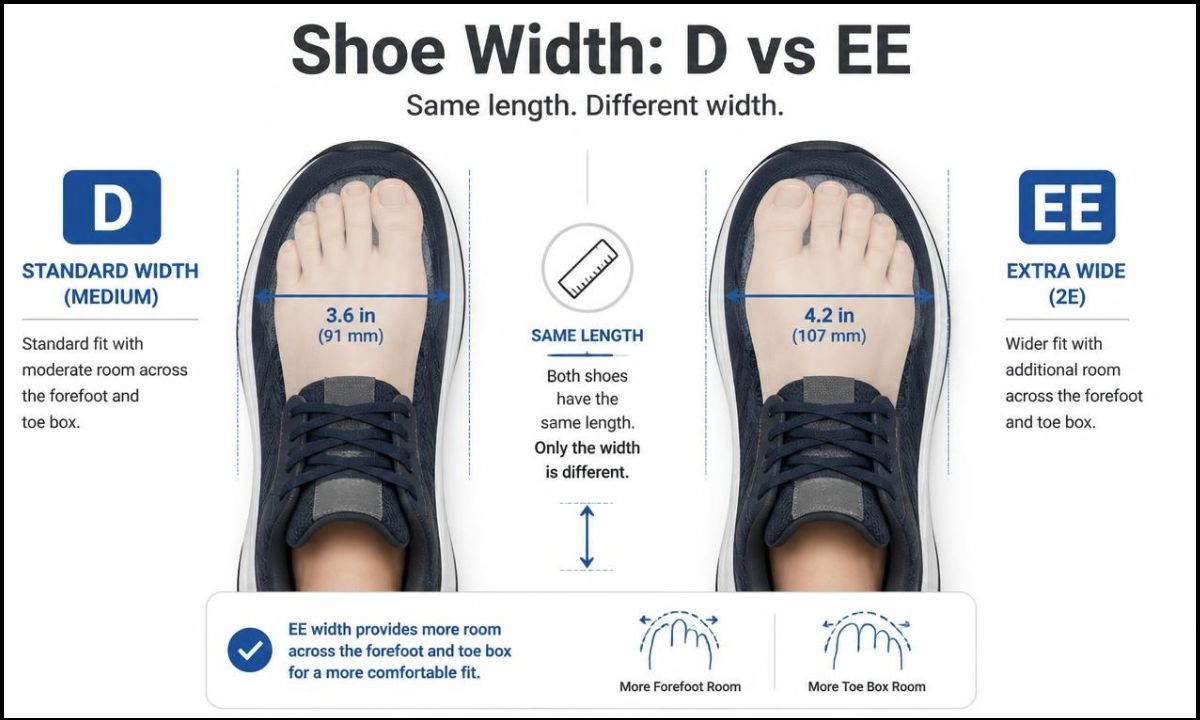
Choosing the right shoe is not only about getting the correct length. Sometimes a shoe can have the “right” US shoe size and still feel painfully tight because the width is wrong. That is where shoe width becomes important, especially when comparing D width and EE width.
If you have ever put on a pair of shoes and thought, “The length is fine, but why are my feet being squeezed?” width may be the missing piece. D width and EE width are not interchangeable, and understanding the difference can make finding a comfortable shoe fit much easier.
The tricky part is that width labels can vary between men’s and women’s shoes, and every shoe manufacturer may use slightly different measurements. So, a width letter should be treated as a useful starting point rather than a universal measurement carved in stone.
What Does D Mean in Shoe Width?

D width is generally considered a medium width for men’s shoes in the United States. In many men’s footwear systems, men’s D width represents the standard or regular width, so it is what many shoppers encounter as the default option.
For example, if you see a shoe listed as “10D,” the 10 refers to the US shoe size, while D identifies the width. Those two numbers and letters are doing different jobs, which is easy to overlook when shopping quickly.
For women’s footwear, however, the story changes a little. Women’s D width is commonly considered a wide width rather than a standard medium width. This is one reason you should always check the individual brand width guide before assuming a particular letter means exactly the same thing everywhere.
D width may work well for someone whose foot width falls around the manufacturer’s regular-width measurement. But if the shoe presses around the ball of the foot, pinches the toes, or leaves noticeable marks along the sides, the length might not be the problem at all.
What Does EE Mean in Shoe Width?
EE width is a wider shoe-width designation than D in the common U.S. men’s sizing system. You may also see EE written as 2E, particularly in men’s shoe width charts.
So, when someone asks, “Is EE wider than D?” the short answer is yes. EE width shoes provide more room across the foot than standard D-width footwear, although the exact difference depends on the shoe brand and its shoe last.
An EE option can be useful for people with wide feet, a broader forefoot, or a foot shape that feels cramped in standard-width shoes. Some people discover this only after wearing regular shoes for a few hours, because feet can naturally become wider or swell during the day.
That little extra room can make a surprisingly big difference. A shoe that feels merely “okay” in D may feel much more natural in EE, while another person’s foot might move around too much in the wider option.
Shoe Width D vs EE: What Is the Main Difference?
The basic distinction in shoe width D vs EE is straightforward: D is narrower than EE in the common men’s U.S. width system.
| Width | Common Men’s Meaning | General Fit |
|---|---|---|
| D | Medium / standard | Regular foot width |
| EE / 2E | Wide | Wider foot |
| 3E / EEE | Extra wide | More room than EE |
| 4E / EEEE | Extra wide | Very broad fit |
The important word here is “common.” Shoe sizing is not perfectly standardized across every manufacturer, so an EE from one brand may not feel identical to an EE from another.
Think of width as a measurement rather than simply a letter. A shoe width chart can tell you how a manufacturer defines D, EE, and other widths, while an actual width measurement gives you a better idea of what your own feet need.
D vs EE Shoe Width for Men
For men’s footwear, D shoe width is commonly the medium or standard option. EE shoe width, meanwhile, is commonly classified as wide.
That means a man who normally wears 10D but needs more room across the forefoot might try 10EE rather than immediately increasing the shoe length. Going from 10D to 10.5D changes length as well as overall proportions, so it may not solve a width problem properly.
This is an important little distinction. If your toes already have enough front-to-back room but the sides feel squeezed, simply buying a longer shoe can create a strange fit where the heel slips while the forefoot is still uncomfortable.
A better approach is to compare men’s D width and men’s EE width using the manufacturer’s measurements and, when possible, try both widths.
Is D or EE Wider?

EE is wider than D in the standard U.S. men’s width system.
You can think of the progression as moving from narrower widths toward wider ones. Depending on the manufacturer, you may encounter labels such as B width, D, E, EE/2E, 3E, and 4E.
Some specialty footwear goes much farther, with widths labeled 5E, 6E, 8E, 9E, 10E, 12E, or even 14E. Those labels are especially common in certain specialized or orthopedic footwear ranges rather than ordinary everyday shoes.
Not every manufacturer offers every width, though. A brand might stop at EE while another provides several extra-wide choices.
D Width Shoes: Who Are They For?
D width shoes are commonly intended for men whose feet fit the manufacturer’s regular or medium-width specifications.
They can be a good match when:
- The sides of the shoe do not squeeze the foot.
- Your toes can move naturally.
- The ball of the foot sits comfortably within the shoe.
- Your heel stays reasonably secure.
- There is no uncomfortable pressure around bunions or the little-toe area.
A proper shoe fit should feel supportive without creating pressure points. Shoes shouldn’t need to be “broken in” through weeks of pain, honestly.
If your feet feel comfortable in D shoes throughout the day, there may be no reason to move to EE simply because EE sounds roomier.
EE Width Shoes: Who Are They For?
EE width shoes are generally designed for people who need more space across the foot than a standard D provides in men’s footwear.
They may be worth considering if:
- The sides of D shoes feel tight.
- The ball of your foot feels compressed.
- Your toes feel crowded despite having enough length.
- You frequently experience pressure around bunions.
- Your feet swell during the day.
- You need additional room for certain orthotics.
- You have a naturally broad forefoot.
Still, wider isn’t automatically better. A shoe that is too wide can allow excessive foot movement, which may cause rubbing, instability, or blisters. The goal is the correct shoe width, not simply the largest width available.
How Much Wider Is EE Than D?
There isn’t one universal inch measurement that applies to every brand. That’s the slightly annoying part of shoe width sizing.
Width measurements depend on the shoe’s length, construction, materials, and shoe last. A manufacturer may publish its own measurements in a shoe width chart, and those specifications should take priority over a generic conversion.
If you need an exact comparison, look for the manufacturer’s width chart for your particular US shoe size. Some brands provide measurements in inches, while others simply classify widths as narrow, medium, wide, or extra wide.
So rather than memorizing one number for “D versus EE,” use the actual brand-specific shoe width information whenever possible.
How to Measure Foot Width at Home
Learning how to measure foot width can make width selection much less mysterious. You don’t need a laboratory or a strange medieval-looking foot machine either.
Place a sheet of paper on a flat floor and stand on it naturally. Keep your weight distributed normally because body weight can change the shape and spread of the foot slightly.
Trace around your foot, or have another person mark the widest points around the ball of the foot. Then measure the widest part of the tracing using a ruler.
For better foot measurement, follow these basic steps:
- Measure both feet because they may not be exactly the same size.
- Stand naturally while measuring.
- Measure the widest part of the foot.
- Record the foot width in inches if your brand provides inch-based sizing.
- Measure at the end of the day if your feet tend to swell.
- Use the larger foot when choosing footwear.
That last point matters more than people expect. One foot can be slightly longer or wider than the other, and choosing footwear around the smaller foot can leave the larger one complaining by lunchtime.
Shoe Width Measurement in Inches
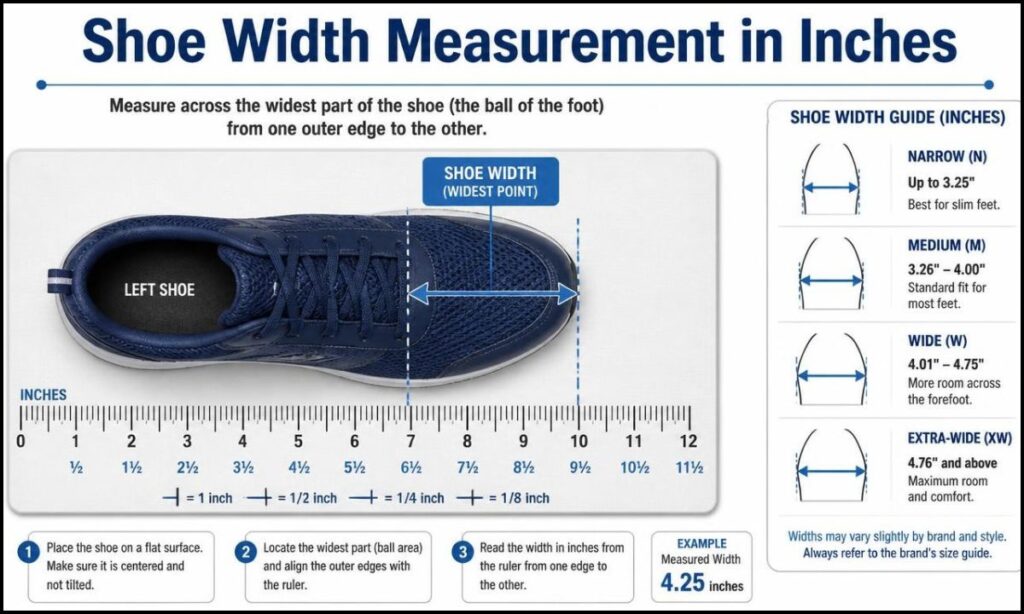
A proper shoe width measurement can be useful when a manufacturer’s chart provides width specifications. But remember that foot width and shoe width aren’t necessarily identical measurements.
Your foot needs room inside the shoe, and the internal shape of the shoe depends on its construction. Materials also stretch differently, while a rigid shoe may provide less forgiving space than a soft upper.
This is why shoe width measurement in inches should be combined with how the shoe actually fits. Numbers are helpful, but your foot is not a perfectly rectangular object, unfortunately.
Using a Shoe Width Chart
A shoe width chart can help translate your foot measurement into the width categories offered by a particular brand.
A typical chart might include:
- B width for a narrower women’s fit in many systems
- D width for standard men’s width
- EE width / 2E for a wider men’s fit
- 3E / EEE for extra-wide options
- 4E / EEEE for even more width
You may also encounter terms such as C width, 2A, 4A, or AAAA in women’s narrow footwear. At the other end, specialty shoes can use WW, XW, or XXW.
Because terminology differs, the manufacturer’s own chart is the safest reference.
Men’s Shoe Width and Women’s Shoe Width
One of the biggest sources of confusion is assuming that the same letter always means the same width for everyone.
In common U.S. sizing conventions, men’s shoe width and women’s shoe width use overlapping letters but assign different meanings to some of them.
For example, D is typically a medium width for men’s shoes, while women’s D width is commonly categorized as wide. Likewise, EE can appear in women’s footwear, but availability and labeling vary considerably by brand.
If you’re shopping for women’s shoe width, check the women’s chart specifically rather than borrowing a men’s conversion chart. It saves a lot of guessing.
Shoe Width D vs EE When You Have Wide Feet
If you have wide feet, the difference between D and EE can become especially noticeable. A regular D shoe may feel restrictive around the forefoot, while an EE can offer more lateral room.
But wide feet don’t always mean every part of your foot needs more space. Some people have a wide forefoot but a relatively narrow heel. Others have swelling that changes their width throughout the day.
That is why the best shoe width recommendation considers your entire foot shape rather than just one measurement.
A shoe with a wider forefoot and secure heel may feel better than a uniformly wide shoe. This is also where a good shoe fitting guide becomes useful.
When Width Isn’t the Only Problem
Sometimes a person assumes they need EE because the shoe feels tight, but the real issue is shoe volume.
If your foot is tall through the instep, you may need extra depth shoes rather than simply a wider shoe. This can be especially relevant when wearing orthotics, an AFO brace, or a custom orthotic.
Some shoes include removable depth layers, allowing extra vertical space without making the entire shoe dramatically wider.
People with bunions, hammertoes, edema, or certain diabetes-related foot concerns may also need specialized footwear. In those situations, a professional fitting can be more appropriate than relying only on an online width chart.
Shoe Width Calculator: Can It Help?
A Shoe Width Calculator or foot width calculator can provide a useful starting estimate based on your shoe size and measured foot width.
These tools can be handy when you’re shopping online and don’t have access to a fitting specialist. But calculator results should still be compared with the specific shoe manufacturer sizing.
Different lasts, materials, and construction methods can make two shoes with the same labeled size feel surprisingly different.
So use a calculator as a guide, not as the final judge of your feet. Your feet have not signed a contract promising to behave exactly like a spreadsheet.
Common Shoe Width Mistakes to Avoid
One common mistake is increasing shoe length when the actual problem is width. If your toes already have adequate lengthwise space, going up half a size may leave your heel swimming around while the sides remain uncomfortable.
Another mistake is assuming that every EE shoe is identical. Brand width guide information matters because manufacturers don’t all measure widths in exactly the same way.
It’s also easy to measure only one foot. Since foot dimensions can differ, measure both feet and use the larger measurement when selecting footwear.
Finally, don’t ignore swelling. Foot swelling can change how shoes feel later in the day, so shoes that feel perfect at 8 a.m. may become noticeably tighter after hours of standing or walking.
Choosing Between D and EE Shoes

If you’re deciding between D and EE, start with your actual foot width rather than the label alone.
If D shoes feel comfortable and provide enough room around the ball of the foot, D may be appropriate. If D consistently creates pressure along the sides while the length is correct, EE is worth trying.
If EE feels loose, causes your foot to slide sideways, or leaves too much empty space around the heel, it may be wider than you need.
For a more reliable choice, combine your width measurement, shoe size, foot shape, and the manufacturer’s sizing information.
Read more : What Size Is 2XB?
Frequently Asked Questions
What Does 2XB Mean in Clothing Sizes?
2XB generally means 2X Big, a plus-size option designed with extra room in the chest, waist, and body length.
Is 2XB the Same as 2XL?
2XB is similar to 2XL in overall size, but the “B” indicates a roomier, broader cut designed for bigger body proportions.
What Measurements Fit a 2XB Size?
Measurements vary by brand, but 2XB commonly provides extra space through the chest and waist compared with a standard 2XL.
How Should a 2XB Shirt Fit?
A 2XB shirt should feel comfortable across the chest and stomach without pulling, while offering enough length and width for easy movement.
Conclusion
The difference between D width and EE width is essentially a difference in available width, with EE being wider than D in the standard U.S. men’s sizing system. D is commonly considered men’s medium width, while EE is commonly considered men’s wide width.
But shoe sizing is not perfectly universal, and that little detail matters. A shoe width chart, accurate foot measurement, and the individual shoe manufacturer’s guide can help you make a much more informed choice.
Most importantly, pay attention to how the shoe feels. Your toes should have room to move, the sides should not be painfully compressed, and your heel should remain reasonably secure. A truly comfortable shoe fit is about balance enough space without excessive movement.
When in doubt, measure both feet, compare the measurements with the brand’s chart, and consider the shape of the shoe itself. D and EE are useful labels, but the right width is ultimately the one that gives your particular feet the space and support they need.
