

Finding the right shoe size can feel strangely complicated. A label may say 7, yet the actual fit can change from one brand to another, and a US shoe size, UK shoe size, or EU shoe size can point to different numbers entirely. Thats why understanding Men’s shoe size 7 is about more than simply reading the number inside the shoe.
For some people, size 7 feels instantly familiar. For others, it becomes a small mystery involving charts, measuring tapes, width letters, and the eternal question: “Why does this pair fit perfectly while the other one feels like it was made for somebody else?” A good Men’s shoe size guide can make that process much easier.
Whether you are shopping for men’s size 7 shoes, comparing international sizing, or trying to understand shoe measurements, this guide explains the basics in a practical and easy-to-follow way.
What Does Men’s Shoe Size 7 Mean?

Men’s shoe size 7 generally refers to a men’s shoe labeled US 7. It is a relatively smaller men’s size, but the exact dimensions can vary depending on the manufacturer, shoe style, and sizing system used. A size 7 dress shoe may not feel exactly like a size 7 athletic shoe, which is something shoppers sometimes discover the hard way.
The number describes a standardized sizing point rather than giving you an exact measurement of your foot. In other words, shoe size and foot measurement are connected, but they are not exactly the same thing.
When looking at men’s shoe sizing, you may encounter US, UK, and European measurements. These systems don’t increase in precisely the same way, so a direct conversion is more useful than simply assuming the numbers match.
For online shopping, it is smart to check the manufacturer’s chart before ordering. A little extra checking can save you from a box arriving at your door containing a shoe that looks perfect but feels very much not perfect.
Men’s Shoe Size 7 in US, UK, and EU Sizing
One of the most common questions about men’s size 7 shoes is how the size translates internationally. A typical conversion places a US men’s 7 around a UK men’s 6 and an EU size around 40, although EU sizing can vary slightly by manufacturer.
| Sizing System | Approximate Equivalent |
|---|---|
| US men’s | 7 |
| UK men’s | 6 |
| EU | Around 40 |
| General category | Men’s sizing |
This is a useful starting point for shoe size conversion, but it should not be treated as an absolute rule. Different brands can use slightly different lasts, sizing conventions, and fits.
For that reason, a men’s shoe size chart should be used together with the individual brand’s recommendations. If you’re buying from a company such as Jay Butler, for example, checking its own sizing information is more dependable than relying only on a generic chart.
The same idea applies when comparing US sizing, UK sizing, and EU sizing. A conversion chart tells you where to begin, while actual measurements and fit help you decide where to finish.
Men’s Shoe Size 7 and Shoe Measurements

A shoe labeled 7 does not necessarily mean the shoe is exactly seven inches long. This sounds obvious once explained, but it is a surprisingly common misunderstanding.
Shoe measurements can refer to the internal dimensions of footwear, while foot measurement refers to the actual length and width of your foot. These two measurements need some room between them because your toes should not be pressed against the front of the shoe.
When measuring your feet, you may see measurements listed in Inches or Centimeters. Measuring both feet is useful because one foot is often slightly longer or wider than the other. It’s normal, really, and not something that means your feet are doing their own little rebellion.
A simple home measurement can help:
- Stand on a sheet of paper while wearing the type of socks you normally use.
- Mark the back of your heel and the tip of your longest toe.
- Measure the distance between those points.
- Repeat the process for the other foot.
- Record the larger measurement.
- Compare it with the manufacturer’s chart.
This gives you a better starting point for accurate shoe size measurement than guessing based on an old pair of shoes.
Shoe Size in Inches and Centimeters
People often search for shoe size in inches or shoe size in centimeters because these measurements appear easier to understand than an arbitrary size number. There is some truth to that, but the relationship isn’t perfectly direct.
For example, your foot might measure a particular number of centimeters, but that doesn’t mean you should automatically select a shoe with exactly the same internal length. Shoes need additional room for movement, socks, and normal foot expansion during the day.
This is where foot size vs shoe size becomes important. Your foot measurement helps you choose a shoe, while the shoe itself needs to provide appropriate space around that foot.
A useful measurement chart might include:
| Measurement | What It Tells You |
|---|---|
| Foot length | Length from heel to longest toe |
| Foot width | Widest part across the foot |
| Shoe length | Approximate internal shoe space |
| Shoe width | Available room across the shoe |
| Inches | Imperial measurement |
| Centimeters | Metric measurement |
So, if you’re searching for inches to shoe size or centimeters to shoe size, use the measurement as a guide rather than a rigid mathematical formula.
Men’s Shoe Size 7 and Shoe Fit
Getting the correct number is only half the job. Shoe fit matters just as much.
A properly fitting shoe should hold your heel comfortably without excessive slipping. Your toes should have enough room to move, and the widest part of your foot should sit comfortably within the widest part of the shoe.
This is the heart of proper shoe fit. A shoe can technically be your correct size and still feel wrong because its shape doesn’t match your foot.
Here are some useful signs of a good fit:
- Your toes can move naturally.
- Your heel stays reasonably secure.
- The shoe does not squeeze the sides of your foot.
- Your toes are not touching the front.
- The upper does not create uncomfortable pressure points.
- You can walk without feeling rubbing or pinching.
- There is suitable shoe clearance in front of the longest toe.
If a size 7 feels too short but the next size feels too loose, the problem might not be length at all. It could be the shoe’s shape or shoe width.
Understanding D Width in Men’s Size 7
Width is an important part of proper shoe sizing, especially for people whose feet aren’t average in width.
In many men’s footwear systems, D width represents a standard or medium width. Therefore, D width shoes for men are often described as medium width men’s shoes.
However, width labels are not perfectly universal. A D-width shoe from one manufacturer can feel different from another D-width shoe because construction, materials, and shoe shape all affect the final fit.
If your feet feel cramped in a size 7 but the length seems right, don’t immediately jump to a larger length. Try checking whether a wider version is available first. Going longer when you actually need more width can leave unnecessary space in front of your toes.
That’s one of those tiny shopping decisions that can make a surprisingly big difference.
E, EE, and EEE Width Options
Some men’s shoes are available in wider widths for people who need additional room.
An E width is generally wider than a standard D width, while EE width provides still more room. EEE width is wider again in sizing systems that offer it.
These labels are particularly useful when shopping for wide men’s shoes, although exact width measurements vary among brands.
| Width | General Description |
|---|---|
| D | Medium/standard men’s width |
| E | Wide |
| EE | Extra wide |
| EEE | Very wide in systems offering it |
Someone wearing a Size 10.0E, for example, may need a Size 10.5 in a particular shoe if the available width doesn’t provide the right fit. But that does not mean everyone with an E-width foot should automatically increase half a size. The correct choice depends on the shoe and the person’s actual measurements.
Sizing up half a size can sometimes help with length, but it isn’t a substitute for selecting the proper width.
Men’s Size 7 Shoes: How Should They Fit?
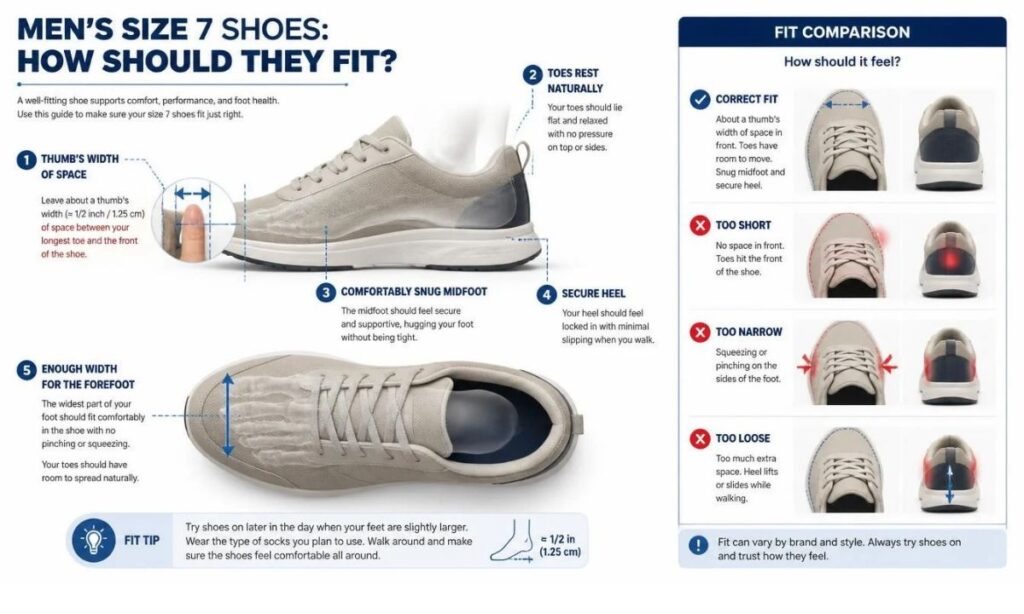
Knowing how men’s size 7 shoes should fit is more useful than memorizing a conversion number.
When you first put the shoes on, stand up and walk around. Feet spread slightly when bearing weight, so testing them while sitting isn’t enough. If the shoe feels comfortable only when your foot is relaxed in a chair, it may tell a different story once you’re walking.
A good shoe fit guide should consider both length and width. The heel should feel secure without being painfully tight, and the forefoot should have enough room without allowing your foot to slide around.
Pay attention to pressure points. If a seam, toe box, or side panel pushes against one particular area, that may become uncomfortable after several hours even if the shoe initially feels okay.
And don’t forget socks. The socks you normally wear with the shoes can change the fit slightly, especially with formal footwear or winter shoes.
Men’s Shoe Size 7 Conversion to Women’s Shoes
Another frequent question involves men’s to women’s shoe size conversion. In US sizing, men’s and women’s sizes generally differ by about 1.5 sizes, although the exact fit can vary by brand and style.
As a rough starting point, a men’s US 7 may correspond to a women’s US 8.5. This is why a women’s size 8 isn’t necessarily the same physical size as a men’s 8.
The reverse conversion can be useful too. Someone researching women’s size 8 to men’s size will commonly encounter approximately men’s 6.5 as a starting point.
Likewise, a men’s size 6 to women’s size may be around women’s 7.5 in US sizing.
These conversions should be treated as estimates, not guarantees. Women’s shoes can also use different width conventions and design shapes, so the number alone cannot tell the whole story.
Men’s Size 7 Versus Men’s Size 6
The difference between men’s size 6 and men’s size 7 is primarily a difference in length, but the exact physical change depends on the sizing system and manufacturer.
If size 7 feels loose, moving down to size 6 might seem like the obvious answer. Yet if the looseness is around the sides rather than the length, you might actually need a narrower shoe instead.
This is why men’s shoe sizing isn’t simply a matter of choosing the smaller or larger number. Length, width, construction, material, and intended use all play their part.
A running shoe, leather loafer, work boot, and casual sneaker can all fit differently even when they carry the same size label.
Men’s Shoe Size Guide for Online Shopping
Buying shoes online can be convenient, but it removes the ability to try them on before purchasing. A reliable Men’s shoe size guide becomes especially useful in that situation.
Before placing an order, check these details:
- The sizing system used by the store.
- The manufacturer’s specific shoe sizing chart.
- Your current foot length and width.
- Whether the shoe runs narrow, standard, or wide.
- The retailer’s exchange or return policy.
- Whether reviews mention sizing differences.
- Whether the listed measurement refers to the foot or the shoe.
Do not assume that your favorite pair of size 7 sneakers proves that every size 7 shoe will fit. Your old shoes may have stretched, and different styles may use completely different shapes.
A little research before clicking “buy” is much less annoying than arranging a return afterward.
Shoe Clearance and Toe Room
Shoe clearance refers to the extra space needed between your longest toe and the front of the shoe. This space is important because feet move forward slightly during walking and because toes need room to function naturally.
Your longest toe may not always be your big toe, either. Some people have a second toe that extends farther forward, so measurements should account for whichever toe is longest.
A shoe that is too short can create uncomfortable pressure at the front. But too much space isn’t ideal either, because excessive movement can make the foot slide inside the shoe.
The goal is balance: enough clearance to move naturally without turning the shoe into a little boat around your foot.
Shoe Width Guide for Men
Length gets most of the attention, but shoe width deserves equal consideration.
A basic shoe width guide may include D, E, EE, and EEE options for men’s footwear. Still, these letters should be interpreted alongside the brand’s actual measurements because width standards are not identical everywhere.
People with wider feet may need E width men’s shoes, EE shoe width, or EEE shoe width, depending on their measurements and the footwear available.
If your shoes repeatedly feel tight around the ball of the foot while the length seems correct, width is worth investigating. On the other hand, if your heel slips excessively while the forefoot feels fine, the issue may be the shoe shape rather than simply needing a smaller size.
Why Men’s Shoe Sizes Vary Between Brands
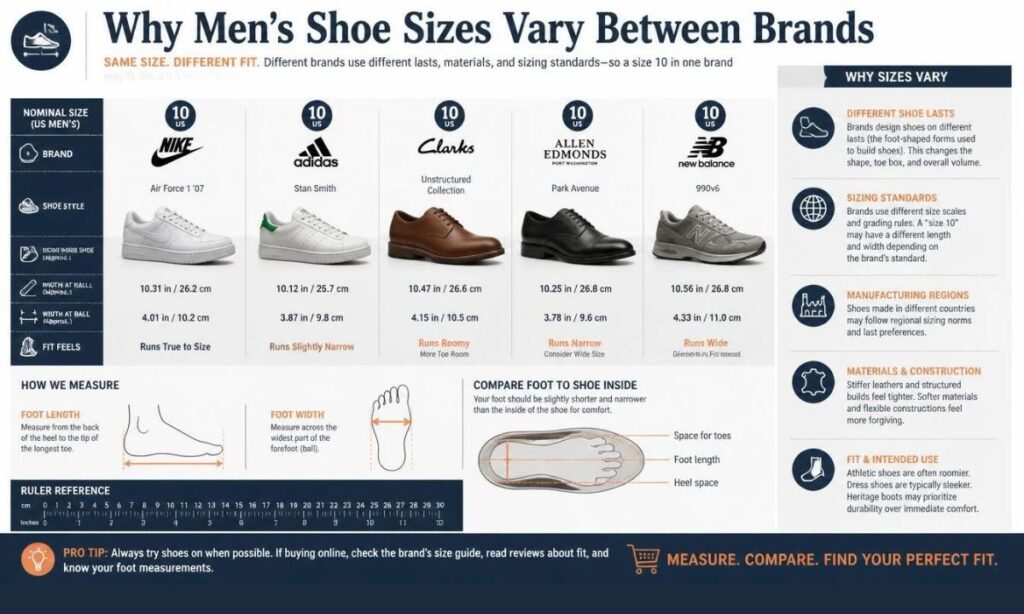
There isn’t one universal physical mold used to create every men’s shoe. Manufacturers use different lasts, materials, construction methods, and intended fits.
That’s why shoe measurement vs foot measurement is such an important distinction.
A leather shoe may soften and change slightly with wear. A running shoe might have a generous toe box. A dress shoe could have a narrower silhouette. Two shoes carrying the same number can therefore produce noticeably different experiences.
This doesn’t mean sizing charts are useless. Quite the opposite. A shoe size conversion chart provides a valuable starting point; you simply need to combine it with the brand’s own information and your measurements.
Practical Tips for Accurate Shoe Sizing
If you’re trying to determine your size at home, take your measurements later in the day when your feet have experienced normal daily activity. Feet can change slightly throughout the day, and measuring only first thing in the morning may not represent how your shoes feel later.
Measure both feet and use the larger result when comparing with the chart. Wear the socks you expect to use with the shoes, especially when buying boots or athletic footwear.
Also remember that shoe size in centimeters and shoe size in inches are not interchangeable with a simple universal formula. Use the manufacturer’s chart whenever possible.
For people between two sizes, trying the shoes in both sizes can be useful. A half-size increase sometimes provides needed length, while a width change may solve the issue if the shoe feels tight across the foot.
Frequently Asked Questions
Is men’s US shoe size 7 the same as UK size 7?
Not usually. A US men’s 7 is commonly around a UK men’s 6, although brand-specific conversion charts should be checked before buying.
What is men’s US shoe size 7 in EU sizing?
A US men’s 7 is generally around EU 40. EU sizing can vary slightly between manufacturers, so use the brand’s own EU shoe size chart when available.
Is men’s size 7 the same as women’s size 8?
No. Men’s and women’s US sizing systems differ. A men’s 7 is often around a women’s 8.5 as a starting conversion, but actual fit depends on the footwear.
How do I know whether I need D or EE width?
Measure the width of your foot and compare it with the manufacturer’s width chart. D is commonly a medium men’s width, while EE is wider, but exact measurements vary by brand.
Conclusion
Understanding Men’s shoe size 7 is much easier when you stop treating the number as the whole story. The number gives you a starting point, while foot measurement, width, shoe clearance, and actual shoe fit tell you whether the footwear is likely to work.
For the most reliable results, measure both feet, compare your measurements with the manufacturer’s shoe sizing chart, and check whether the shoe is offered in different widths. When converting between US, UK, and EU sizing, use a trusted conversion chart rather than guessing from the numbers.
Most importantly, remember that proper sizing is about comfort as much as measurement. A correctly fitted shoe should let you walk naturally, provide suitable toe room, and avoid unnecessary pressure around your foot. And if you’re uncertain, checking the manufacturer’s Help and sizing support can be one of the simplest ways to avoid an expensive sizing mistake.
A size label is only a little number stitched onto a shoe. The real goal is finding footwear that fits your feet comfortably, wherever those feet happen to take you.
Explore More Blogs
