


Buying shoes can feel oddly complicated. You find the right length, the color looks perfect, and then a tiny letter—D—appears beside the shoe size and suddenly the whole thing feels like a puzzle. What does D actually mean? Is it wide, medium, or something in between? And does it mean the same thing for everyone? Well, not quite.
Understanding D Shoe Width can make shoe shopping much less of a guessing game. Width affects how your feet sit inside the shoe, how much room your toes have, and whether you finish the day thinking, “Ahh, finally,” or “Why did I buy these?” A good Shoe Width is just as important as getting the length right, although people often forget that little detail.
In most U.S. sizing systems, D commonly represents a standard or medium width for men, while it can represent a wider width for women. That difference is one of the most important things to remember when looking at a Shoe Width Chart. Shoe brands can also use slightly different measurements, so the letter alone isn’t the entire story.
What Does D Shoe Width Mean?
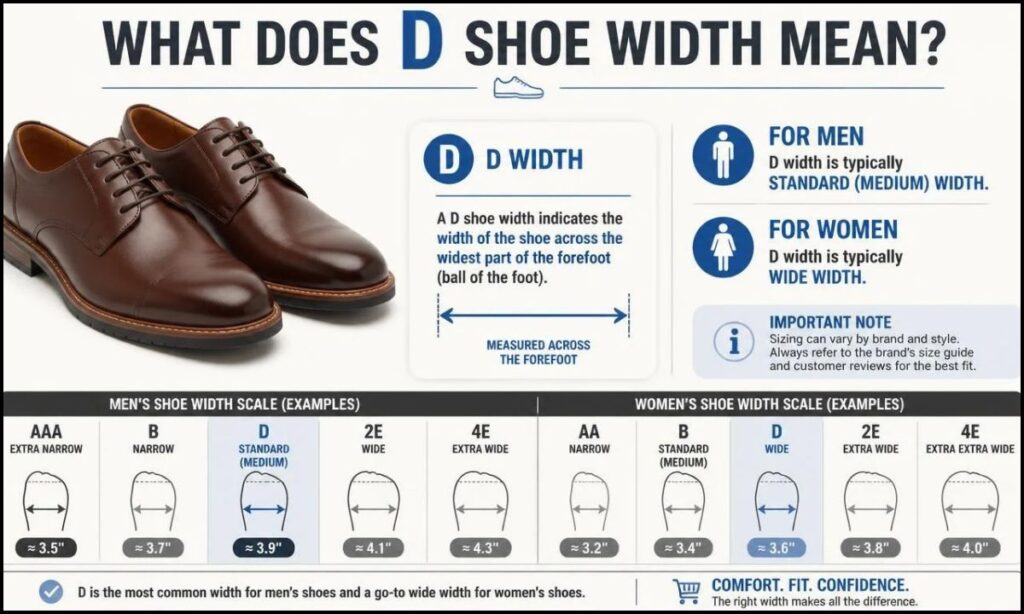
So, what does D shoe width mean? In U.S. footwear, D is generally considered a medium or standard width for men. For women, D is commonly considered a wide width. That sounds simple enough, but shoe sizing has a sneaky habit of becoming less simple once different brands enter the room.
The D shoe width meaning depends on both the wearer’s category and the Shoe Manufacturer. A men’s D shoe and a women’s D shoe don’t necessarily provide the same amount of width. This is why looking only at the number—such as 9D or 10D—can sometimes give you an incomplete picture.
A shoe marked 10D, for example, tells you two things: the shoe has a US Shoe Size length of 10 and a D width. The D isn’t another part of the length measurement. It’s a width designation.
In many men’s shoes, D means Medium, while women’s shoes often use B as the medium or standard width. A women’s D shoe is therefore typically a wider option than a women’s B shoe.
Still, don’t treat these letters as universal measurements carved into stone. Different manufacturers may use their own lasts, materials, and sizing systems, so actual interior dimensions can vary.
D Shoe Width for Men
For men’s footwear, D Shoe Width is usually the standard or medium width. If you regularly wear men’s shoes and a D width feels comfortable without squeezing the sides of your feet, you’ve probably encountered the common men’s D width.
A men’s D is often described as a standard width or medium shoe width. It sits between narrower options and wider E-family widths. For someone shopping for everyday sneakers, boots, loafers, or dress shoes, D is one of the most common width choices.
But here’s the funny part: two pairs both marked 10D can still feel different. One might feel roomy around the toes, while another feels more snug. The reason can be the Shoe Last, construction, toe shape, materials, and the particular Shoe Brand.
Common men’s width designations can include:
- B or narrower widths in some men’s sizing systems
- D for medium or standard width
- E for wide
- EE or 2E for extra wide
- 3E and 4E for progressively wider footwear
Some manufacturers continue into 5E, 6E, 8E, 10E, 12E, and even larger widths for specialty footwear. Not every brand offers all of these options, naturally.
If you’re comparing D vs E shoe width, the E option generally provides more width than D. The exact increase varies by size and manufacturer, though, so a brand-specific chart is still worth checking.
D Shoe Width for Women
Women’s sizing is where the letter D gets particularly interesting. In many U.S. women’s shoes, D width is considered wide, rather than medium.
A common women’s width pattern looks something like this:
- AAA or 4A — very narrow
- AA or 2A — narrow
- B — medium or standard
- C — somewhat wider
- D — wide
- EE or 2E — extra wide in some brands
So, women’s D width is not normally equivalent to men’s D in practical width. The letter is the same, but the sizing convention can differ.
This is why searching for a D width for women without checking the brand’s chart can create confusion. You may find one retailer calling D “wide,” while another uses a slightly different naming system.
If you usually wear women’s B width shoes and suddenly move to D, you’ll likely notice more room across the Ball of the Foot and sides. Whether that’s comfortable or too loose depends on your actual Foot Width Measurement.
D Width Shoes and the Shoe Width Chart
A Shoe Width Chart is one of the easiest ways to understand width letters. It places the width designations beside the shoe sizes so you can see how different widths relate to one another.
A simplified U.S. width guide may look like this:
| Width Letter | Common Men’s Meaning | Common Women’s Meaning |
|---|---|---|
| AA / 2A | Narrow | Narrow |
| B | Narrow in many men’s shoes | Medium/Standard |
| C | Slightly narrow or medium | Slightly wide |
| D | Medium/Standard | Wide |
| E | Wide | Extra wide in some brands |
| EE / 2E | Extra wide | Extra wide |
| 3E / 4E | Very wide | Specialty extra-wide options |
This table is a general guide, not a universal law. Shoe Manufacturer sizing can differ, and some brands use terms such as Medium, Wide, X-Wide, or XXW instead of letters.
That’s why a shoe width measurement chart should be treated as a starting point rather than a final verdict.
How to Measure Foot Width at Home
If you’re unsure about your width, learning how to measure foot width can be surprisingly easy. You don’t need a fancy laboratory or a suspicious-looking machine from a shoe store.
You can use paper, a Ruler, a pencil, and preferably the type of Socks you normally wear with the shoes.
Try these steps:
- Place a sheet of paper on a hard, flat floor.
- Stand naturally with your full weight on the foot.
- Trace around the foot carefully.
- Measure across the Widest Part of Foot, usually around the ball area.
- Record the measurement in Inches.
- Repeat the process for the other foot.
- Use the measurement from the Larger Foot when selecting footwear.
Standing while measuring matters because your foot can spread slightly when it carries your Body Weight. Measuring while sitting may give you a narrower result than you actually need.
You can also use a Measuring Tape around the forefoot, although a flat width measurement is commonly easier to compare with a manufacturer’s chart.
The goal isn’t to create a perfect scientific model of your foot. It’s to get useful information for selecting a more appropriate Shoe Width Size.
Why Foot Width Measurement Matters
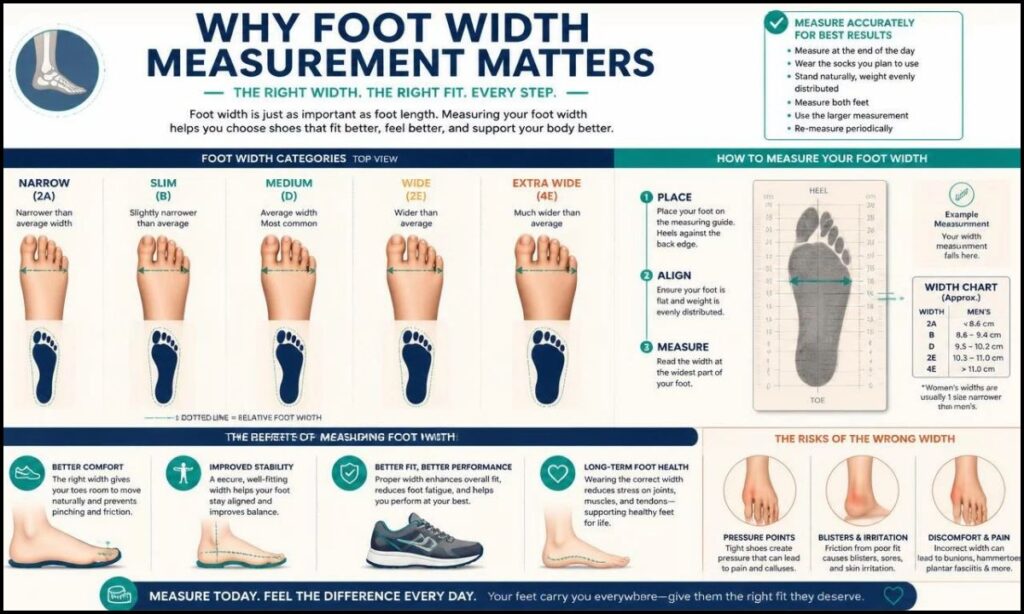
Length gets most of the attention in shoe shopping, but Foot Width Measurement can be just as important. A shoe can be exactly the right length and still feel terrible if the sides are squeezing your feet.
A shoe that’s too narrow may create pressure around the toes and forefoot. Over time, that pressure can make walking uncomfortable, especially for people already dealing with Bunions or Hammertoes.
On the other hand, a shoe that’s too wide may allow excessive movement. Your heel might slip, your foot can slide forward, and the shoe may not feel secure.
The sweet spot is a Proper Fit where your foot has enough room without swimming around inside the shoe.
This is also why Shoe Width Measurement should be considered alongside length. Width isn’t a replacement for shoe size; the two measurements work together.
D Width Compared With Other Shoe Widths
The easiest way to understand D is to compare it with nearby width options.
D vs B Shoe Width
For many U.S. men’s shoes, D is medium while B is narrower. In women’s footwear, B is often medium and D is wide. So the meaning changes depending on whether you’re looking at men’s or women’s sizing.
D vs E Shoe Width
E is generally wider than D. If D feels tight around your forefoot but the shoe length is correct, an E width may provide additional room.
D vs EE Shoe Width
D vs EE shoe width is a more noticeable difference. EE, also written as 2E, is commonly used for extra-wide footwear. Someone with a significantly broad forefoot may find EE more comfortable than standard D.
D vs 2E Shoe Width
D and 2E aren’t interchangeable. In men’s shoes, 2E generally offers considerably more width than D. If a D shoe creates side pressure, moving to 2E may provide more space without necessarily changing the length.
D vs 4E Shoe Width
A 4E is wider still and is commonly associated with extra-wide men’s footwear. It may be useful for people whose feet require substantial additional room, but width needs should be based on actual measurements rather than simply choosing the biggest letter available.
Understanding Shoe Width Letters
The alphabet used in Shoe Width Sizing can look intimidating at first. It is basically a shorthand system for communicating how wide the shoe is.
Narrow widths may be represented by A, AA, 2A, 4A, or even AAAA depending on the manufacturer. Standard widths commonly include B for women and D for men. Wider shoes may use E, EE, 2E, 3E, EEE, EEEE, and higher designations.
Some specialty brands use labels such as XXW, 3X-Wide, 4X-Wide, 5X-Wide, 6X-Wide, or 7X-Wide instead.
There’s no universal dictionary where every brand has to use exactly the same labels. That’s the annoying little wrinkle in Shoe Width Letters Meaning.
When shopping, always check how that specific brand defines its widths.
Choosing the Correct D Width Shoes
Choosing D width shoes starts with knowing how your feet actually measure. If your feet fall comfortably within the manufacturer’s D range and the shoe doesn’t squeeze or slide, D may be a suitable option.
Think about how you’ll use the footwear too. Running shoes, work boots, dress shoes, and casual sneakers can all fit differently.
The shape of the toe box matters. A shoe with a rounded toe may feel wider than a pointed shoe even when both carry the same width label.
Materials matter as well. Soft mesh can flex around the foot, while rigid leather may feel less forgiving. A shoe’s Shoe Last can also dramatically change the interior shape.
In other words, the width letter tells you something important—but it doesn’t tell you everything.
When a D Width May Not Be Enough
Sometimes your feet simply need more room. If your toes feel crowded, the sides of your feet experience pressure, or you notice persistent discomfort, consider checking a wider size rather than simply buying a longer shoe.
People with Bunions, Hammertoes, Foot Swelling, or certain Foot Conditions may need additional width or depth.
For people with Diabetes or diabetes-related foot concerns, footwear choices can be particularly important, and professional guidance may be appropriate. A shoe that looks roomy isn’t automatically a suitable medical or Orthopedic Shoe Fit.
Some footwear is designed with Extra Depth, removable layers, or space for Custom Orthotics. Others are made to accommodate Compression Socks, AFO Brace equipment, or swelling.
If you wear an AFO, Orthotics, or another brace, ordinary width charts may not tell the complete story. The insert or brace changes the amount of space your foot requires inside the shoe.
Shoe Width, Comfort, and Everyday Fit

A Comfortable Fit isn’t necessarily the loosest possible fit. Your foot should have enough room to move naturally, but the shoe should still hold your foot securely.
There should generally be adequate Foot Room around the toes, with no painful pressure along the sides. Your heel shouldn’t constantly slip, either.
A Snug Fit can be acceptable around some parts of the shoe, but snug shouldn’t mean squeezing. Shoes don’t need to hug your feet like they’re trying to win an argument.
For people whose feet change size during the day, trying shoes later in the day can sometimes provide a more realistic fit. Feet may become slightly larger after standing and walking for hours.
That small change can make a surprisingly big difference when you’re deciding between widths.
Shoe Brands Can Size D Differently
One of the biggest mistakes people make is assuming that every D shoe will fit exactly the same. A Shoe Brand may use a different last, construction method, or sizing philosophy than another manufacturer.
The same foot can therefore feel comfortable in a D sneaker from one company and slightly cramped in a D dress shoe from another.
Brand-specific charts are useful because they can explain whether D means Medium, Wide, or another category in that company’s system.
This is particularly important for online shopping, where you can’t try the shoes before ordering. If the manufacturer provides a Shoe Width Chart, compare your measurement with it before choosing.
Reviews can also provide clues, although individual experiences aren’t a substitute for actual measurements.
Using a Shoe Width Calculator
A Shoe Width Calculator can make the process easier by combining your foot length and width with a sizing database or chart.
Some calculators ask for your US Shoe Size, while others require measurements in inches or centimeters. A Foot Width Calculator may then suggest a width category.
Treat calculator results as guidance rather than an absolute answer. Different brands use different sizing standards, and your feet aren’t obligated to obey a spreadsheet.
If you’re between widths, checking the manufacturer’s recommendations is usually more useful than relying on a generic calculator alone.
D Shoe Width and Shoe Size Conversion
People sometimes assume that converting shoe sizes between countries also converts width perfectly. Unfortunately, Shoe Size Conversion mainly deals with length systems, while width can follow separate conventions.
For example, converting a U.S. size into UK or EU sizing doesn’t automatically tell you the correct width. EU footwear may not use the same letter system as U.S. shoes.
So if you’re buying internationally, check both the length conversion and the brand’s width information.
The phrase shoe width conversion can be misleading because there isn’t always a direct one-to-one conversion between width letters across countries.
D Width and Orthopedic Footwear
For people who need Orthopedic Shoes, width can become even more important. Orthopedic footwear may provide additional room, supportive structures, or adjustable features for specific needs.
Some designs include Removable Depth Layers, allowing the wearer to create more interior space for inserts or orthotics.
People with bunions, swelling, diabetes-related concerns, or other foot issues may need footwear that accommodates their individual requirements rather than simply choosing “wide.”
A healthcare professional or qualified footwear specialist can help when a foot condition affects shoe selection.
The goal is still the same: reduce unnecessary pressure and create a stable, Proper Fit.
Common Mistakes When Choosing D Width Footwear
One common mistake is buying a longer shoe because the current pair feels too narrow. This can create extra length without solving the width problem.
Another is assuming that D always means medium. That’s often true for men’s shoes, but women’s D width commonly means wide.
People also sometimes measure one foot and forget the other. Feet aren’t always identical twins; one can be slightly larger.
Ignoring socks is another little trap. Thick winter socks can change how a shoe fits compared with thin dress socks.
Finally, don’t ignore discomfort just because the label says D. A shoe size printed on the box can’t feel your feet for you.
A Simple D Shoe Width Measurement Guide
If you want a practical process, keep it uncomplicated:
- Measure both feet while standing.
- Wear the socks you’ll normally use.
- Record your length and width.
- Pay attention to the Widest Part of Foot.
- Compare the measurements with the manufacturer’s chart.
- Check whether D means medium or wide for that shoe.
- Consider the shoe’s toe shape and Shoe Last.
- Leave appropriate room for natural movement.
- Recheck the fit after walking for several minutes.
This approach is far more reliable than guessing based on the letter alone.
Read more : What Size Is a 28 Waist for Women?
Frequently Asked Questions
What Does D Shoe Width Mean?
D shoe width usually means a medium or standard width for men, while it commonly represents a wide width for women.
Is D a Wide or Medium Shoe Width?
For men, D is generally medium or standard width. For women, D is typically considered a wide shoe width.
How Do You Measure D Shoe Width?
Measure the widest part of your foot while standing, then compare the measurement with the shoe brand’s width chart.
Is D Shoe Width Right for Your Feet?
D width may be suitable if your feet fit comfortably in standard men’s shoes or wider women’s shoes without squeezing or excessive movement.
Conclusion
Understanding D Shoe Width makes footwear shopping a little less mysterious. In general, D is a standard or medium width in many men’s U.S. shoes, while D commonly represents a wide width in women’s U.S. footwear. But brand-specific sizing can change the practical fit, so the manufacturer’s chart remains important.
Your Foot Width Measurement, shoe length, foot shape, socks, and intended use all matter. A Shoe Width Calculator can help, but actual measurements and a brand’s own sizing information are usually better guides.
The right shoe shouldn’t require you to spend every step negotiating with your feet. Whether you need D width footwear, a narrow option, a wide fit, or Extra Wide shoes, the real objective is simple: enough space for your feet, secure support, and everyday Shoe Comfort.
When in doubt, measure both feet, compare the results with the relevant Shoe Width Chart, and remember that width letters are useful guides not magical promises. A little measuring before you buy can save a whole lot of uncomfortable walking later.
Explore More Blogs
