


Finding the right clothing size can feel oddly complicated. You see an “M” on a shirt and think, okay, that should be simple enough, but then one brand fits perfectly while another feels like it was designed for a completely different human being. This is why understanding Adult medium size is more useful than relying on one letter alone.
A Medium size generally falls between Small and Large in adult apparel, but the exact measurements can change by brand, garment type, gender, and country. A men’s medium is not necessarily the same as a women’s medium, and even two shirts marked M may have very different cuts.
If you are wondering what is an adult medium size, this guide explains the usual measurements, how to use a clothing size chart, and how to measure yourself before buying clothes online.
What Is an Adult Medium Size?

An adult medium size usually refers to a standard M size in men’s clothing or women’s clothing. It is a general size category intended for people whose body measurements fall within a particular range.
There isn’t one universal measurement for M. Clothing manufacturers create their own sizing systems, so a Manufacturer size chart can be slightly different from another company’s chart. Thats why the letter M should be treated as a starting point, not a final answer.
In many US clothing systems, medium is commonly represented by US size M or simply “M.” A typical US clothing size chart may list measurements for the chest, waist, hips, sleeve, and inseam, depending on the garment.
For example, a medium shirt might be designed around a particular chest measurement, while medium pants may depend much more on waist and inseam measurements.
Adult Medium Size for Men
For men, Men’s medium commonly refers to a chest size around the high-30s to low-40s in inches, although exact ranges vary considerably between brands. A men’s M may also have different proportions in the shoulders, sleeves, and torso.
A basic men’s medium size chart often considers:
- Chest: commonly around 38–40 inches
- Waist: commonly around 32–34 inches
- Neck: often around 15–16 inches
- Sleeve length: varies according to height and garment design
- Inseam: depends strongly on height and pants style
These figures are only general examples, not a universal standard sizing rule. Someone with a 40-inch chest could comfortably wear M in one brand and L in another, especially if the garment has a slim or relaxed cut.
Men’s Medium Shirts
For shirts, chest size is usually one of the most useful measurements. Men’s casual shirt sizing may also consider shoulder width, sleeve length, and overall shirt length.
A relaxed-fit M can feel quite roomy, while a slim-fit M may feel much closer to the body. The label hasn’t changed; the pattern has.
For Men’s dress shirt sizing, neck measurement and sleeve length become particularly important. Dress shirts are often sold using specific neck and sleeve measurements rather than only S, M, L.
Adult Medium Size for Women

Women’s medium can be harder to define because women’s apparel uses several different sizing systems. A women’s M may correspond roughly to a US numeric size such as 6–10, depending on the brand and garment.
A typical women’s medium size chart may include:
- Bust: commonly around 36–38 inches
- Waist: commonly around 28–31 inches
- Hip: commonly around 38–40 inches
- Shoulder width: varies by garment
- Sleeve length: depends on height and design
Again, these measurements are general rather than fixed. Women’s regular sizing can differ substantially between fashion brands, athletic brands, and outdoor companies.
The same person might wear M in a T-shirt, a different size in jeans, and perhaps L in a fitted jacket. Clothing is weird like that sometimes.
Medium Size Clothing Measurements
If you’re searching for medium size clothing measurements, the most important thing is to look beyond the M printed on the tag.
A useful size chart may provide measurements for the garment itself or for the body it is designed to fit. Those aren’t always the same thing.
For example, a loose medium shirt may measure several inches larger across the chest than the recommended body measurement because the garment includes extra room for movement.
Here is a simplified reference:
| Measurement | Typical Adult Medium Range |
|---|---|
| Men’s chest | About 38–40 inches |
| Men’s waist | About 32–34 inches |
| Women’s bust | About 36–38 inches |
| Women’s waist | About 28–31 inches |
| Women’s hip | About 38–40 inches |
| Men’s neck | About 15–16 inches |
These ranges are broad estimates. Always compare your measurements with the specific brand’s clothing size chart before ordering.
How to Measure Your Body for a Medium
Knowing how to measure clothing size properly can save you from ordering the wrong size, especially online.
You don’t need fancy equipment. A flexible measuring tape is usually enough, and having another person help can make the process much easier.
Chest or Bust Measurement
For men, wrap the tape around the fullest part of chest while keeping the tape level across the back. Don’t pull it so tightly that it digs into the body.
For women, measure around the fullest part of the bust while wearing a normal, well-fitting bra. The tape should remain parallel to the floor.
Your chest measurement or bust measurement is particularly useful when choosing shirts, jackets, coats, and dresses.
Waist Measurement
To measure waist for clothing, place the tape around your natural waist or follow the specific instructions supplied by the brand.
Don’t suck in your stomach while measuring. It might make the number look nicer, but your shirt won’t be fooled later.
Your waist measurement is especially important for pants, skirts, fitted tops, and dresses.
Hip Measurement
For an accurate hip measurement, stand naturally with your feet together and wrap the tape around the fullest part of hips.
This measurement is particularly important for women’s pants, dresses, skirts, and fitted garments.
Inseam Measurement
To measure inseam, measure from the crotch down along the leg to the bottom of the inside seam.
The inseam measurement matters most for pants and jeans. Two people can both wear medium pants but need different inseam lengths because their heights and leg proportions are different.
Neck and Sleeve Measurements
For dress shirts, measure around the base of the neck or near the Adam’s apple, leaving enough room for comfortable movement.
For sleeve length, measure from the shoulder area down the arm. Sleeve length can be surprisingly important because a shirt can fit your chest perfectly but still have sleeves that are too short.
Some brands also provide shoulder width and arm measurement, especially for jackets and outerwear.
Medium Size for Different Types of Clothing
An M label doesn’t behave exactly the same way across every garment.
Medium Shirts and Tops
For medium shirt size, chest or bust measurement is generally the first thing to check. T-shirts often have more flexibility than structured shirts.
A medium casual shirt may have a relaxed cut, while a fitted top may be noticeably narrower.
Medium Dress Shirts
A medium dress shirt size is usually more dependent on neck and sleeve measurements than a basic T-shirt. A person might technically be a medium but need a different neck size or sleeve length.
Medium Pants
A medium pants size depends primarily on waist and inseam measurements. Some pants use numeric waist sizes instead of S, M, or L.
Women’s pants can also involve Women’s pants sizing, which varies considerably between manufacturers.
Medium Jackets and Coats
A medium jacket size should provide enough room for the chest, shoulders, and arms. If you plan to wear a sweater underneath, you may need additional room.
The same principle applies to a medium coat size. Outerwear often has intentional extra space, so its measurements should not be compared directly with a fitted shirt.
Is Medium the Same as Size M in the USA?

Yes, generally, M means Medium in US sizing, but there is no single nationwide measurement that every manufacturer must follow.
The phrase M clothing size in USA describes a category rather than one exact body shape.
A standard medium size from one clothing brand may have a 40-inch chest recommendation, while another brand may use a slightly different range. Some companies also create athletic, slim, relaxed, or oversized versions of the same nominal size.
This is why regular sizing, Petite sizing, Plus sizing, and Big and tall sizing should not be treated as interchangeable systems.
Women’s Regular, Petite, Plus, and Junior Medium
Women may encounter several versions of medium depending on the department or brand.
Women’s regular sizing is generally designed around average height proportions. Women’s petite sizing is intended for shorter proportions and may adjust sleeve, inseam, rise, and garment length.
Women’s plus sizing uses a different measurement range and garment construction. A medium in regular women’s clothing should not be compared directly with a plus-size garment simply because both may use familiar letters.
There is also Women’s junior sizing, which often uses a different cut and proportion from women’s misses sizing.
So, if a garment says M, check which sizing category it belongs to first. Otherwise the letter can be a little misleading.
Brand Sizing Can Change the Meaning of Medium
One of the biggest reasons people struggle with M sizing is brand sizing variations.
Popular clothing companies may use their own patterns, fit models, and measurement standards. Outdoor brands such as The North Face, Patagonia, Outdoor Research, and Cotopaxi may also design garments around different activities and layering needs.
For example, an outdoor medium jacket might intentionally provide enough room for a base layer and sweater. A fashion medium blazer could be much more fitted.
This is why checking the individual Clothing brands size guide is usually smarter than assuming every M will fit identically.
Clothing Fit Matters More Than the Letter
The perfect clothing fit isn’t necessarily the smallest size you can squeeze into.
A shirt can technically be your size but still feel uncomfortable across the shoulders. Pants can have the correct waist but be too tight around the hips. A coat may fit your chest while restricting your arm movement.
Pay attention to:
- Shoulder comfort
- Chest or bust room
- Waist placement
- Sleeve length
- Overall garment length
- Arm movement
- Pant rise
- Inseam length
The goal is not merely to “fit into medium.” The goal is for the clothing to sit properly on your body.
Adult Medium Size and Size Conversion
If you’re shopping internationally, size conversion can make things even more confusing.
A US medium may not correspond perfectly to a medium in another country’s sizing system. Different regions use different numeric systems, and some brands use country-specific labels.
Instead of relying on a generic clothing size conversion chart, compare the actual body measurements whenever possible.
This is particularly helpful when purchasing expensive clothing or ordering from an international website. A conversion table is a useful shortcut, but measurements are usually the more dependable option.
Medium Size vs. Other Sizes
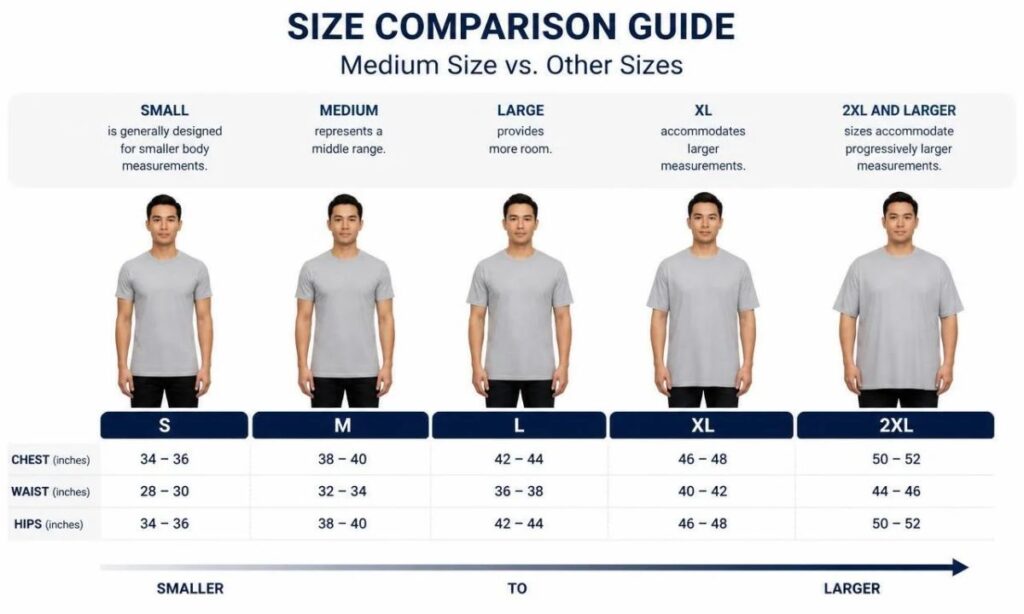
Medium generally sits between Small and Large, but the progression isn’t always perfectly proportional.
For example:
- Small is generally designed for smaller body measurements.
- Medium represents a middle range.
- Large provides more room.
- XL and larger sizes accommodate progressively larger measurements.
However, moving from M to L doesn’t simply add the same amount of fabric everywhere. Designers may adjust the shoulders, sleeves, body length, waist, and proportions differently.
That’s why comparing the actual clothing measurements by size is more informative than assuming each size increases in exactly the same way.
How to Choose the Right Medium Online
Shopping online is where an adult clothing size chart becomes your best friend.
First, measure your chest or bust, waist, and hips. For pants, record your inseam too. For dress shirts, measure your neck and sleeve length.
Then find the retailer’s online clothing size guide and compare your numbers with its recommendations.
If you’re between two sizes, think about the garment’s intended fit. A stretchy T-shirt may work in the smaller size, while a winter jacket might be more comfortable in the larger one.
Also look at customer reviews when available. Comments such as “runs small,” “true to size,” or “oversized fit” can provide useful context, though they shouldn’t replace the official chart.
Common Mistakes When Choosing Medium
One common mistake is assuming that M always means the same thing. It doesn’t.
Another mistake is measuring an existing shirt and treating that number as your body measurement. Garment measurements include design ease, so they aren’t automatically equal to your body measurements.
People also forget about length. A medium may fit across your chest but still have sleeves that are too short or pants with an unsuitable inseam.
Finally, don’t assume US clothing measurements are identical across every brand. Standardization is helpful, but clothing companies still have plenty of room to create their own fits.
Frequently Asked Questions
What Is an Adult Medium Size?
Adult Medium (M) is a general clothing size between Small and Large, but measurements can vary by brand and garment type.
What Measurements Are a Medium Size?
A medium commonly depends on chest, waist, bust, and hip measurements, with exact ranges differing between men’s and women’s clothing.
Is Medium the Same for Men and Women?
No, men’s medium and women’s medium use different measurement ranges and clothing proportions, so always check the brand’s size chart.
How Do You Choose the Right Medium?
Measure your body accurately and compare the results with the manufacturer’s clothing size chart before buying, especially when shopping online.
Conclusion
So, what size is medium in clothes? In simple terms, Medium or M is a general adult clothing category between Small and Large. But the actual measurements can differ based on whether you’re buying men’s or women’s clothing, what type of garment you’re purchasing, and which manufacturer made it.
For the most accurate result, measure your chest, bust, waist, hip, inseam, neck, and sleeve length when needed. Then compare those numbers with the brand’s specific chart.
The best size isn’t the one that looks familiar on the label. It’s the one that lets you move comfortably, sits where it should, and makes you forget about the clothing altogether. That’s usually when you’ve found the right fit.
