


Finding the most common male shoe size sounds like it should have one simple answer, but shoe sizing is a little more complicated than it first appears. Men’s feet come in many different lengths and widths, and the most frequently purchased size can change depending on the country, age group, brand, and population being measured.
Still, knowing the typical range can be useful when shopping for shoes, comparing sizes, or trying to understand where your own shoe size falls. A man wearing a US 9, for example, is right around a very common part of the men’s sizing range, while sizes such as 14 or 15 are much less frequently seen in ordinary stores.
The important thing is not to treat an “average” size as a rule. Your feet dont need to match the average to be perfectly normal. The better goal is finding the size and width that actually fit your feet comfortably.
What Is the Most Common Male Shoe Size?
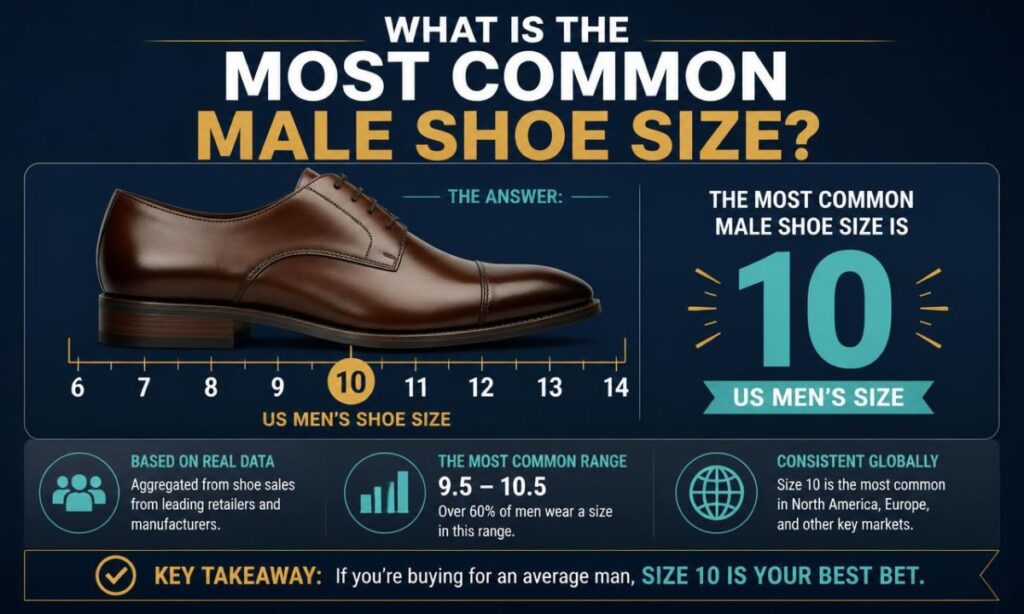
In the United States, US men’s shoe size 9 is commonly cited as being around the middle of the typical adult men’s shoe-size range. Sizes 9 and 10 are both very common choices, depending on the population and source being considered.
There isn’t one universal worldwide most common male shoe size, because different countries use different sizing systems. A US men’s 9, for instance, is approximately a UK 8.5 and an EU 42 in the conversion information provided here.
| US Men’s Size | UK Size | EU Size | Foot Length |
|---|---|---|---|
| 8 | 7.5 | 41 | 25.4 cm |
| 8.5 | 8 | 41–42 | 25.7 cm |
| 9 | 8.5 | 42 | 26 cm |
| 9.5 | 9 | 42–43 | 26.7 cm |
| 10 | 9.5 | 43 | 27 cm |
| 10.5 | 10 | 43–44 | 27.3 cm |
| 11 | 10.5 | 44 | 27.9 cm |
These measurements are useful as a starting point, but they arent a promise that every shoe in the same numbered size will fit identically.
Why Is US Men’s Size 9 So Common?
A men’s size 9 sits close to the center of many adult men’s shoe-size ranges, which helps explain why it appears frequently in footwear inventories. Shoe stores often carry substantial quantities around common middle sizes rather than stocking every size equally.
That said, the idea of a single most common male shoe size can be misleading. A store’s inventory is influenced by its customers, location, shoe category, and brand. A running store in one city could sell a different mix of sizes than a formal footwear store somewhere else.
Age also matters. Foot dimensions can change over a person’s lifetime, and younger men may wear smaller sizes while larger sizes may be more represented among other groups.
So, if you’re a US men’s 9, you’re not unusual at all. And if you’re a 7, 12, or 15, that doesnt make your feet abnormal either.
Most Common Male Shoe Size in Different Sizing Systems
The same physical foot can have several different numerical labels depending on the sizing system. This is why simply saying “size 9” without mentioning the country can cause confusion.
For example, according to the conversion chart supplied here, a US men’s 9 corresponds approximately to:
- US: 9
- UK: 8.5
- EU: 42
- Inches: 10.25 inches
- Centimeters: 26 cm
The numbers don’t follow a universal mathematical pattern across countries, so converting between systems is more reliable than trying to guess based on the number alone.
US Men’s Shoe Size
US men’s sizing is commonly used in American footwear stores and online retailers. The adult men’s chart supplied here ranges from US 6 through US 16.
A US men’s 9 is listed as approximately 26 cm, while a US men’s 10 is about 27 cm. Those small differences can matter quite a bit when a shoe has a snug design.
UK Men’s Shoe Size
UK men’s sizing generally uses numbers that are slightly lower than their US equivalents. A US men’s 9 is approximately a UK 8.5 in the supplied conversion chart.
If you’re ordering from a British retailer, dont automatically choose the same number you normally wear in US sizing. Check the retailer’s conversion information first.
EU Men’s Shoe Size
European sizing uses a different numerical scale. A US men’s 9 corresponds to approximately EU 42 in the chart.
EU sizes such as 41, 42, 43, and 44 are often seen when shopping for European footwear, and half-size equivalents can appear as well. Brand-specific sizing can still vary, however.
Shoe Size Converter for the Most Common Male Shoe Size
A Shoe Size Converter makes it easier to compare US, UK, EU, inches, and centimeters without doing mental gymnastics every time.
The basic conversion information for men’s shoes includes:
| US | UK | EU | Inches | CM |
|---|---|---|---|---|
| 6 | 5.5 | 39 | 9.25″ | 23.5 |
| 6.5 | 6 | 39 | 9.50″ | 24.1 |
| 7 | 6.5 | 40 | 9.63″ | 24.4 |
| 7.5 | 7 | 40–41 | 9.75″ | 24.8 |
| 8 | 7.5 | 41 | 9.94″ | 25.4 |
| 8.5 | 8 | 41–42 | 10.13″ | 25.7 |
| 9 | 8.5 | 42 | 10.25″ | 26.0 |
| 9.5 | 9 | 42–43 | 10.44″ | 26.7 |
| 10 | 9.5 | 43 | 10.56″ | 27.0 |
| 10.5 | 10 | 43–44 | 10.75″ | 27.3 |
| 11 | 10.5 | 44 | 10.94″ | 27.9 |
| 12 | 11.5 | 45 | 11.25″ | 28.6 |
| 13 | 12.5 | 46 | 11.56″ | 29.4 |
| 14 | 13.5 | 47 | 11.88″ | 30.2 |
| 15 | 14.5 | 48 | 12.19″ | 31.0 |
| 16 | 15.5 | 49 | 12.50″ | 31.8 |
Sizing varies by brand, so these figures should be used as a starting point rather than a final fitting decision.
How to Measure Your Shoe Size
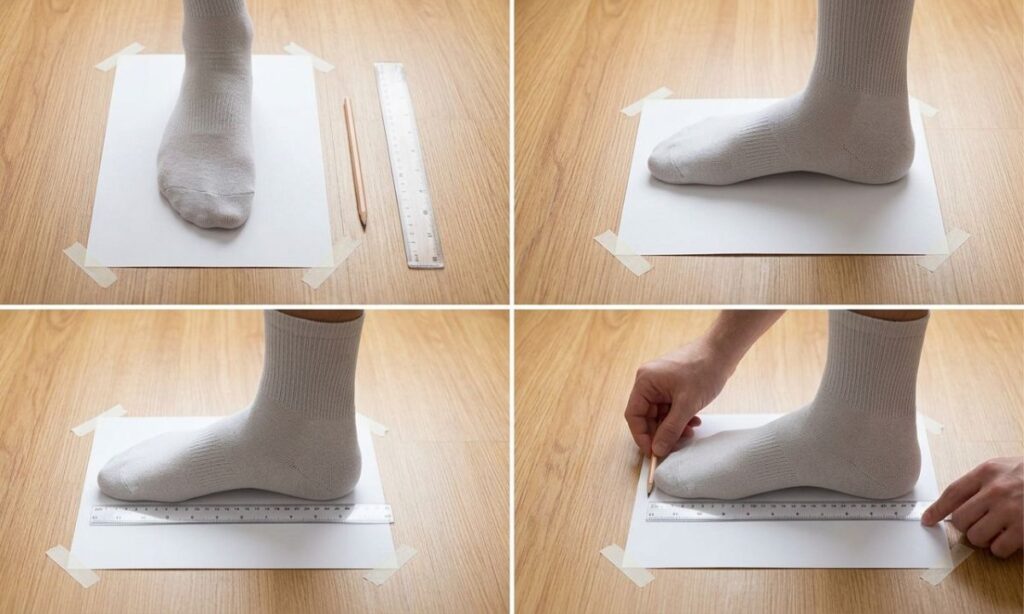
Knowing the most common male shoe size is interesting, but measuring your own feet is much more useful when you’re actually buying shoes.
You can measure your feet at home with a piece of paper, a pencil, and a ruler. It is a simple little process, though getting someone to help trace your foot can make the measurement more accurate.
Place the paper on a flat floor and stand on it with your full weight distributed naturally. Trace around your foot, then measure from the back of your heel to the tip of your longest toe.
Measure both feet because they may not be exactly the same length. It is pretty normal for one foot to be slightly larger than the other.
Use the larger measurement when selecting your shoe size. This avoids choosing a pair that fits one foot nicely while squeezing the other.
Does Foot Length Determine Men’s Shoe Size?
Foot length is an important part of shoe sizing, but it isnt the whole story. Two men with the same foot length can need different shoes because their feet may have different widths, arches, toe shapes, or overall volume.
For example, two men who both measure around 26 cm might both begin by trying a US men’s 9, but one may prefer a wider shoe.
This is especially important for athletic footwear. Running shoes, hiking boots, work shoes, and casual sneakers can all have different shapes even when their numerical size looks identical.
Why Shoe Brands Can Fit Differently
One of the most frustrating things about footwear is that a US 9 isn’t always exactly the same experience from one brand to another. The number provides a useful reference, but construction changes the actual fit.
Brands can differ in:
- Toe-box shape
- Heel width
- Shoe volume
- Arch position
- Cushioning
- Upper materials
- Last shape
- Available width options
A shoe with a narrow toe box may feel tight even when its length is correct. Another US 9 may feel roomy and comfortable on exactly the same foot.
This is why relying only on the most common male shoe size isn’t enough when selecting a particular pair.
Is a Men’s Size 9 Considered Average?
A US men’s 9 can reasonably be described as being around the common middle of adult men’s footwear sizing, but “average” shouldnt be confused with “required.”
People naturally have different body proportions, and foot size varies too. Shoe size isn’t a measurement of health, athletic ability, or anything else about a person.
If you wear a size 9, 10, 11, or another size, the number simply tells you which footwear dimensions are most likely to work as a starting point.
The more useful question is always: Does the shoe fit my feet correctly?
Most Common Male Shoe Size for Running Shoes
Running shoes deserve special attention because feet can swell during prolonged activity. A shoe that feels perfectly snug while standing in a store may feel noticeably tighter after several miles.
Many runners prefer some extra room in the toe box, often around a thumb’s width between the longest toe and the front of the shoe. The exact amount depends on the runner, shoe design, and activity.
The supplied sizing guidance recommends considering a half-size increase for running shoes in many cases. So, someone who normally wears a US men’s 9 in dress shoes might find a US 9.5 more comfortable for running.
But dont treat that as an automatic conversion. Try the shoe and assess the actual fit.
What If You Are Between Men’s Shoe Sizes?
Being between sizes is common, and half sizes exist for exactly this reason.
If your foot measurement falls between two sizes, trying the larger size can provide additional room, particularly in athletic footwear. A smaller shoe can create pressure at the toes and may become uncomfortable as your feet swell.
A half size may look tiny on a chart, but inside a shoe that difference can be surprisingly noticeable.
Also consider width. Sometimes the problem isn’t length at all. If your toes feel cramped while the heel fits properly, a wider version may solve the problem better than simply buying a longer shoe.
How Should a Men’s Shoe Fit?

A properly fitting shoe should feel secure without squeezing your foot. Your heel should remain comfortably held while walking, and your toes should have enough room to move naturally.
A useful guideline is to have roughly a thumb’s width between your longest toe and the front of the shoe. The exact amount depends on the shoe type, but your toes shouldn’t be pressed against the end.
Try walking around before deciding. Bend your toes, move your feet, and pay attention to pressure points. A shoe that feels uncomfortable in the first few minutes rarely becomes magically perfect after several hours.
Most Common Male Shoe Size vs. Your Actual Shoe Size
The popularity of a size doesn’t tell you what size you should buy. That’s probably the most important distinction to remember when researching the most common male shoe size.
Suppose US men’s 9 is frequently purchased. If your foot measures closer to the dimensions associated with US 11, wearing a 9 simply because it is “common” would be a bad fitting strategy.
Likewise, someone with a smaller foot shouldn’t size up just to match an average.
Shoe sizing is personal. The chart gives you a doorway into the right size; your actual foot measurements and the shoe’s construction decide which door you walk through.
Common Men’s Shoe Sizes at a Glance
Here’s a quick reference for several commonly encountered men’s sizes:
| US Men’s Size | Approx. EU | Approx. UK | Approx. Foot Length |
|---|---|---|---|
| 7 | 40 | 6.5 | 24.4 cm |
| 8 | 41 | 7.5 | 25.4 cm |
| 8.5 | 41–42 | 8 | 25.7 cm |
| 9 | 42 | 8.5 | 26 cm |
| 9.5 | 42–43 | 9 | 26.7 cm |
| 10 | 43 | 9.5 | 27 cm |
| 10.5 | 43–44 | 10 | 27.3 cm |
| 11 | 44 | 10.5 | 27.9 cm |
| 12 | 45 | 11.5 | 28.6 cm |
These are approximate conversions and should always be compared with the manufacturer’s own chart when possible.
Tips for Choosing the Right Men’s Shoe Size
A few practical habits can make shoe shopping much less frustrating.
Measure both feet. One foot may be slightly larger, and choosing according to the larger foot generally gives a more comfortable result.
Measure at the right time. Feet can expand during the day, so measuring later rather than immediately after waking may provide a more realistic measurement.
Wear the socks you’ll actually use. Thick athletic socks can change the amount of space inside a shoe, while thin dress socks create a different fit.
Check the toe box. Your toes need room to move. A shoe can be technically long enough while still being too narrow.
Walk before buying. Standing still tells you only part of the story. Take several steps and notice whether your heel slips or your toes hit the front.
Check the brand chart. A US 9 from one manufacturer may feel different from another US 9. This small step saves alot of unnecessary returns.
Read more : B Width Shoes
Frequently Asked Questions
Most Common Male Shoe Size
US men’s size 9 is often considered one of the most common adult shoe sizes, with sizes 9 and 10 frequently seen in everyday footwear.
Average Men’s Shoe Size in the US
The average adult male shoe size is generally around US 9–10, though foot length, height, and genetics can cause significant variation.
Most Common Male Shoe Size by Age
Shoe size can vary with age and lifestyle. Adult men typically reach their full shoe size after adolescence, with size 9–10 remaining common.
How to Find Your Correct Male Shoe Size
Measure both feet from heel to longest toe and compare the larger measurement with a reliable shoe size chart. Brand sizing can vary, so always check the manufacturer’s guide.
Conclusion
The most common male shoe size is often discussed as a single number, with US men’s 9 frequently appearing around the center of common adult men’s sizing. But there is no universal shoe size that every man should expect to wear.
A US men’s 9 is approximately EU 42, UK 8.5, and 26 cm according to the conversion chart provided here. Those numbers give shoppers a useful reference when moving between international sizing systems.
Still, your own measurements matter more than the average. Feet have their own quirks, sometimes rather stubborn ones, and a good shoe should accommodate them rather than force them into an imaginary standard.
Measure both feet, compare your results with a reliable shoe size converter, check the individual brand’s chart, and pay attention to width as well as length. The most common size can help you understand the market, but the right size is the one that lets your feet feel comfortable, supported, and ready to move.
