

Have you ever slipped on a pair of shoes that looked absolutely perfect, only to feel your toes squeezed together like they were trying to share a tiny apartment? If that sounds familiar, you may have wondered, how do I know if I have a wide foot? It’s a very common question, and the answer usually has less to do with how your feet look and more to do with their actual measurements and how your shoes fit.
A wide foot does not simply mean a foot that looks broad. Your foot width, overall shoe size, foot shape, and the way a particular shoe is constructed all matter. A person can have a relatively narrow heel but a wide forefoot, while someone else may have a generally broad foot from heel to toe. So, yes, feet can be a little complicated.
The good news is that you can identify wide feet at home with a ruler, paper, and a few minutes of patience. You can also look for everyday signs, compare your measurements with a shoe width chart, and pay attention to whether your current shoes are actually giving your feet enough room.
| Sign | What to Check |
|---|---|
| Foot width | Measure the widest part of your foot while standing. |
| Shoes feel tight | Sides of your feet or toes feel squeezed. |
| Toe space | Your toes feel cramped or rub against each other. |
| Side bulging | Your foot spills over the sides of the shoe sole. |
| Correct length, tight width | Your shoe length fits, but the sides feel uncomfortable. |
| Foot measurement | Measure both feet and use the larger measurement. |
| Shoe width chart | Compare your measurement with the brand’s width chart. |
| Wide shoe size | If standard width is consistently uncomfortable, try Wide or Extra Wide. |
How Do I Know If I Have a Wide Foot?
The simplest answer is this: measure the widest part of your foot and compare that measurement with the width recommended for your US shoe size by the specific shoe manufacturer or shoe brand. Width is related to length, so there isn’t one single measurement that means “wide” for everybody.
If your measured width is noticeably greater than the standard width listed for your shoe size, you may need a wide shoe size. But don’t treat one generic chart as the final word, because width sizing can vary quite a bit between brands. One company’s Wide can feel like another company’s Medium, which is honestly a little annoying.
Here are some common clues that you may have wide feet:
- Your toes feel cramped even when the shoe length seems correct.
- The sides of your foot bulge over the shoe’s sole.
- Your little toe rubs against the side of the shoe.
- You regularly need to loosen your shoelaces to create more space.
- Your shoes feel tight around the ball of the foot.
- You frequently buy a longer shoe just to get enough width.
- Your feet feel sore after wearing otherwise comfortable shoes.
- The upper material stretches noticeably across the widest part of your foot.
- Standard shoes leave pressure marks along the sides of your feet.
- Wide or extra-wide shoes feel much more comfortable immediately.
These signs are useful, but they’re not a diagnosis of foot width by themselves. A shoe can also feel tight because of its shoe last shape, toe-box design, materials, or inadequate depth.
How Do I Know If I Have a Wide Foot by Measuring It?
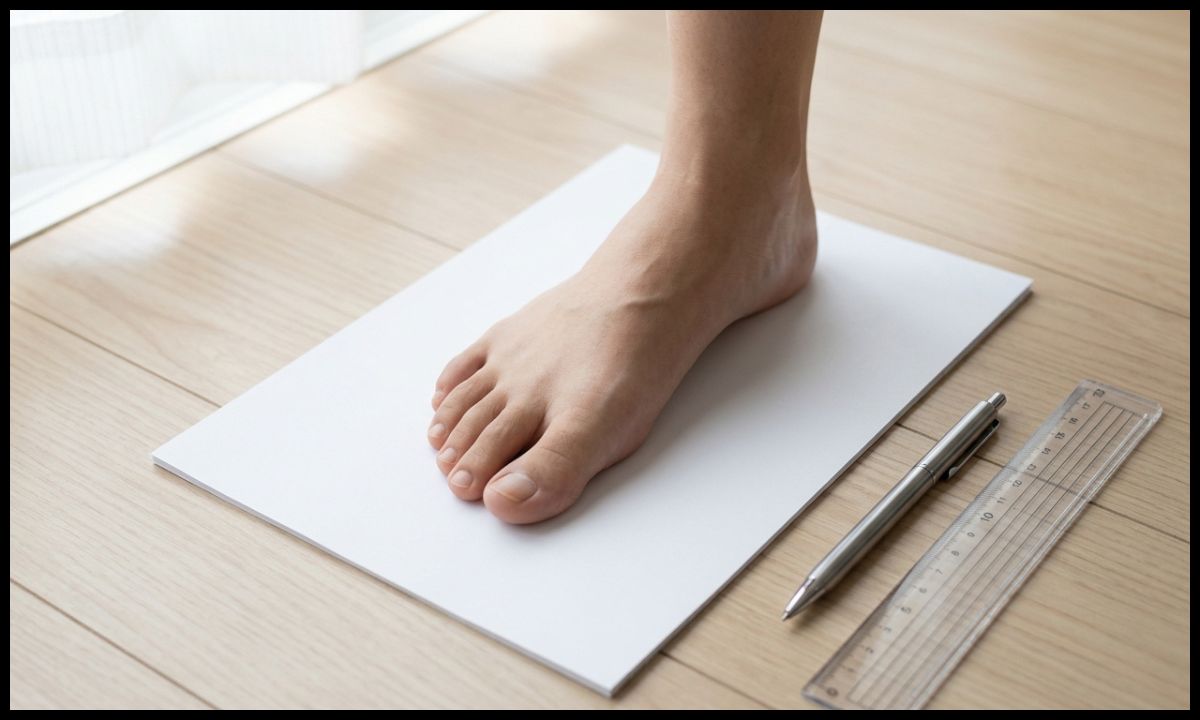
If you want a more reliable answer, how to measure foot width is the place to start. You don’t need fancy equipment; a sheet of paper, pen or pencil, ruler, and a flat surface are generally enough.
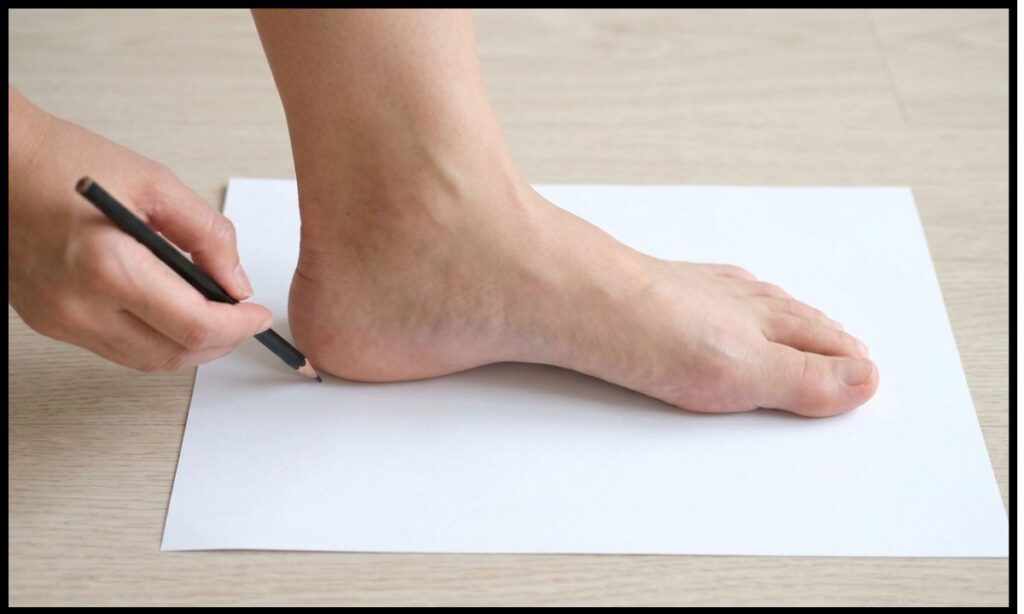
Put the paper on the floor and stand on it with your normal body weight. This part matters because your foot spreads slightly when you’re standing, and measuring while sitting can give you a smaller number than your real standing measurement. Feet are sneaky like that.
Trace around your foot or ask someone to trace it while you stand naturally. Keep the pencil reasonably upright rather than leaning it underneath your foot, since that can change the outline.
Now find the widest part of the foot, usually around the ball of the foot just behind the toes. Mark the two widest points on opposite sides, then measure the distance between those marks with your ruler.
For better accuracy, measure both feet. It is completely normal for one foot to be slightly larger than the other. When selecting shoes, use the measurement of the larger foot rather than averaging both measurements.
Measure your feet later in the day if possible, especially if your feet tend to swell. Normal daily activity can cause some foot swelling, so an evening measurement may better represent the space your shoes need.
Write your result down in inches, preferably to the nearest 1/8 inch when your ruler allows it. You can use either decimal or fraction measurements, but be consistent when comparing your result with a chart.
How to Measure Foot Width for Shoes at Home
A proper foot width measurement is more useful when you follow a repeatable process instead of simply eyeballing your feet. Here’s a practical method that works for most people at home, and it doesn’t require turning your living room into a shoe laboratory.
What you need:
- A sheet of paper
- A pen or pencil
- A ruler or measuring tape
- A flat floor
- The socks you normally wear with the shoes
Stand naturally on the paper while wearing your usual socks. Keep your weight distributed normally on both feet, because standing differently can change the apparent foot width measurement.
Trace each foot, or have someone else do the tracing. Mark the widest points on each side of the forefoot, then measure directly between those marks. Avoid measuring at an angle, as that can make the width look larger than it really is.
Repeat the process once or twice if your result seems unusual. If the numbers are slightly different, use the measurement you can reproduce most consistently rather than picking the biggest number just because it sounds safer.
Remember that foot tracing gives you an approximate measurement. Your actual foot can behave differently inside a shoe because the shoe’s interior shape, cushioning, upper material, and depth all affect the final shoe fitting experience.
What Is Considered a Wide Foot?
There is no universal width number that automatically makes a foot “wide.” A width that is wide for one shoe size may be completely normal for another size, because foot width generally changes as shoe length changes.
This is why a wide foot measurement should always be interpreted alongside your shoe size. For example, a particular width measurement might be standard at one size but wide at another. The same number doesn’t mean the same width category for every foot.
The most useful comparison is therefore:
Your shoe size + your measured foot width + the brand’s width chart = a better estimate of your correct width.
You may see labels such as Slim, Narrow, Medium, Standard width, Wide, Extra Wide, or abbreviations such as W, XW, and XXW. Some brands use letter systems instead, and those can become surprisingly alphabet-heavy.
In general, more “A” letters tend to indicate narrower widths, while “E” letters usually indicate wider widths. But these labels aren’t perfectly standardized across every manufacturer.
Shoe Width Chart: Understanding the Letters
A shoe width chart can look confusing at first because men’s and women’s shoes commonly use different width conventions. The letters aren’t simply a universal language where D always means the exact same thing everywhere.
For many commonly used US sizing systems, women’s medium width is often represented by B, while men’s medium width is commonly D. Women’s Wide may be represented by D, while men’s Wide may commonly be E or EE.
You may encounter width labels such as:
- AAAA / 4A – very narrow
- AAA / 3A – narrow
- AA / 2A – narrow
- A – narrow
- B – commonly women’s Medium
- C – sometimes used between standard and wide
- D – commonly men’s Medium and often women’s Wide
- E / EE / 2E – wide in many men’s systems
- EEE / 3E – extra-wide in some brands
- EEEE / 4E – extra-wide
- 5E, 6E, 7E, 8E – increasingly wider options in some footwear
- 10E, 12E, 14E – very wide options offered by selected manufacturers
Some brands instead use M, S, N, W, XW, or XXW. There may even be 3X-Wide, 4X-Wide, 5X-Wide, 6X-Wide, and 7X-Wide options for specialized footwear.
So if you’re asking what shoe width do I need, don’t choose based only on the letter. Check the brand’s own sizing information whenever possible.
Women’s Shoe Width: What Does Wide Mean?
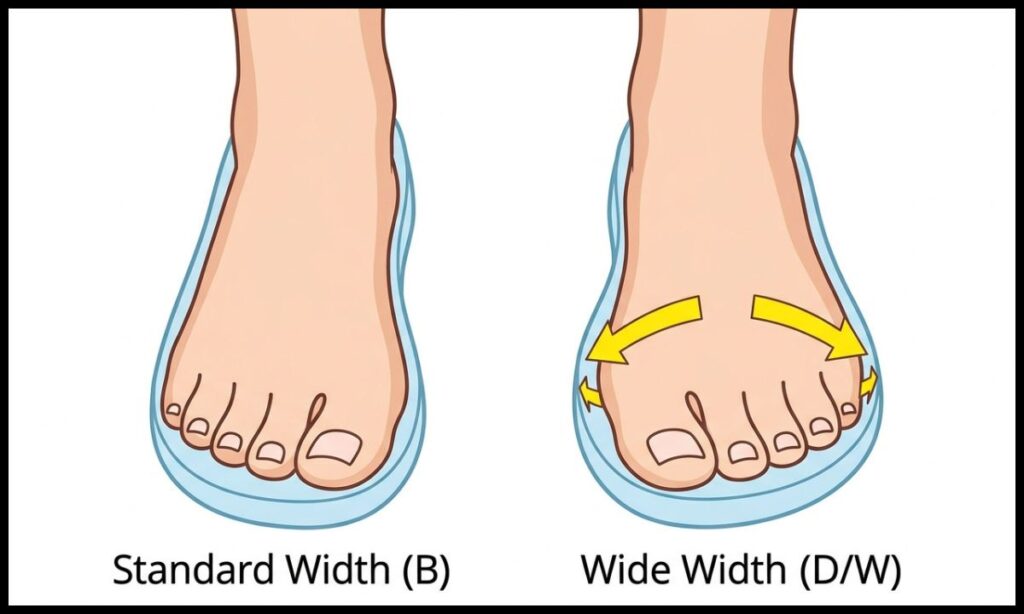
A women’s shoe width chart can be particularly confusing because women’s standard widths and wide widths may use letters that are different from men’s systems. In many common US sizing systems, women’s width B is considered Medium or Standard.
A women’s width D is often considered Wide, although the exact labeling can vary. Some manufacturers may use different terminology, and some styles are naturally roomier because of their construction.
If you’re shopping for women’s shoes, look for terms such as women’s wide shoes, women’s extra wide shoes, or a specific women’s wide shoe size chart. Don’t assume that moving up half a shoe size will solve a width problem.
A longer shoe may give your toes more front-to-back space, but it doesn’t necessarily provide the correct side-to-side room. In fact, an oversized shoe can cause your heel to slip while the forefoot still feels wrong, which is not exactly the comfortable fit anyone ordered.
Men’s Shoe Width: Understanding Wide Sizes
For men’s shoes, the commonly used standard or Medium width is often D. Wide widths may be labeled E or EE, while broader options can include 3E, 4E, 5E, and 6E depending on the manufacturer.
A men’s shoe width chart can help you compare your measurement with the width offered at your particular shoe size. Again, the chart should belong to the brand you’re purchasing from whenever possible.
If standard men’s shoes constantly pinch your forefoot, searching specifically for men’s wide shoes may make more sense than buying increasingly longer sizes. The right width can change the whole feeling of a shoe, sometimes more than people expect.
Signs Your Shoes Are Too Narrow
Sometimes you don’t need a measuring tool to realize something is wrong. Your feet will usually send a few rather clear complaints.
If your shoes leave red marks along the sides of your feet, squeeze your toes together, or make your little toe rub against the upper, they may simply be too narrow. Persistent pressure isn’t something you should ignore just because the shoe looks stylish.
Another clue is stretching. If the shoe’s upper is pulling tightly across the ball of the foot, particularly after a short walk, you may need a wider fit rather than a larger length.
Shoes should feel secure without squeezing. Your toes should have enough toe room to move naturally, while your heel should remain reasonably stable. A proper fit isn’t supposed to feel like your foot has been wrapped in a tiny leather sandwich.
How Shoe Size and Width Work Together
Your shoe size describes more than just length. Width is a separate dimension, which means two shoes can have the same length but completely different amounts of interior space.
This is why a shoe size and width chart can be more useful than a length-only conversion chart. Your US shoe size gives the starting point, while your width measurement helps determine whether you need Standard, Wide, or Extra Wide.
If your foot falls between two width categories, the next wider width may sometimes provide a more comfortable shoe fit, particularly if your current shoes create pressure around the forefoot. However, don’t automatically size wider if your foot isn’t actually wide, because excessive space can affect stability.
A good shoe width calculator can help organize measurements, but it should be treated as a guide rather than an absolute answer. Brand-specific sizing remains important.
Why One Brand’s Wide Shoe May Feel Different
You can measure your feet correctly and still discover that one pair of shoes feels perfect while another feels oddly tight. That’s because footwear isn’t manufactured from one universal mold.
The shoe manufacturer, design, materials, toe-box shape, sole, and internal construction all affect how wide a shoe feels. Two shoes labeled “Wide” can therefore fit quite differently.
This is why shoe width variation is normal. Always check the brand-specific width guide before buying when one is available.
A stretchy knit upper may accommodate a broader forefoot more easily than a stiff leather upper. Likewise, a shoe with additional shoe depth may work better for someone who needs vertical space as well as width.
Wide Feet, Bunions, Hammertoes, and Swelling

Sometimes the need for wider footwear isn’t simply about naturally broad feet. Conditions such as bunions, hammertoes, and edema can change the amount of room your feet need.
A person with a bunion, for example, may have a relatively ordinary foot width overall but require extra room around a particular area. Choosing a wider shoe can reduce pressure, but the ideal shape still depends on where the pressure occurs.
People using orthotics, custom orthotics, or an AFO brace may also need shoes with extra interior volume. In those situations, extra-depth shoes can be more appropriate than simply choosing a wider shoe.
Some extra-depth footwear includes removable depth layers, allowing you to create additional internal space for an orthotic or brace. That’s a different problem from width alone, and mixing the two can lead to a poor fit.
If you have diabetes-related foot concerns, significant swelling, persistent pain, numbness, sores, or other ongoing foot problems, professional advice from a qualified healthcare provider or foot specialist is more appropriate than relying only on an online chart. Your feet deserve more than guesswork, really.
How to Find Your Correct Shoe Width
Once you’ve measured both feet, compare the larger measurement with the shoe width measurement chart for the exact brand and style you’re considering.
Start with your normal shoe length, then look across the width options available for that size. If your measurement corresponds to a Wide category, try a Wide shoe rather than automatically increasing your shoe length.
When possible, try shoes on later in the day, when your feet may be slightly larger. Wear the socks you normally use, and if you use compression socks, orthotics, or another insert, bring those along for the fitting.
Walk around rather than simply standing in the shoes. Check the widest part of your foot, the toes, heel security, and overall pressure. A comfortable fit should feel supportive without creating obvious squeezing or painful pressure.
How Wide Should Your Shoes Be?
Your shoes should be wide enough that the foot isn’t squeezed from the sides, but not so wide that your foot slides around uncontrollably.
There should be enough foot space for the natural shape of your foot. Your toes shouldn’t be forced together, and the widest part of your foot should sit comfortably inside the widest portion of the shoe.
If you need extra width because of swelling, bunions, orthotics, or another condition, you may also need more depth. In that case, looking for wider footwear alone may not solve the problem.
Think of shoe fitting as matching the shape of your foot to the shape of the shoe, rather than simply chasing a particular number or letter. That small change in thinking makes shopping much easier.
Common Mistakes When Measuring Wide Feet
One common mistake is measuring while sitting. Since your body weight isn’t fully on your feet, the foot may appear narrower than it does during normal standing and walking.
Another mistake is measuring only one foot. Even small differences matter when a shoe is already close to the limit of your available space.
People also sometimes measure the widest part incorrectly. The measurement should generally be taken around the forefoot near the ball of the foot, not across the toes or diagonally from heel to toe.
Finally, don’t assume that every wide shoe size has the same dimensions. A Wide shoe from one company isn’t guaranteed to match a Wide shoe from another. The manufacturer’s chart is your best reference point.
A Simple Wide-Foot Checklist
If you’re still asking how can I tell if I have wide feet, use this quick checklist:
- Measure both feet while standing.
- Trace each foot on paper if helpful.
- Find the widest points around the ball of the foot.
- Measure the distance in inches.
- Record the larger foot measurement.
- Check your normal US shoe size.
- Compare both measurements with the shoe brand’s width chart.
- Look for signs of side pressure or cramped toes.
- Try Wide or Extra Wide options if the measurements indicate you need them.
- Check shoe depth if you use orthotics or have swelling.
- Walk in the shoes before deciding they fit.
This approach is much more dependable than looking at your feet and thinking, “Yep, those seem wide.” Sometimes they do, sometimes they don’t, and feet are terrible at following visual logic.
Read more : Size 24 Shoes Mexico in US
Frequently Asked Questions
Your Toes Feel Cramped
If your toes feel squeezed together or pressed against the sides of your shoes, your feet may need a wider shoe.
Your Feet Spill Over the Shoe Edges
When your foot extends beyond the sides of the shoe sole, it can be a clear sign that the shoe is too narrow.
Shoes Feel Tight Even in the Correct Length
If your shoe length feels right but the sides feel uncomfortable or restrictive, you may have wide feet.
You Often Get Blisters or Pressure Marks
Frequent blisters, redness, or pressure around the sides of your feet can indicate that your shoes do not provide enough width.
Measure Your Foot Width
Measure the widest part of your foot and compare it with the brand’s width chart. This is one of the most reliable ways to check whether you need wide-width shoes.
Conclusion
So, how do I know if I have a wide foot? Start by measuring the widest part of both feet while standing, then compare the larger measurement with a shoe width chart made for your shoe size and the specific brand you’re buying.
Pay attention to real-world fit, too. If your toes are cramped, the sides of your feet bulge over the sole, or standard shoes consistently create pressure, those are meaningful signs that you may need a wider shoe.
Most importantly, don’t confuse length with width. Going up a shoe size isn’t always the answer to a width problem. Finding the correct shoe width can give your feet the room they need while keeping the overall shoe length appropriate.
Your feet carry you through an awful lot of ordinary days shopping, working, walking, standing, running errands, and everything in between. They don’t need luxury treatment, but they do deserve shoes that fit them properly. A few minutes with a ruler today can save you plenty of uncomfortable steps tomorrow.
If you’d like to explore further, I can:
- Create a men’s and women’s shoe width chart with common US width letters.
- Write a step-by-step foot measurement guide with examples in inches.
- Create a wide-foot shoe fitting FAQ targeting additional Google search keywords.
