

Buying shoes should feel simple. You see a size, choose it, pay for it, and move on. Yet somehow a US shoe size, UK shoe size, and EU shoe size can make the same pair of feet look like three different mathematical problems. It gets even more confusing when inches, centimeters, men’s and women’s sizing, or different brands enter the picture.
That is exactly why a reliable shoe size chart is so handy. Instead of guessing whether a US 9 is closer to a UK 8 or an EU 42, you can compare the systems side by side and then check your actual foot length. Small detail, big difference especially when ordering shoes online.
The tables below are designed as a practical starting point for shoe size conversion, but remember that sizing isn’t perfectly universal. A particular brand, shoe model, width, or toe-box shape may fit differently even when the printed number is identical.
Shoe Size Chart: US, UK, EU & Inches Conversion
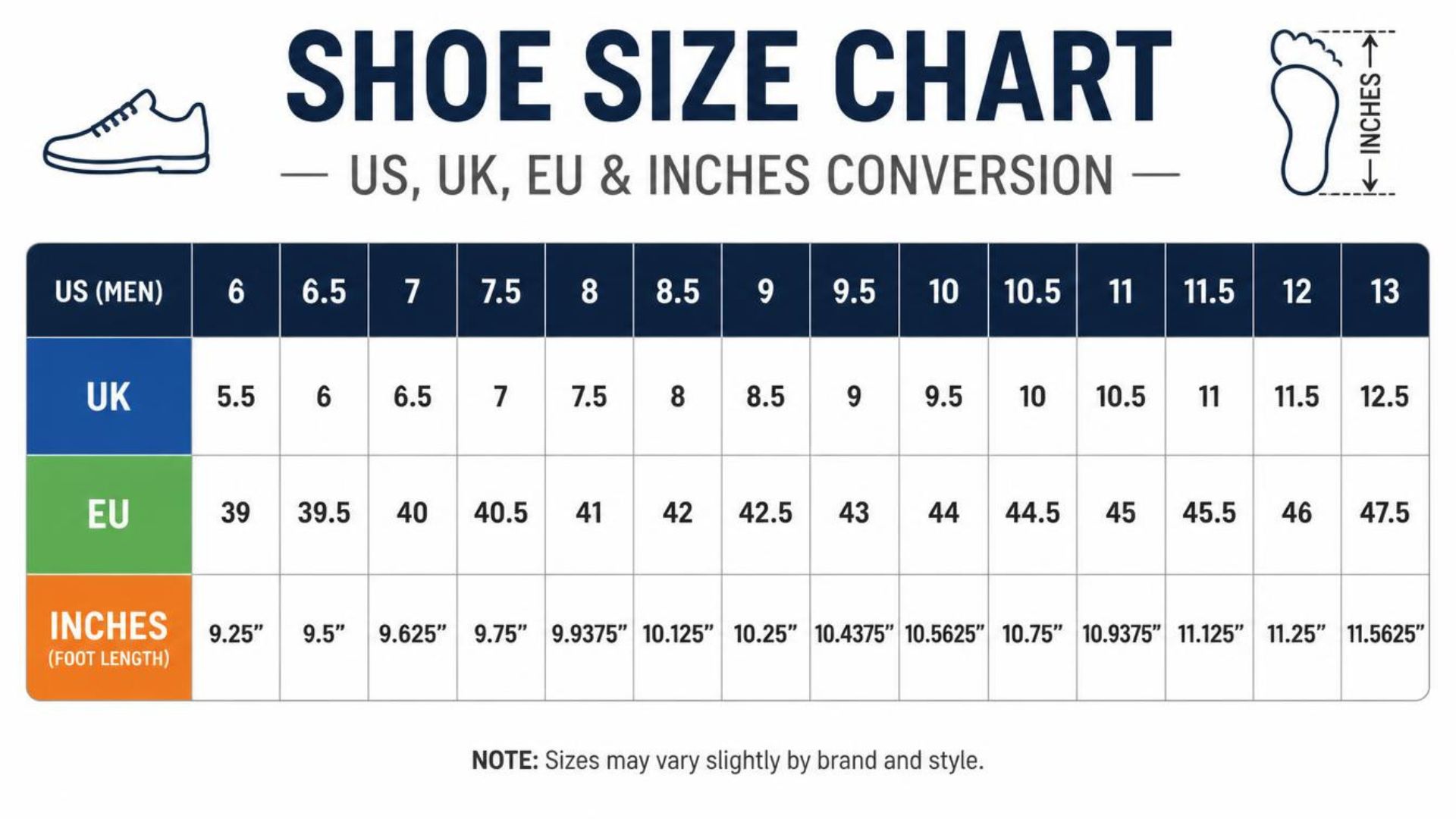
The first thing to understand is that shoe sizes are not simply different names for exactly the same measurement. US and UK systems use different scales, while the European system generally progresses in whole or half sizes based on a different unit of measurement.
Here is a useful adult shoe size conversion chart for everyday reference:
| US Men’s | US Women’s | UK | EU | Approx. Foot Length |
|---|---|---|---|---|
| 6 | 7.5 | 5.5 | 39 | 9.25 in / 23.5 cm |
| 7 | 8.5 | 6.5 | 40 | 9.75 in / 24.8 cm |
| 8 | 9.5 | 7.5 | 41 | 10.0 in / 25.4 cm |
| 9 | 10.5 | 8.5 | 42 | 10.5 in / 26.7 cm |
| 10 | 11.5 | 9.5 | 43 | 10.75 in / 27.3 cm |
| 11 | 12.5 | 10.5 | 44 | 11.0 in / 27.9 cm |
| 12 | 13.5 | 11.5 | 45 | 11.25 in / 28.6 cm |
| 13 | 14.5 | 12.5 | 46 | 11.6 in / 29.5 cm |
| 14 | 15.5 | 13.5 | 47 | 12.0 in / 30.5 cm |
| 15 | 16.5 | 14.5 | 48 | 12.4 in / 31.5 cm |
These measurements are approximate because shoe sizing and actual shoe length aren’t identical things. A shoe needs internal space for your toes, movement, and the shape of its construction, so don’t treat the inch figure as a promise that the shoe itself will measure exactly that length.
US to UK shoe size conversion
For adults, a common rule of thumb is that a men’s US shoe size is roughly one size larger than its UK equivalent. So US men’s 9 is commonly around UK 8, although individual charts can differ slightly.
Women’s sizing is a little more complicated because the US women’s scale starts differently. A US women’s 8 is commonly around UK 6, but checking the manufacturer’s own chart is still the smarter move.
US to EU shoe size conversion
There isn’t a perfectly reliable mathematical shortcut for converting US to EU shoe size. As a rough guide, US men’s 9 is often EU 42, while US women’s 8 is often around EU 38–39.
That variation is not you doing the conversion wrong. European sizing itself can vary between manufacturers, and some brands publish their own conversion tables. Numbers are helpful, but foot measurement should get the final vote.
Shoe Size Chart for Women’s Shoes
Women’s footwear often uses a separate US sizing scale, even when the physical difference between two similarly sized men’s and women’s shoes isn’t enormous. That can make shopping for unisex sneakers especially confusing, honestly.
A practical women’s shoe size chart looks approximately like this:
| US Women’s | UK | EU | Foot Length, Approx. |
|---|---|---|---|
| 4 | 2 | 35 | 8.2 in / 20.8 cm |
| 5 | 3 | 36 | 8.5 in / 21.6 cm |
| 6 | 4 | 37 | 8.9 in / 22.5 cm |
| 7 | 5 | 38 | 9.3 in / 23.5 cm |
| 8 | 6 | 39 | 9.6 in / 24.4 cm |
| 9 | 7 | 40 | 9.9 in / 25.1 cm |
| 10 | 8 | 41 | 10.2 in / 25.9 cm |
| 11 | 9 | 42 | 10.5 in / 26.7 cm |
| 12 | 10 | 43 | 10.9 in / 27.6 cm |
If you’re wondering, “What is a US women’s 8 in UK?” the usual answer is UK 6. In European sizing, it is commonly around EU 39, though some brands may list EU 38.5 or EU 39.
The same thing happens with half sizes. A women’s US 8.5 may appear as UK 6.5 and somewhere around EU 39–40 depending on the manufacturer. Thats why a half-size difference shouldn’t be treated as a universal formula.
Shoe Size Chart for Men’s Shoes
Men’s sizing follows a different US scale, and the conversion to UK sizes is generally easier to estimate than women’s conversions.
| US Men’s | UK | EU | Foot Length, Approx. |
|---|---|---|---|
| 6 | 5.5 | 39 | 9.25 in / 23.5 cm |
| 7 | 6.5 | 40 | 9.75 in / 24.8 cm |
| 8 | 7.5 | 41 | 10.0 in / 25.4 cm |
| 9 | 8.5 | 42 | 10.5 in / 26.7 cm |
| 10 | 9.5 | 43 | 10.75 in / 27.3 cm |
| 11 | 10.5 | 44 | 11.0 in / 27.9 cm |
| 12 | 11.5 | 45 | 11.25 in / 28.6 cm |
| 13 | 12.5 | 46 | 11.6 in / 29.5 cm |
| 14 | 13.5 | 47 | 12.0 in / 30.5 cm |
| 15 | 14.5 | 48 | 12.4 in / 31.5 cm |
For example, if you’re searching for a US men’s 10 in UK, UK 9 is a useful starting point. A US men’s 10 in EU is often EU 43, but EU 44 can appear depending on the brand and construction.
This is where a shoe size converter is convenient, but it shouldn’t replace checking the manufacturer’s chart. Conversion tools translate sizing systems; they don’t know how snug a particular model is across the toes.
How to Measure Your Shoe Size at Home
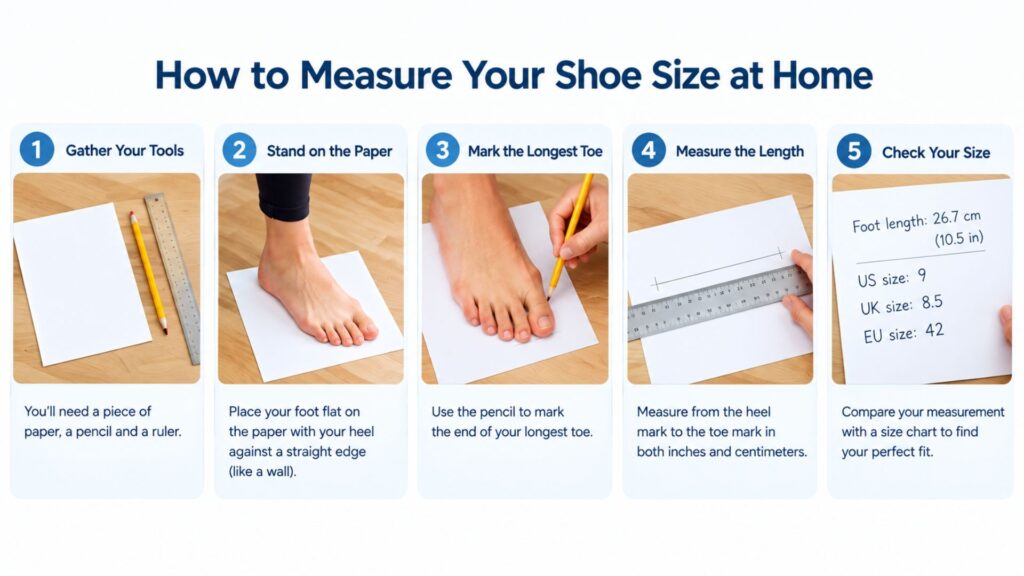
A surprisingly large number of shoe-fitting problems begin before the shoes are even ordered. People measure one foot while sitting down, use an old pair of shoes as their measurement, or round a number because it looks nicer. Feet, unfortunately, do not care about nice numbers.
You can measure your foot length at home with paper, a pencil, and a ruler. Stand on the paper rather than sitting, because your feet spread slightly when carrying your body weight.
Place your heel against a straight edge and mark the end of your longest toe. Measure the distance from the heel to that mark in both inches and centimeters. It takes a couple minutes and can save a very annoying return.
Measure both feet, too. It is completely normal for one foot to be slightly larger than the other. Choose your size based on the larger foot, while allowing enough room for comfortable movement.
Your measurement should look something like:
- Foot length: 25.4 cm
- Equivalent length: about 10 inches
- Approximate men’s US size: 8
- Approximate men’s UK size: 7.5
- Approximate EU size: 41
That example is only a guide, not a universal prescription. A shoe size based on foot length still needs to be checked against the brand’s specific sizing information.
Inches vs. Centimeters: Which Measurement Is Better?
Both work, but centimeters can be easier when comparing modern international sizing charts. Many manufacturers provide a CM measurement because it gives shoppers a more direct way to compare their feet with the manufacturer’s recommended size.
For example, 10 inches equals approximately 25.4 cm. Likewise, 27 cm is approximately 10.63 inches. You don’t need to perform these conversions manually every time, thankfully.
When possible, record your foot measurement to the nearest few millimeters. Saying “my foot is around 10 inches” is less useful than saying “my foot measures 25.6 cm.” Those little decimals can matter when you’re choosing between two sizes.
Why Shoe Sizes Differ Between Brands
Here comes the part that makes every neat international shoe size chart slightly less magical: brands don’t all build shoes the same way.
A size 9 running shoe from one company can feel different from a size 9 running shoe from another. The internal shape, known as the last, influences width, volume, heel position, and toe-room.
Brands such as Brooks, Saucony, and ASICS often have different interpretations of what a comfortable medium fit feels like. Hoka models can have noticeably different toe-box shapes, while Altra is known for a more foot-shaped toe-box approach. New Balance also offers a particularly broad range of width options.
So when comparing brand-specific sizing, pay attention to more than the number printed on the box. Look at the manufacturer’s foot-length chart, width options, and customer guidance for the exact model.
Men’s and Women’s Shoe Size Conversion
A common question is whether you can simply move between men’s and women’s sizes by adding or subtracting one number. There is a common US convention that women’s sizes are about 1.5 sizes higher than men’s for the same approximate length.
For example, a men’s US 8 may correspond roughly to a women’s US 9.5.
But this is only a conversion starting point. Width can change too, and the shoe’s design may make the conversion feel different. A men’s version may be built on a wider last, while a women’s model can have different proportions around the heel and forefoot.
If you’re purchasing unisex shoes, don’t rely on the men’s-to-women’s conversion alone. Use the manufacturer’s size chart whenever one is available.
Kids’ Shoe Size Chart
Children’s sizing has its own little universe, and confusing it with adult sizing can lead to some truly tiny shoes for surprisingly fast-growing feet.
A broad kids shoe size chart can be organized into little-kid and big-kid ranges:
| US Kids | UK | EU | Approx. Foot Length |
|---|---|---|---|
| 10.5 | 9.5 | 27 | 6.6 in / 16.8 cm |
| 11 | 10 | 28 | 6.8 in / 17.3 cm |
| 12 | 11 | 30 | 7.3 in / 18.6 cm |
| 13 | 12 | 31 | 7.7 in / 19.6 cm |
| 1 | 13 | 32 | 7.9 in / 20.1 cm |
| 2 | 1 | 33 | 8.2 in / 20.8 cm |
| 3 | 2 | 34 | 8.5 in / 21.6 cm |
| 4 | 3 | 36 | 8.8 in / 22.4 cm |
| 5 | 4 | 37 | 9.1 in / 23.1 cm |
| 6 | 5 | 38 | 9.4 in / 23.9 cm |
| 7 | 6 | 39 | 9.75 in / 24.8 cm |
Children’s feet grow quickly, so measuring periodically is more useful than assuming last year’s size still fits. A child may also need a different width or toe-box shape even when the length appears correct.
How Should Shoes Fit?
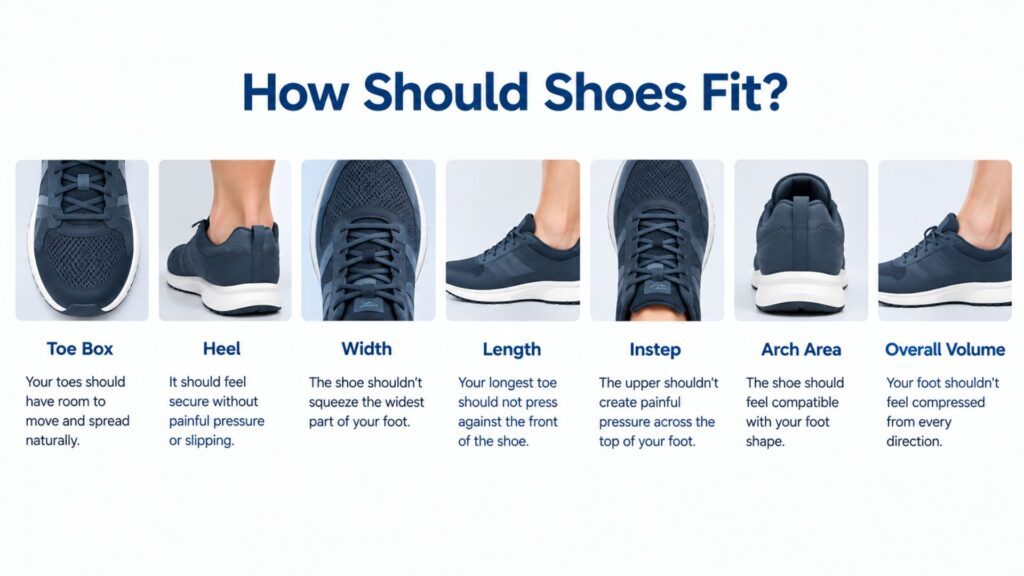
The correct shoe fit should feel secure without feeling like your foot has been politely trapped.
Your heel should remain reasonably stable without painful pressure. Your toes should have enough space to move, and the front of the shoe shouldn’t push against your longest toe while you’re standing.
For everyday footwear, check these areas:
- Toe box: Your toes should have room to spread naturally.
- Heel: It should feel secure without excessive slipping.
- Width: The shoe shouldn’t squeeze the widest part of your foot.
- Length: Your longest toe should not press against the front.
- Instep: The upper shouldn’t create painful pressure across the top of your foot.
- Arch area: The shoe should feel compatible with your foot shape.
- Overall volume: Your foot shouldn’t feel compressed from every direction.
A shoe can have the “right” number and still be the wrong shoe. That’s one of the most important lessons in proper shoe fit.
What If You Are Between Shoe Sizes?
Being between sizes isn’t unusual. Feet aren’t manufactured according to the tidy half-size increments printed on shoe boxes, which would be convenient but apparently nobody consulted our feet about it.
If you’re between sizes, first check whether the brand offers half sizes or different widths. A wide option may solve a fit problem more effectively than simply buying a longer shoe.
For running shoes, you may prefer a little additional room because feet can swell during longer activity. However, “always size up” isn’t a universal rule. Too much extra space can allow your foot to slide and create blisters or instability.
Try shoes later in the day when your feet have experienced normal daily swelling. For athletic footwear, also wear the socks you actually intend to use.
Running Shoe and Hiking Boot Sizing
Running shoe sizing deserves special attention because movement changes the way your feet interact with the shoe. During longer runs, feet can swell, and your toes need room to move without repeatedly hitting the front.
A common fitting approach is to leave roughly a thumb’s width of space in front of the longest toe, though the ideal amount depends on the shoe, foot shape, activity, and personal preference.
For hiking boot sizing, consider the terrain and socks you’ll wear. Downhill walking can push the toes toward the front of the boot, so heel security becomes especially important.
Don’t assume that the size printed on a running shoe and hiking boot should feel identical. Different footwear categories use different lasts, cushioning systems, and intended fits.
Common Shoe Size Conversion Mistakes
The biggest mistake is treating a conversion table as though it were an exact scientific law. It isn’t. A chart gives you a sensible starting point, while your measured foot and the manufacturer’s information finish the job.
Another mistake is measuring only one foot. If your left foot is 25.2 cm and your right is 25.7 cm, the smaller measurement shouldn’t determine the size. Your larger foot needs enough space.
People also sometimes confuse shoe size with the exact length of the shoe. A US 9 doesn’t mean the inside of every US 9 shoe is exactly the same number of inches. Construction, cushioning, materials, and toe-box shape all change the internal dimensions.
Finally, don’t ignore width. Two shoes can have identical lengths but feel completely different because one is narrow and the other accommodates a wider foot.
Quick Shoe Size Conversion Reference
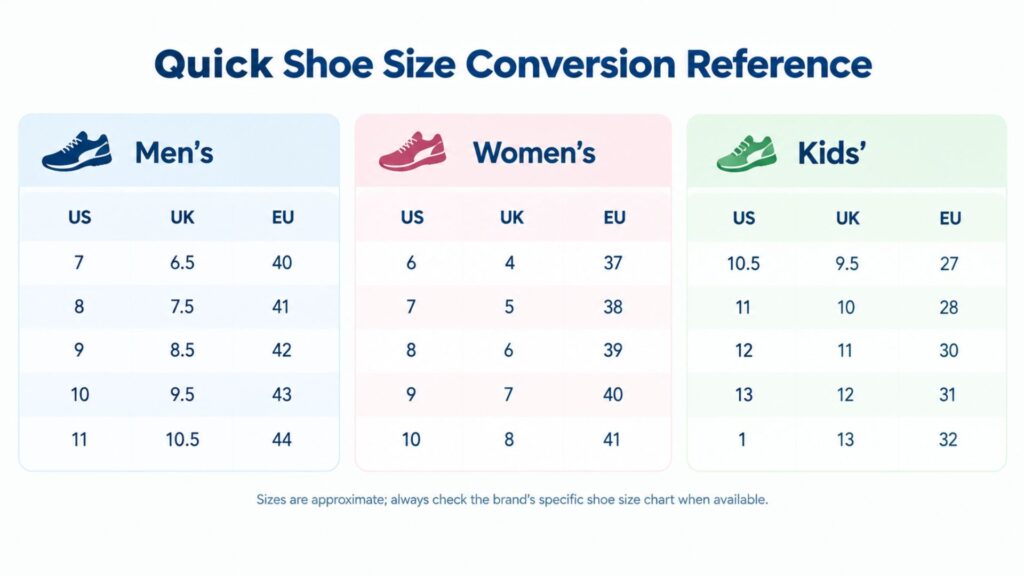
When you need an answer quickly, these common conversions are useful as starting points:
- US men’s 7 ≈ UK 6.5 ≈ EU 40
- US men’s 8 ≈ UK 7.5 ≈ EU 41
- US men’s 9 ≈ UK 8.5 ≈ EU 42
- US men’s 10 ≈ UK 9.5 ≈ EU 43
- US men’s 11 ≈ UK 10.5 ≈ EU 44
- US women’s 6 ≈ UK 4 ≈ EU 37
- US women’s 7 ≈ UK 5 ≈ EU 38
- US women’s 8 ≈ UK 6 ≈ EU 39
- US women’s 9 ≈ UK 7 ≈ EU 40
- US women’s 10 ≈ UK 8 ≈ EU 41
These are approximate shoe size equivalents, not guarantees. If the manufacturer’s chart says something different, follow that chart for that particular shoe.
How to Choose the Right Size When Shopping Online
Online shopping removes the easiest fitting method: putting your foot into the shoe and walking around. So you need to replace that with better information rather than a hopeful guess.
Start by measuring both feet. Write the larger measurement in centimeters and inches. Then find the manufacturer’s shoe sizing chart for the exact model you’re considering.
Check whether the shoe is narrow, standard, wide, or available in multiple widths. Read the manufacturer’s notes about fit, especially for running shoes, boots, and technical footwear.
If reviews repeatedly mention that a model runs small or has a narrow toe box, take that information seriously, but don’t let one random review dictate your decision. Your foot shape is still the most important variable.
A Simple Way to Remember Shoe Sizing
Think of the size printed on a shoe as a translation, not a measurement carved into stone.
US, UK, and EU systems speak different sizing languages. Inches and centimeters give you a more direct description of your foot, while a brand’s chart tells you how that particular company translates measurements into its own footwear.
The best process is therefore simple: measure your feet, compare the measurement with the brand chart, consider width and foot shape, and then choose the size that gives your larger foot a comfortable fit.
Read more :
Frequently Asked Questions
euro shoe size to us women’s
EU shoe size 39 is approximately US women’s 8–8.5, depending on the brand.
size 39 in us
A EU size 39 generally converts to about US women’s 8–8.5.
eu size to us
EU shoe sizes usually convert to US sizes approximately, but the exact fit can vary by brand and shoe style.
uk to us shoe size
For women’s shoes, a UK size 6 is roughly equivalent to a US women’s size 8.
size 40 shoes in us
EU size 40 is approximately US women’s 9–9.5.
Conclusion
A good shoe size chart can take much of the mystery out of buying footwear, especially when you’re moving between US, UK, EU, inches, and centimeters. But the most accurate conversion isn’t necessarily the one with the cleverest formula. It’s the one that combines a reliable chart with an actual measurement of your feet.
Remember the useful basics: measure both feet, use the larger foot as your reference, check the exact brand’s chart, pay attention to width, and don’t confuse a numerical size with a guaranteed fit. A US 9 is a starting point, not a personality trait your foot is legally required to have.
And if you’re ordering online, keep your measurements somewhere easy to find. The next time a website asks whether you’re a US 8, UK 7, or EU 41, you’ll have something much better than a guess you’ll have your own foot length, your preferred fit, and a sensible shoe size conversion reference to work from.
If you’d like to explore further, I can:
- Create a complete US–UK–EU shoe size chart for men, women, and kids with every half size.
- Turn this into an SEO-optimized 2,500–3,000 word article with FAQs and search-friendly headings.
- Create a printable shoe size conversion chart in PDF or spreadsheet format.
